Table of Contents Show
What is A Glass Reactor Used For?
A glass reactor is a component used in process industries to mix chemicals in a contained environment. A glass reactor is commonly used for this process due to its compatibility with a wide range of chemicals. Moreover, a glass reactor can be pressurized to work and operate in varying temperatures.
Glass reactors are used to carry out various chemical reactions. There are many different types of reactors, including glass-lined reactors, hydrothermal synthesis reactors, stirring magnetic reactors, electric heating reactors, steam reactors, and others.
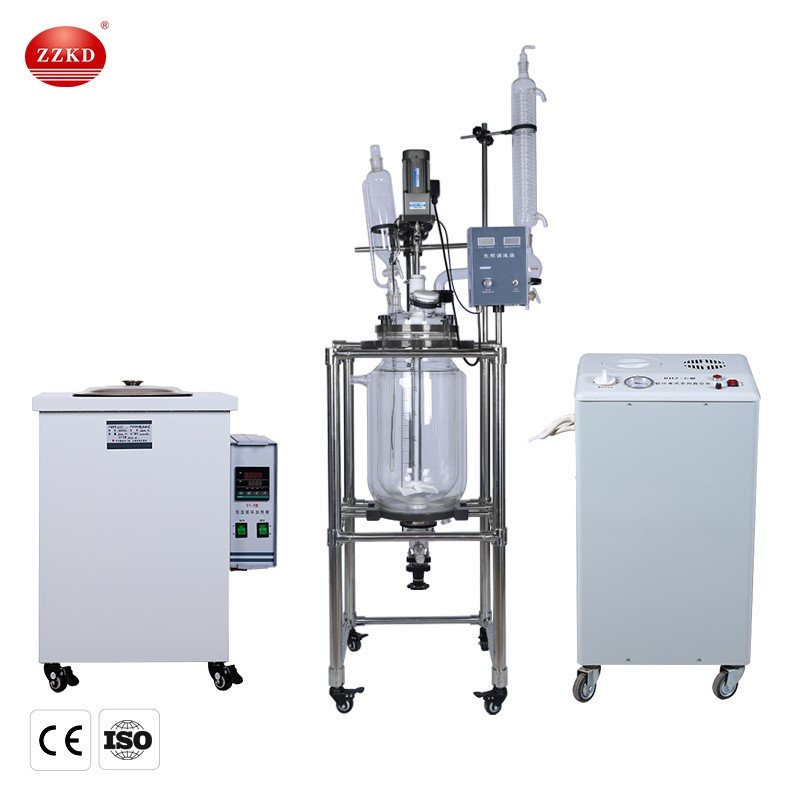
Although the glass reactor is only one variety, it is one of the most widely employed. It has a lot of benefits, including the fact that it is not only corrosion and high temperature resistant but also highly hygienic.
A glass reactor’s primary premise is to agitate the reaction while controlling the reflux and evaporation of the solution in a sealed container at a fixed temperature and normal or negative pressure. Single-layer, double-layer, and three-layer glass reactors are available.
A complete vacuum may be used to run the 5litre reactor vessel securely. The chemical and pharmaceutical industries benefit greatly from jacketed glass reactor systems for mixing, reaction, and distillation.
One can heat and cool glass reactors up to 100 liters and immersion heater reactors up to 200 liters with a hot liquid. Reliable mixing, repeatable heat transport, and tight environmental activity are needed for strong response management.
The process specifies various specifications for various types of agitation tools and mechanical agitator motors to address these various objectives.
Additionally, the glass reactors can be combined with gears for unit operations such as distillation, filtration, extraction, absorption, and concentration for both discontinuous and semi-continuous reactors and continuous reactors.
There are different sizes of glass reactors. They range from 5L to 100L. The borosilicate glass used in the 5L glass reactor is known for its exceptional quality. It is powerful and possesses the best physical and chemical properties.
5L glass reactor will not ignite and are easy to regulate, thanks to a low-speed booster motor and good torque. Also, the smooth operation is the best part about them. It is long-lasting.
Jacketed Glass Reactor
One of the most common forms of glass reactor is the jacketed glass reactor. It’s a chamber with a cooling or heating “shell” surrounding the reactor that circulates refrigerant or heating fluid to regulate the temperature of its contents.
The housing can facilitate a consistent thermal exchange between the circulating fluid and vessel junctions. Dimple jackets, paint rings, medium pipe curl jackets, and standard jackets are the most well-known jacket reactors.
These coats have unique features. Encapsulated chemical reactors are commonly used to minimize the thickness of very viscous liquids or eliminate the reaction’s high heat. Cooling jackets, in particular, serve an essential purpose.
There are various jacketed glass reactor manufacturers prevalent in the market today. Therefore, when choosing a jacketed reactor manufacturer, ensure you get a reliable manufacturer that will guarantee you high quality.
The reactor jacket features a variety of functional ports that allow users to accomplish a variety of tasks. Materials are added to the reactor at a given pace, the temperature of the materials is measured, dust or particles are added to the reactor, and refined materials are recovered. The jacket can be fully customized to meet the needs of the customer.
There are several advantages to using a jacketed reactor. For example, they provide more flow since the weight is distributed over a smaller area than if the entire deck were a separate zone. We can direct the flow to specific portions of the housing.
With all of this in mind, the jacketed reactor may be found in various industries, including food, chemicals, medicines, color, and educational institutions. If you get one, you will access an increasing amount of important information on the internet these days.
The Uses of A Glass Reactor
A glass reactor is used for various reasons. Glass reactors are designed to produce responses to various materials at regulated temperatures and vacuum conditions.
Flexible mixing rates and a steady feed channel are featured in each reactor, allowing you to add ingredients to the tank at a consistent and regulated rate. Because of the built-in condenser, it is possible to recover certain materials at a regulated speed.
A glass reactor can be used for high-temperature reactions (, low-temperature reactions, vacuum for adverse pressure reactions, constant-temperature solvent synthesizing, distillation and reflux reactions, vacuum distillation reactions, extraction separation reactions, purified reactions, concentration reactions, and stirring reactions.
Users can modify the temperature and pressure for various testing environments according to the conditions and requirements of the operation.
The glass reactor is a popular choice. It is widely used biochemistry equipment in the industry and current fine chemical, scientific research experiments, biological pharmacy, college and technical secondary school, and other settings. It’s the perfect tool for training, experimentation, manufacturing, and pilot testing.
How a Glass Reactor Works
The chemicals are introduced into a controlled chamber and agitated by a centrally mounted agitator. Baffles are usually incorporated in the vessel to guarantee enough turbulence within to mix and blend the chemicals and allow the reactor to function.
If the right catalysts, chemicals, pressure/temperature conditions, and contact time are present, normal chemical reactions occur. The final result may be either crystalline or liquid.
Here Are Some of The Advantages of A Glass Reactor
The chemical industry, laboratory research, metallurgical industry, and pharmaceutical business use glass reactors. In a nutshell, glass reactors are critical in a variety of sectors. Aside from those mentioned above, chemical batch glass reactors are also popular on the market.
Advantages Include
- The glass reactor is resistant to all sorts of chemical corrosion.
- For all sorts of reactions, glass provides better vision.
- Glass may be used to test and react with a wide range of substances.
- Glass reactors are quite low in weight.
Disadvantages of Glass Reactors
- Certain glass reactors may react with other glass reactors.
- Other glass reactors are rather costly.
- The manufacturing procedure is a little laborious
- Some glass reactors are fragile and can break.