Table of Contents Show
When determining the length of a power cord or chord set, it is crucial to examine if the wiring will give an appropriate level of efficiency.
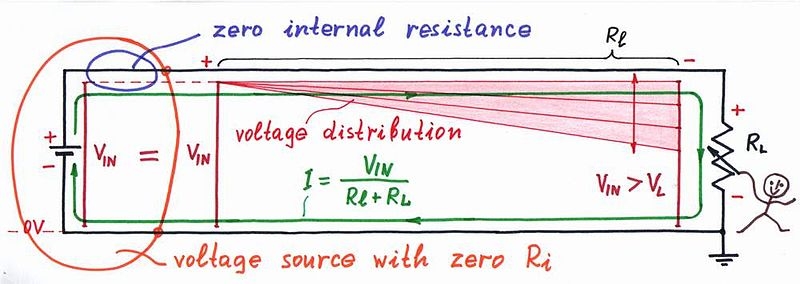
This process can be simplified if we use a voltage drop calculator. Long chord assemblies could provide a safety risk because of the voltage drop they would produce.
Voltage Drop Definition
There is a constant resistance to current flow, or impedance, in wires carrying current. Voltage loss that happens between a power cord’s connection to a power source and the device it is giving power to on the other end is known as a power cord or cord-set voltage drop.
Voltage drop on long cord assemblies must be measured. Due to potential safety issues, it’s critical to assess voltage drop for lengthy chord assemblies (above 50 feet). Among the causes are safety concerns, potential cord and wire damage, and device power loss.
Potential Wire and Cord Damage
Heat is also produced when a voltage drop occurs. Insulation in a wire or cable can be harmed by an excessive buildup of heat.
The type of damage can be anything from the insulation material degrading (breaking down), to the material softening, which could lead to tearing if the cable or wire is bent or moved, to the insulation actually melting and exposing the conductor wire(s) underneath.
In any case, this shortens the wire or cable’s lifespan and may cause further safety hazards. Additionally, excessive heat build-up can lead to conductor material degradation and an increase in resistance, which exacerbates the problem by increasing the voltage drop and the temperature.
Safety Concerns
The two safety concerns are shock and fire. A user may unintentionally touch the exposed conductor wires if the insulation so deteriorates that it splits or melts away, exposing the wires. This could result in a shock. The buildup of heat grows together with the voltage decrease.
The material may become weakened by too much heat to the point that arcing between conductors may happen, raising the temperature further until the insulation and/or nearby flammable materials catch fire. Both manual calculation and the use of a voltage drop calculator are acceptable methods for calculating voltage drops.
Manual calculation
The estimated direct current resistance from the relevant standard or a measurement of the resistance via the cable in issue must first be obtained in order to compute voltage drop.
Standards provide this data in ohms/km and, occasionally, ohms/1000ft. If using a value from the standards, it must be decreased to ohms/ft or converted to that value.
Tables 5 and 6 in UL 62 should be used to determine the value of North American cable. IEC 60228 Table 1 should be utilized for international cable types such as H05VV-F. These figures won’t provide accurate voltage loss figures, but they’ll be close enough to spot probable problems.
Once the ohms/ft of a cable size is known, this number must be multiplied by the assembly’s length in feet. This provides the assembly’s overall anticipated resistance.
After that, using Ohm’s Law is as simple as multiplying the assembly’s resistance value by its steady-state current to determine the voltage drop (use the highest value if the current will fluctuate a lot due to the application’s components switching on and off.).
The remaining voltage and % loss can then be calculated using this value along with the mains voltage value if desired.
Calculator for Voltage Drop
A “voltage drop calculator” can be found online. When you provide the necessary information, an automatic calculation of the voltage drop, percentage loss, and remaining voltage is made.
However, be aware that the majority of these are configured for North American AWG cable. Use the closest AWG size that corresponds to the international sizes.
This can be discovered by consulting UL 62 or asking a cable maker for help. The Voltage Drop Calculator on calculator.net is an illustration of an excellent voltage drop calculator. This one also offers a cable chart on the same page, which the user may find useful.