Table of Contents Show
Air purifiers are often presented as a straightforward solution to indoor air problems. In practice, their effectiveness depends less on the device itself and more on what they are expected to handle.
The more useful question is not whether air purifiers “work” in general, but when they make a meaningful difference in everyday home environments — and when they don’t.
What Air Purifiers Are Designed to Do
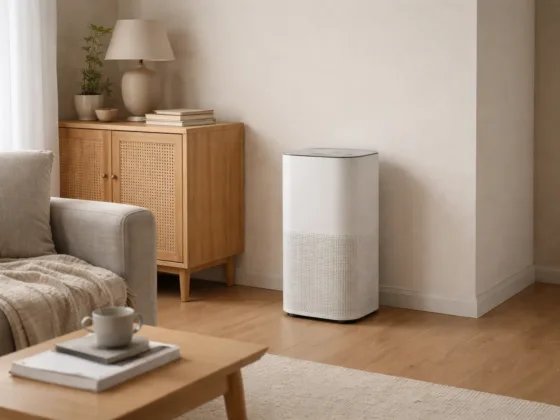
At their core, air purifiers are designed to remove certain airborne particles from the air that passes through them. They work by pulling indoor air through filters that capture dust, pollen, and other suspended matter before releasing the filtered air back into the room.
This process is localized. An air purifier does not clean an entire home at once, nor does it eliminate pollutants at their source. Its impact is limited to the air volume it can circulate repeatedly.
Where Air Purifiers Tend to Work Well
Air purifiers are most effective in enclosed spaces where airborne particles are the primary concern. Bedrooms, home offices, and smaller living areas are typical examples.
They are especially helpful when dust, pet dander, or lingering odors are present, and when the unit runs consistently rather than intermittently. In these conditions, gradual improvement is more realistic than immediate transformation.
In real homes, results are often most noticeable over time rather than immediately. Air purifiers work by gradually reducing the concentration of airborne particles with each circulation cycle, not by resetting the air in a single pass. When expectations are aligned with this slower, cumulative effect, users are more likely to perceive meaningful improvement instead of assuming the device is ineffective.
Perceived effectiveness is also shaped by what people expect to notice. Air quality improvements are often subtle and indirect, such as reduced dust buildup or fewer lingering odors, rather than dramatic sensory changes. When improvements are measured against unrealistic expectations, even properly functioning units can feel ineffective.
Where Air Purifiers Often Fall Short
Air purifiers are less effective in large, open-plan spaces or homes with ongoing pollution sources. Cooking smoke, moisture problems, and poor ventilation can overwhelm a single device.
It’s also common to expect air purifiers to compensate for structural or environmental issues. In reality, they reduce exposure to airborne particles; they do not eliminate pollution at its source.
A common point of frustration comes from treating air purifiers as substitutes for fixing the source of a problem. Odors caused by moisture, smoke from frequent cooking, or outdoor pollution entering through open windows will continue to reintroduce particles faster than a purifier can remove them. In these situations, the device appears to fail even though it is operating as designed.
This gap between expectation and function is why air purifiers receive mixed reviews. They are often judged on problems they were never meant to solve, rather than on the specific role they actually play.
Room Size, Placement, and Expectations
The relationship between room volume and airflow matters more than most specifications. A purifier that is undersized for the space will cycle air too slowly to produce noticeable results.
Placement also affects performance. Units positioned where air can circulate freely tend to work more consistently than those tucked into corners or blocked by furniture. We explore this in more detail in our guide on air purifier size and room placement.
How Air Purifiers Fit Within a Bigger System
Air purifiers are best understood as part of a broader indoor air strategy. Ventilation, source control, regular cleaning, and humidity management all play significant roles in air quality.
When these factors are ignored, even a well-matched purifier may appear ineffective. When they work together, expectations tend to align more closely with real outcomes.
Thinking in systems rather than individual devices helps clarify why results vary so widely between homes. A purifier placed in a well-ventilated, reasonably sealed space supports existing air quality efforts. The same unit placed in a poorly ventilated environment with active pollution sources is forced into a role it cannot realistically fulfill.
This is why two households using similar devices can report very different results. Differences in room layout, outdoor air exchange, cleaning habits, and humidity levels quietly shape outcomes. Without considering these factors, it becomes difficult to judge whether a purifier is underperforming or simply operating within realistic limits.
Concerns Often Mistaken for Performance Problems
Some issues attributed to poor performance are actually related to normal early-use behavior or maintenance factors. New units may emit temporary odors, and filters can influence airflow and scent as they settle.
We address these situations separately in our guide on when air purifier smells actually matter, which focuses on distinguishing normal behavior from signs that require attention.
The Bottom Line
Air purifiers can be useful tools in real homes, but only when their role is clearly understood. They improve conditions within defined limits rather than solving every air-related problem.
Asking whether air purifiers “work” often compresses several different questions into one. Do they remove some airborne particles? Yes. Do they solve broader indoor air problems on their own? No. Framing the question this way helps align expectations with what these devices are realistically capable of delivering.
When expectations match their capabilities, air purifiers tend to feel effective. When expectations exceed them, disappointment is more likely than cleaner air.
Author & Editorial Review
Author: Perla Irish, a design and home improvement writer covering interior materials, everyday home decisions, safety-aware planning, and real-world performance.
Editorial Review: This article was reviewed by the DreamlandsDesign editorial team for clarity, accuracy, balanced explanations, safety awareness, real-world usability, and long-term relevance. Content is evaluated to ensure balanced explanations, clear intent, and alignment with Google Helpful Content and E-E-A-T quality standards.
Last updated: January 2026