Muskrats and beavers are large animals and strongly resemble large rats because of their rat-like tail. The muskrat and beaver are common all across the continental United States and live anywhere ponds and lakes are because it is their natural habitat where they can hide and easily find food.
A beaver or muskrat in your pond is not necessarily a bad thing, as they eat all the unwanted vegetation around the pond such as cattails.
However, these large rodents can cause serious problems, such as eroding and damaging the shoreline and dams as they dig holes and tunnels, and they love to chew fountain and aerator cables, which can be very costly to repair or replace.
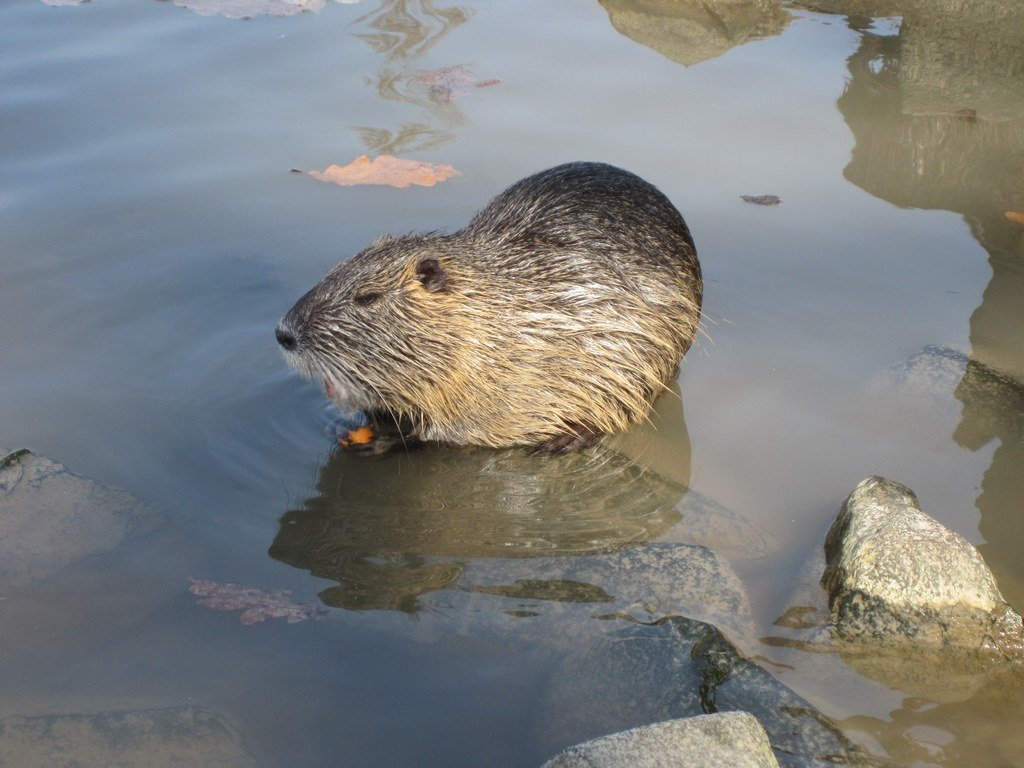
Muskrats and beavers are most active in the early evening and this is the best time to catch a glimpse of them in your water and the best time to plan traps so that you can remove these critters.
You can also detect them by finding trails or runs along the shoreline, generally just at the surface of the water.
These critters have a thick coat of brown fur and give off a musky smell during mating season. These critters are prolific breeders, like rabbits, and muskrats can produce several litters of young in a season.
Muskrat dens are constructed mostly of the vegetation around the pond, beaver dens are constructed of sticks found on land near the pond.
Burrowing activity is the most common cause of critter damage because the burrows often damage the shoreline. Tunneled burrows make for great home caves but can cause a collapse of the shoreline which can lead to injury for residence.
Proper pond construction can help prevent the burrowing activity of these critters as well as constructing barriers out of fencing. The costliest damage, these critters have a nasty habit of chewing on pond fountain and lighting equipment, like pond aerator cables.
The damage is most often occurs at the ends of the cable run, or near the motor lead, or lighting lead, where that cannot be repaired. When a muskrat or beaver chews on the equipment wire, it will cause the motor to trip.
If you have muskrats in your water, we recommend installing PVC flex hose, or stainless steel Flex braiding, or both, especially at the equipment connection, to protect it.
If you have these menacing critters near your pond, there are several common methods to help control the pesky rodents. Trapping is the most popular method since it is very effective and humane.
Read Also:
There are several companies who provide this product, and it is also a do-it-yourself method. Changing the habitat environment, like removing the main food source like cattails and other aquatic vegetation, can deter the muskrats or beavers from making their home in your pond.
Using toxic chemicals is another effective method of control, however, it is definitely not the preferred method because that can be toxic to other wildlife and the pond water.
Beavers are a much larger rodent than the muskrat, with larger teeth that can create much larger problems. An adult beaver can live up to 24 years in the wilderness, reaching 3 feet in length (plus their tail) and weigh upwards of 50 pounds.
The beaver diet is trees and branches near the pond, as they are able to digest cellulose. Beavers also eat aquatic plants in a pond, which can be an attraction for these critters. So clearing aquatic plants in your pond is a good deterrent.
We have all seen how a beaver can powerfully chew through a tree, it is unbelievable. So imagine the damage it can do to your pond equipment.
If beavers decide to set up camp near your pond, they can completely decimate the trees around the shores to make their lodge or possibly a dam.