Table of Contents Show
Quick answer: Buying wrapping paper in bulk ahead of the holiday season saves money, prevents last-minute shortages, and gives you more control over quality.
If you’ve ever reached mid-December only to realize your wrapping supplies are running low, you already know the problem. Prices climb, options disappear, and suddenly you’re making compromises you didn’t plan for. That’s why retailers, small businesses, and households that host large gatherings tend to buy wrapping paper in bulk well before the season starts.
Planning early isn’t about overbuying — it’s about removing friction. When wrapping paper is already sorted and stored, the holiday rush feels manageable instead of chaotic. It also fits neatly into a broader holiday home preparation checklist, where small decisions made early prevent bigger problems later.
This guide serves as the central overview for choosing, storing, and planning bulk wrapping paper efficiently. It connects practical buying advice with deeper guides on storage, quantity planning, and reorder timing, so each step works together without waste.
Types of Gift Wrapping Paper to Purchase in Bulk
Premium Christmas Wrapping Paper
Premium Christmas wrapping paper is typically heavier, easier to fold cleanly, and less prone to tearing at corners. That matters when you’re wrapping dozens — or hundreds — of gifts. For retailers and gift-wrapping services, consistent paper quality also creates a more polished, professional look.
Many premium options now include recycled content, which appeals to shoppers and homeowners who are actively trying to make more responsible choices. That makes this type of paper a natural fit for people exploring broader sustainable home ideas.
Holiday Counter Rolls
Counter rolls are designed for speed. Large rolls — often around 24 × 417 inches — allow you to wrap continuously without stopping to reload, which is especially useful in busy retail settings. These rolls are commonly available as half-ream (24″ × 417′) and small counter rolls (24″ × 85′).
Because counter rolls are often sold as seasonal specials, availability can be limited. Buying early isn’t just cheaper — it’s often the only way to secure the sizes and patterns you actually want, especially when sourcing bulk gift wrap for high-volume use.
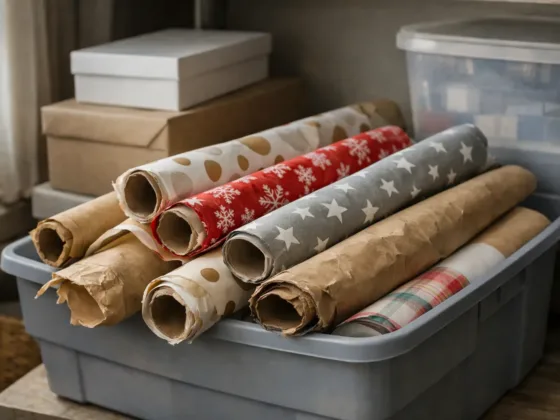
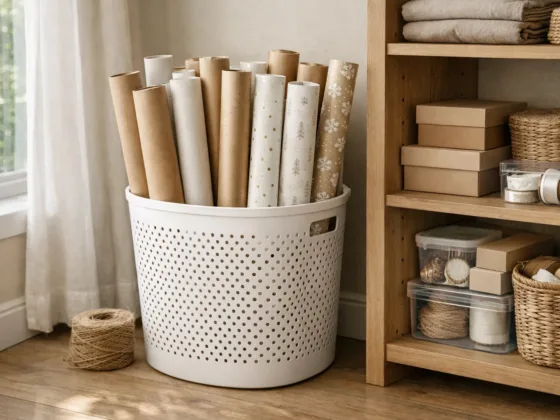
Proper storage is critical after purchasing wrapping paper in bulk, as moisture, pressure, and poor stacking can permanently damage rolls. This is especially important for commercial counter rolls and high-volume gift wrap. We explain practical, space-efficient solutions in our guide on how to store bulk wrapping paper properly over time.
Once you’ve chosen the right type and quantity, learning how to organize wrapping paper for long-term use helps prevent damage, clutter, and unnecessary waste over time.
Stone Wrapping Paper
Stone wrapping paper is made primarily from limestone rather than wood pulp. It feels smoother and is more resistant to water and tearing than many traditional gift wraps, which makes it a strong option if you want durability and a modern look.
This option appeals to eco-conscious buyers interested in alternatives to standard paper and other eco-friendly home materials.
Kraft Gift Wrap
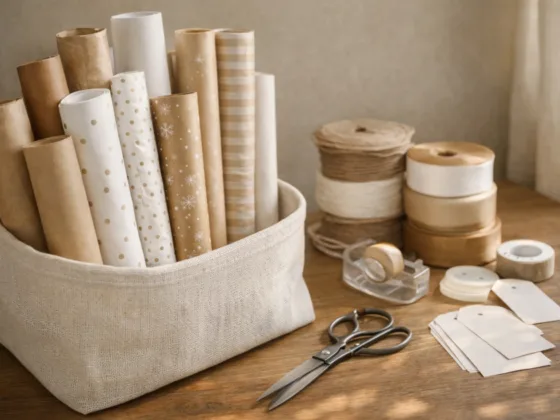
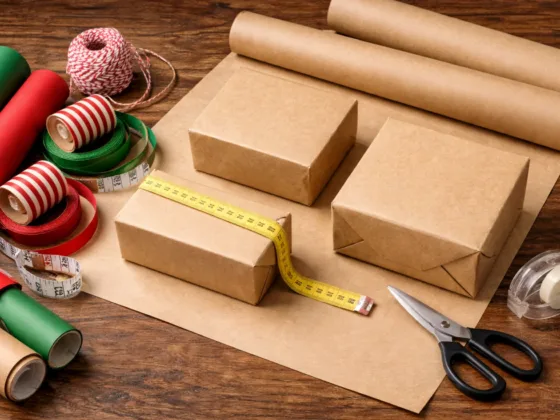
Kraft wrapping paper remains one of the most flexible options available. It works well for minimalist, rustic, and boutique brands alike and is simple to customize with twine, stamps, or a business card.
Kraft ties neatly into minimalist home design trends and often carries sustainability benefits when it’s responsibly sourced.
Size Cheat Sheet (quick reference)
Use this short cheat sheet for fast decision-making when buying rolls or reams:
- Small gifts (jewelry, small boxes): typical sheet ~ 8″ × 20–26″.
- Medium gifts (book, mug, small tool): typical sheet ~ 12–18″ × 30–50″.
- Large gifts (appliance box, large toy): expect widths of 30″+ or multi-sheet wraps.
- Common commercial roll: 24″ × 417′ (good all-rounder for mixed gift sizes).
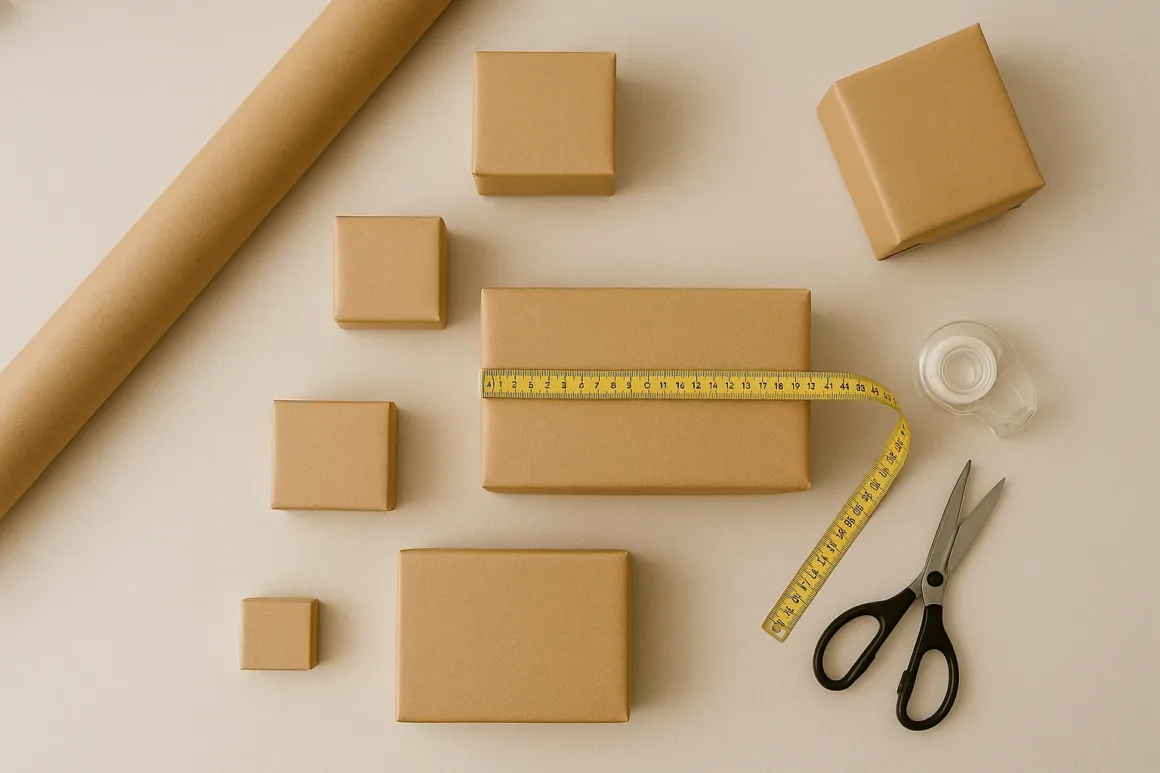
Before buying in bulk, it helps to understand how much paper you’ll realistically use across a season. Guesswork often leads to overbuying or shortages, especially when gift sizes vary. This guide on how much wrapping paper you really need walks through a practical way to estimate quantities based on average box size, wrapping style, and overlap.
Interactive wrapping paper calculator
Use this quick calculator to estimate how much wrapping paper you’ll need. Enter your average box dimensions and how many gifts you plan to wrap, and it will give you a practical estimate based on standard professional wrapping methods.
“Most households underestimate wrapping paper by 15–30%. Using average box dimensions and a standard overlap allowance helps avoid running out mid-holiday.”
The estimation method below is translated into a simple calculator so you can apply the same logic to your own gift sizes.
Units:
Preset sizes:
“This calculator uses a professional 15% overlap allowance.”
Step-by-step formula (boxes)
1) Wrap length (how much to cut from the roll):
Perimeter = 2 × (Length + Width)
Cut length = Perimeter × (1 + overlap) — we recommend overlap = 15% (multiply by 1.15) to allow for neat sealing.
2) Paper width (how wide the sheet must be):
Paper width ≈ 2 × Height + smaller of (Length or Width)
This gives enough paper to fold the sides up and tuck neatly under the top and bottom.
Worked examples (exact numbers)
Example A — small box: box = 6″ L × 4″ W × 2″ H
- Perimeter = 2 × (6 + 4) = 2 × 10 = 20 inches
- Cut length with 15% overlap = 20 × 1.15 = 23.0 inches
- Paper width = 2 × 2 + min(6,4) = 4 + 4 = 8 inches
- If using a 24″ × 417 ft roll (417 ft = 5,004 inches), theoretical sheets per roll = floor(5,004 / 23) = ~217 gifts
Example B — medium box: box = 12″ L × 8″ W × 4″ H
- Perimeter = 2 × (12 + 8) = 2 × 20 = 40 inches
- Cut length with 15% overlap = 40 × 1.15 = 46.0 inches
- Paper width = 2 × 4 + min(12,8) = 8 + 8 = 16 inches
- Using a 24″ × 417 ft roll (5,004 inches), sheets per roll = floor(5,004 / 46) = ~108 gifts
Note: Roll counts vary a lot depending on average gift size — small gifts can push a 24×417 roll into the 175–250 gift range, while many medium/large gifts reduce that number. Use the formula above with your average box dimensions to estimate precisely.
How many 24″ × 417′ rolls will I need?
Estimate your average gift’s cut length (from the mini-calculator) and then divide the roll total length (417 ft = 5,004 inches) by that number. Example: if your average cut is 30 inches, a 24×417 roll will yield roughly 5,004 / 30 ≈ 166 sheets (gifts).
Retailers commonly report that a 24″ × 417′ commercial counter roll will cover roughly ~175–200 smaller gifts depending on packing style and overlap — so your own calculation should sit near that range if your gifts are small.
Sustainability and responsible packaging
Wrapping paper may be temporary, but the environmental impact isn’t. Choosing recycled, kraft, or FSC-certified wrapping paper helps reduce waste and supports responsible sourcing. For paper products, the Forest Stewardship Council (FSC) standards define how forests are responsibly managed, while the U.S. Environmental Protection Agency provides guidance on Sustainable Materials Management and paper recycling best practices.
When estimating quantities in the calculator above, the built-in 15% overlap factor (×1.15) reflects real-world wrapping experience. It accounts for seams, trimming, and neat folding — helping avoid under-buying during peak season.
To plan more efficiently, it also helps to understand when to reorder bulk wrapping paper, how much you actually need, and what causes excess stock to go to waste over time.
FAQ — quick answers
How many gifts does a 24 × 417′ roll wrap?
It depends on gift size. For small gift averages it’s common to see ~175–200 gifts per 24×417 roll; for mixed or larger gifts expect fewer. Use the mini-calculator above to estimate for your stock.
Is kraft paper recyclable?
Most plain kraft paper is recyclable. Avoid metallic, glitter, or PVC-coated papers — these are often not recyclable. Check local recycling guidance.
What’s stone wrapping paper?
Stone paper is made with mineral (limestone) and a small plastic binder. It’s tear-resistant and water-resistant; recycling rules vary by region so check local guidance if recycling is a priority.
Author: Perla Irish — Home & lifestyle writer focused on practical materials, seasonal planning, and sustainable choices.
Editorial reference: This article refers to standards and guidance from the Forest Stewardship Council (FSC) and the U.S. Environmental Protection Agency (EPA) as authoritative sources on responsible paper sourcing and sustainability. FSC is cited as an industry standard, not as a direct editorial reviewer.