Table of Contents Show
Drilling through concrete walls is a very power-hungry task. While there might be a lot of tools that are labeled as capable of drilling through concrete, very few actually are up to the task when it comes to real-world conditions.
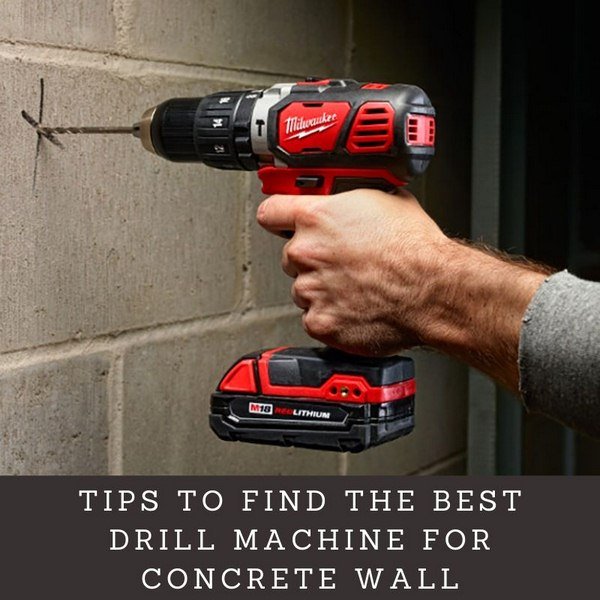
If you’re looking to get a proper tool for concrete drilling, then the choices might seem a little complicated and at times overwhelming.
But here are a few tips to find the best drilling machines when working on concrete walls that will make the choice easier and more educated.
-
Type of Drilling
This is something you have to consider carefully before looking at the different types of available tools. Do you want to drill a hole through the wall or demolish a part/all of it? This question determines a lot of what you want in your tool.
If you’re only drilling, then you will need a more precise tool with greater control so that you won’t cause any cracks or additional damage beyond what is needed.
For demolition, you will need more power with a bigger spread as well. Here accuracy will not be as big of a deal and you will have less control over your machine. But you can still control how much of the concrete you want to break.
-
Type of Concrete
While concrete, in general, is hard, you have to take in to account the nature of it as some type of concrete tends to harden further over time which would require more power to drill through.
In some cases, it could become brittle which will cause a lot more breakage than intended making controlled drilling harder without extremely accurate tools.
Taking note of the types of concrete you are likely to work with will help greatly in choosing the right tool for your work.
-
Corded vs. Cordless
Corded drills and hammers are cheaper, more powerful and do not need to be recharged in the middle. So, they offer a steady supply of power and tend to hold up well over long periods of time.
Cordless models, on the other hand, focus more on the convenience factor. They can be used anywhere as long as the batteries are charged but they don’t run for very long and require the batteries to be frequently recharged.
If you value mobility and only work in short bursts at a time, then a cordless one could be the better option but, in most cases, corded is the way to go.
-
Type of Drill/hammer
When dealing with concrete, you can opt for two different types of drills depending on the concrete you’re working with and the type of work you’re doing.
First is a rotary hammer that uses a rotating bit to drill through concrete. This offers good precision and can be used for making controlled holes in concrete walls.
The second type is the combination hammer which is capable of both drilling and breaking the concrete using a thrusting motion.
This can be used to drill through concrete when there is no need for precisely calculated holes. The combination hammer is more powerful but it is also harder to control and only used for larger holes.
-
Power
The amount of power you will need varies depending on what you’re working with. But when it comes to drilling, you want to avoid a motor that is too powerful for your job as over drilling could lead to unwanted cracks even in concrete.
So, it is always advised to go for a drill with variable speed and torque or at least variable torque with a limited speed. This will not only prevent over drilling but also provide much greater control and precision.
-
Drilling Bits
The bits you select determine a large part of the overall quality of your tool and your work. Carbide drills are recommended for concrete drilling as they are a lot more durable than regular ones and also work more efficiently by automatically clearing the debris around them.
This allows for much greater precision and speed while also improving the longevity of the tool.
-
Bit Size
The bit size determines the size of the hole you will be making in the concrete. When it comes to concrete drilling, you want to use bits that are exactly the same size as the hole you want to make or slightly bigger.
A good rule of thumb would be 1/64th of an inch bigger than the hole you want to make. This helps in relieving some of the pressure from the tool and will improve its life expectancy.
-
Get an Auxiliary Handle
While an auxiliary handle is not necessary for the functioning of your drill, it will greatly help with the positioning, comfort and the control you have over your drill.
It is especially useful if you want to work on drilling precise holes into the concrete over long periods of time as it also helps with fatigue.
-
Make sure that Chuck is Keyless
The chuck is what holds on to your bit when you’re drilling and prevents it from wobbling around. Having a keyless chuck would mean that you can effortlessly remove the current bit from the chuck without any additional tools and replace it with a more appropriate one.
This saves a lot of time when working on different types of concrete at the same time.
-
Opt for a Brushless Motor
This is again not a necessity for operation but a brushless motor is far superior to a regular motor. It is more powerful, efficient and manages heat much better.
Heat management, in particular, comes in very handy here as you will be producing a lot of heat when working on concrete and poor heat dissipation could drastically reduce the lifetime of a motor.
Conclusion
Drilling through concrete is a tough job without the right tools. It is especially tough if you are working on your concrete walls inside your home to drill holes as you’d want them to be precise and avoid any collateral damage.
The above tips should have all the information you’d need to make sure the drilling tool you purchase will be adequate for your particular needs.