Table of Contents Show
Bulk stone serves as one of the most versatile materials in residential landscape engineering. Gravel forms durable footpaths, establishes stable sub-bases under patio pavers, creates clean borders around outbuildings, and accelerates subsurface water drainage. However, ordering the exact tonnage requires methodical spatial calculation rather than rough guesswork.
Underestimating material requirements halts site work mid-project, forcing homeowners to absorb additional quarry delivery fees. Overordering leaves surplus rock piles on driveways, inflates material expenditures, and requires manual labor to haul away unused aggregate. Balancing site dimensions against material compaction factors secures a clean installation without financial waste.
Quick Takeaway: To estimate gravel landscaping needs, multiply surface length by width, convert depth into decimal feet, and divide the total cubic feet by 27 to calculate cubic yards. Multiply cubic yards by your stone’s bulk density rating (typically 1.35 to 1.5 tons per cubic yard) and add a 10% safety margin to account for compaction and soil settlement.
Measure the Landscaping Area Carefully
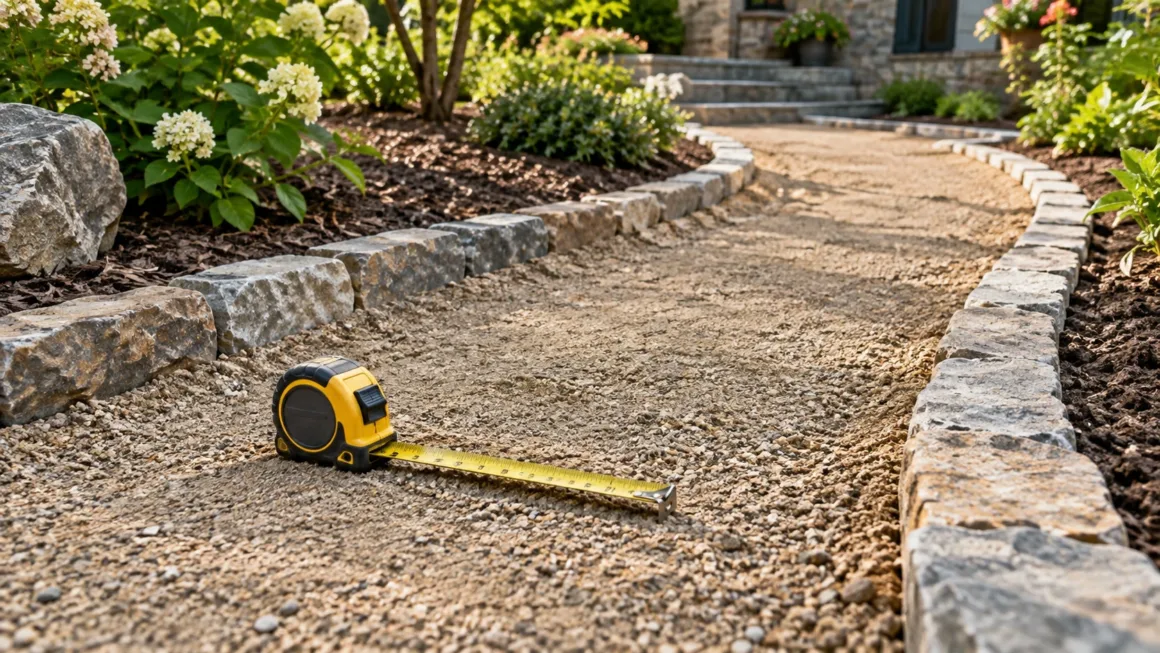
Every reliable aggregate estimate starts with precise surface site measurements. Run a commercial steel tape measure along the exterior boundaries of your project zone. For rectangular footprints, calculate the base area using standard geometric multiplication:
Area = Length × Width
For instance, a residential utility path measuring 18 feet long by 10 feet wide yields a surface footprint of:
18 ft × 10 ft = 180 sq ft
When working with metric project plans, the identical mathematical principle applies:
5 m × 3 m = 15 sq m
Double-check perimeter figures prior to running volume calculations. A minor 6-inch discrepancy along a 40-foot border compounds into significant tonnage errors once depth spread comes into play.
Calculating Irregular Landscaping Geometry
Curved garden beds, winding walkways, and L-shaped patios rarely conform to square boxes. Instead of estimating whole irregular footprints at once, divide the space into smaller geometric sub-sections. Measure each shape independently, solve for surface area, and sum the totals.
- L-Shaped Courtyards: Split the layout into two distinct rectangles. Calculate length times width for each section, then combine the square footage figures.
- Circular Fire Pit Pads: Measure from the center point to the outer edge to find the radius (r). Apply the circular area formula (3.14 × r²). A 12-foot diameter circle (r = 6 ft) equals 3.14 × 36 = 113.04 sq ft.
- Winding Paths: Segment serpentine walkways into 5-foot straight rectangular spans. Sum the individual rectangular areas to form an accurate baseline.
Establish Target Aggregates Installation Depth
Surface area alone cannot determine bulk order weights. Aggregate application requires a third volumetric component: installation depth. A sub-base installed 4 inches deep demands twice the material volume of a 2-inch decorative top layer.
Depth specifications depend directly on load-bearing requirements and stone particle size:
- Decorative Planting Beds & Flower Borders: 2 inches (0.167 ft). Shallow layers prevent weed breakthrough while allowing air transfer to plant roots.
- Pedestrian Footpaths & Patio Borders: 3 inches (0.25 ft). Provides solid foot cushion without deep shifting underfoot.
- Residential Driveways & Shed Foundations: 4 to 6 inches (0.333 to 0.50 ft). Deeper base layers distribute heavy vehicular axle weight without rutting sub-soils. For structural layout guidelines, read our technical breakdown on the role of hardscaping in landscape design.
To avoid mathematical errors during volumetric calculation, convert target depth inches into decimal feet by dividing by 12:
- 2 inches ÷ 12 = 0.167 feet
- 3 inches ÷ 12 = 0.250 feet
- 4 inches ÷ 12 = 0.333 feet
- 6 inches ÷ 12 = 0.500 feet
For metric applications, convert depth millimeters into meters by dividing by 1,000:
- 50 mm ÷ 1,000 = 0.05 meters
- 75 mm ÷ 1,000 = 0.075 meters
- 100 mm ÷ 1,000 = 0.10 meters
Calculate Required Material Volume
With spatial dimensions and depth values converted to compatible units, apply the universal volumetric formula:
Volume = Length × Width × Depth
Consider a project installing a 3-inch gravel layer over an 18-foot by 10-foot path section. Multiply the dimensions:
18 ft × 10 ft × 0.25 ft = 45 cubic feet
Quarries and landscape yards sell loose aggregate primarily by the cubic yard. Because one cubic yard contains 27 cubic feet (3 ft × 3 ft × 3 ft), divide your cubic feet total by 27:
45 cu ft ÷ 27 = 1.67 cubic yards
If you prefer digital calculation tools, cross-check manual arithmetic with an online gravel calculator to verify estimated volumetric requirements before contacting suppliers.
Executing Metric Volumetric Conversions
Metric projects utilize direct cubic meter calculations without complex fractional conversions.
Calculate a garden border measuring 5 meters long, 3 meters wide, and 50 millimeters deep (0.05 m):
5 m × 3 m × 0.05 m = 0.75 cubic meters (m³)
Avoid entering raw millimeter figures directly into volume formulas. Entering 50 instead of 0.05 inflates theoretical orders by a factor of 1,000, creating severe overordering errors.
Convert Volumetric Requirements to Delivery Weight
While design plans yield cubic yards or cubic meters, commercial supply yards invoice and load delivery trucks by weight (tons or metric tonnes). Physical volume does not equal weight across different mineral types.
Tonnage calculations depend on aggregate bulk density, governed by material testing standards such as ASTM C29 bulk density aggregate testing. The weight formula requires multiplying volume by bulk density:
Weight (Tons) = Volume (Cubic Yards) × Bulk Density (Tons / Cu Yd)
Bulk density values fluctuate based on mineral composition, particle shape, and moisture content:
| Aggregate Material Type | Average Bulk Density (Tons / Cu Yd) | Compaction Tendency | Primary Landscaping Application |
|---|---|---|---|
| Pea Gravel (Rounded River Rock) | 1.35 Tons | Low (Rolls under load) | Decorative paths, patio borders, drainage grids |
| Crushed Granite (#57 Stone) | 1.40 Tons | Moderate (Angular interlock) | Driveway top coats, walkway surfacing |
| Crushed Limestone with Fines (Dense Grade) | 1.50 to 1.60 Tons | High (Packs solid) | Driveway sub-bases, patio paver foundations |
| Lava Rock (Pumice) | 0.50 to 0.60 Tons | None (Porous structure) | Decorative planter top-dressing |
Applying an average density factor of 1.4 tons per cubic yard to our earlier 1.67 cubic yard path requirement yields the target delivery weight:
1.67 cu yd × 1.4 tons/cu yd = 2.34 short tons
Request exact density conversion factors directly from your local quarry, as regional rock varieties alter final haul weights.
Account for Mechanical Compaction Factors
Loose aggregate delivered in a dump truck contains air voids between individual stone particles. When spread and compacted with a mechanical plate compactor or hand tamper, air gaps disappear, compressing material into a thinner, denser mass.
Compaction allowances remain vital for heavy structural bases:
- Clean Angular Crushed Stone (#57): Compacts roughly 5% to 8%. Loose particles interlock with minimal vertical loss.
- Dense-Graded Base (Crusher Run / ABC): Compacts 10% to 15%. High ratios of fine stone dust fill voids between larger crushed rocks, reducing net finished depth. For foundation stability techniques, check our practical guide on inspecting base structural integrity.
- Rounded Pea Gravel: Compacts under 3%. Rounded smooth river stones resist mechanical interlock, shifting sideways under foot pressure rather than locking down.
To compensate for a 10% compaction reduction on a structural base, multiply your calculated theoretical volume by 1.10 prior to placing quarry orders.
Manage Waste Margins Without Excess Overordering
Adding arbitrary 20% or 25% waste buffers to purchase orders causes unnecessary costs and leaves pile waste on site. Instead, match waste margins to actual ground conditions:
- Smooth, Machine-Excavated Sub-soils: Add 5% waste allowance.
- Rough, Hand-Dug Sub-grades with Roots & Depressions: Add 10% waste allowance.
- Sloped, Irregular Terraces & Soft Clay Sub-grades: Add 12% to 15% waste allowance. Soft soil absorbs sub-base gravel during initial plate compaction.
Prepare Site Excavation Prior to Taking Final Measurements
Executing calculations over raw, unexcavated grass leads to depth miscalculations. Turf grass and organic topsoil compress unpredictably when heavy stone drops on top.
Execute these ground preparation steps before taking final dimensional readings:
- Mark perimeter boundaries using wooden stakes and mason line string.
- Strip off sod, roots, and organic topsoil down to firm sub-grade clay or native mineral soil.
- Excavate to your full planned trench depth (4 inches for base stone plus 2 inches for surface gravel).
- Grade sub-soils smoothly, sloping surfaces away from house foundations at a 2% grade (1/4 inch drop per foot) to prevent water pooling.
- Tamp the bare sub-soil floor thoroughly using a mechanical plate compactor.
- Measure length, width, and excavated depth inside the prepped trench to run final aggregate ordering math.
Select the Appropriate Aggregate Class for Your Project
Choosing improper stone grades compromises installation longevity regardless of accurate volume estimates.
Decorative Surface Gravel
Decorative stones include washed river rocks, marble chips, and crushed granite. Selecting a 3/8-inch particle size provides comfortable walking surfaces under foot while maintaining clean visual lines along garden edges. If you are integrating stone borders into broader yard upgrades, explore creative layout options in our roundup of unique garden decor styles for backyards.
Rounded Pea Gravel
Pea gravel consists of naturally weathered, smooth river stones measuring 3/8 inch in diameter. Its smooth edges make it ideal for barefoot patio areas, dog runs, and play spaces. However, because rounded stones do not interlock, keep layer depths under 2 inches to prevent sinking when walking across the surface.
Angular Crushed Aggregate
Crushed granite, limestone, and basalt feature jagged, machine-fractured faces. When rolled or mechanical-tamped, sharp corners interlock to form stable bases. Use angular aggregate for driveways, shed foundations, and sub-layers beneath paver installations.
Drainage Stone & French Drains
Drainage projects require clean-washed #57 stone (1/2 to 3/4 inch angular rock) washed free of stone dust. Clean stone voids allow heavy stormwater to flow rapidly through subsurface French drain pipes and dry wells without clogging perforated drainage sleeves.
Install Landscape Fabric and Rigid Border Edging
Uncontained gravel spreads laterally into adjacent turf grass under foot traffic, while bare sub-grade clay migrates upward into clean stone layers over time.
Line excavated soil trenches with woven non-woven geotextile landscape fabric prior to spreading aggregate. Geotextile fabric acts as a structural separation barrier, preventing stone base loss into soft clay sub-soils while allowing groundwater to filter downward freely.
Install heavy-duty metal, commercial plastic, or masonry edging along path boundaries. Anchor edging securely with 10-inch steel landscape spikes to lock gravel within defined perimeter walls. To keep surrounding exterior features clean during gravel installation, review our guide on patio cleaning and maintenance tips.
Common Gravel Estimation Pitfalls to Avoid
Mixing Inches and Feet Without Conversion
Multiplying 18 feet length by 10 feet width by 3 inches depth (18 × 10 × 3) yields 540—a massive calculation error. Always convert 3 inches into 0.25 feet prior to running volumetric multiplication.
Confusing Square Feet with Volume Measurements
Square feet measure two-dimensional surface area, while cubic yards measure three-dimensional volume. Quarries sell bulk materials by volume or weight, making depth conversion mandatory before placing orders.
Assuming Uniform Weight Density Across All Rock Types
Applying a light pea gravel density figure (1.35 tons/cu yd) to dense limestone base stone (1.60 tons/cu yd) results in ordering insufficient material weight. Match exact bulk density factors to your specific stone selection.
Rounding Intermediate Conversion Values Too Early
Maintain at least three decimal places throughout intermediate calculations (0.167 ft for 2 inches). Rounding figures prematurely at every step skews final delivery tonnage results on expansive projects.
Verify Supply Yard Order Units and Minimums
Confirm your landscape supplier’s exact billing and delivery parameters prior to authorizing payment orders:
- Sales Units: Determine whether the yard bills per cubic yard, per short ton (2,000 lbs), per metric tonne (2,204 lbs), or by 1-ton bulk tote bags.
- Minimum Delivery Increments: Most quarries deliver in half-yard (0.5 cu yd) or full-ton increments. Round calculated requirements up to match supplier thresholds.
- Hauling Drop Limits: Verify truck clear-heights and driveway access limitations before ordering tri-axle dump truck deliveries.
Pre-Order Material Audit Checklist
Review this final verification sequence before placing your bulk aggregate order:
- Sub-grade soil excavated, graded, and tamped to target depth.
- Surface area calculated using compatible length and width units.
- Depth inches divided by 12 to convert into decimal feet.
- Total cubic feet divided by 27 to yield required cubic yards.
- Specific material bulk density factor applied to calculate order tonnage.
- Compacting allowance (5% to 15%) added based on stone aggregate type.
Frequently Asked Questions
How many square feet does 1 cubic yard of gravel cover?
One cubic yard of gravel covers 324 square feet at 1 inch depth, 162 square feet at 2 inches depth, 108 square feet at 3 inches depth, and 81 square feet at 4 inches depth.
How much does 1 cubic yard of gravel weigh?
One cubic yard of dry gravel weighs between 1.35 and 1.5 short tons (2,700 to 3,000 lbs), depending on particle size, rock type (granite vs limestone), and moisture content.
How deep should gravel be for a residential walkway?
A pedestrian gravel walkway requires an aggregate depth of 3 inches over a compacted sub-base lined with geotextile landscape fabric to prevent stone sinking.
Do I need landscape fabric under gravel driveways and paths?
Yes. Installing heavy-duty geotextile fabric between native soil and aggregate base layers prevents stone from sinking into clay while blocking sub-grade weed growth.
Author & Editorial Review
Author: Perla Irish serves as Content Manager at DreamlandsDesign. Drawing on extensive experience across hardscaping planning, site excavation, and outdoor maintenance, she delivers technical calculation guides for residential home improvement projects.
Editorial Review: This guide was reviewed by the DreamlandsDesign editorial team for mathematical accuracy, civil earthworks practices, and material density precision. All calculation standards align with civil engineering aggregate testing criteria and residential hardscaping best practices.