Table of Contents Show
Are you struggling with a case of hard water stains? Hard water stains often appear as white spots on plumbing fixtures or the dreaded orangish film that lines your tub.
When you’re battling a serious hard water problem, the solution requires a multi-pronged approach.
Like most problems in life, you must start by getting to the root of the problem.
Once you identify what’s causing your hard water stains, then it’s time to create a plan that will not only eliminate the stains but keep them gone for good.

In most cases, remedying a hard water problem requires an upfront investment that’s larger than a minor home renovation.
Consequently, it’s wise to put money aside where you can to save enough to complete the job.
The good thing is that once you get the job done, the maintenance cost is low.
Step 1: Test Your Water
The most affordable way to test your water is to order or pick up a set of “total hardness test strips.”
This type of strip is similar to a paper pH test strip, except it tests water hardness rather than pH.
On the strips, you’ll find measurements for both grains per gallon (gpg) and parts per million (ppm).
To conduct the test, simply dip the strip in your water sample and match the color to the chart on the bottle.
Next, it’s important to keep an original test strip to compare the before & after results.
Additionally, you’ll want to test your water after following Step #2.
If you want to go a step further, opt for a water test kit that tells you exactly what’s in your water or have it professionally tested by a lab.
A thorough water test will show you the exact amounts of the minerals in your water that are making it hard.
Typically, hard water contains elevated levels of calcium and magnesium.
Step 2: Install a Water Softener
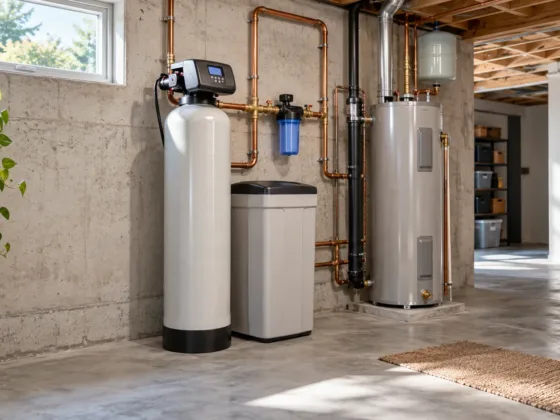
Once you confirm that your water is hard, it’s time to install a water softener system.
There are two primary options: salt and salt-free systems. If your water is really hard or you’re on well water, you’ll more than likely want to stick with a traditional salt system for best results.
Secondly, you’ll want to decide whether you prefer to do the installation yourself or hire a plumber.
To choose the right system, there’s some math involved and manual labor, though, if you’re somewhat handy, you’ll more than likely be able to complete the job on your own.
Also, you’ll install your water softener near the point of entry to soften all the water that’s entering your home.
As a result, you’ll notice a significant reduction in lime deposits around your plumbing fixtures, more suds when doing your laundry & bathing, and less spotting on your dishes.
Read Also:
Step 3: Test your Water After Installing your New Softener
Now, it’s time to break out those test strips again and your original test result.
Once your water softener has had time to do its job, you’ll want to see the before & after results.
This way, you’re able to confirm whether the softener is doing its job efficiently.
If after installing your softener you get the same results or continue to notice hard water problems, then it’s time to troubleshoot the problem to ensure your water softener is running smoothly.
Also, this goes back to doing the math upfront to choose the correct softener size.
Two common water softener sizes for residential applications are 24,000 and 48,000 grains.
The more people in your household the higher the number of grains you’ll need to adequately soften the water throughout your home.
The bottom line is to measure twice and buy once when selecting your water softener size.
Step 4: Consider Updating your Faucets
If your taps were running slowly before installing your softener, there’s a good chance that mineral deposits in your lines are the root of the problem.
Since replacing your plumbing lines is a major project, you might find that replacing your faucets is a better place to start.
Choosing good kitchen and bathroom faucets for hard water will help to prevent spots from forming after installing your water softener.
Ryan at 123 Faucet Guides recommends models by Moen, Kohler, and Delta.
Also, it’s important to consider the faucet finishes to prevent spotting. For instance, if you currently have chrome faucets, chrome shows spots more so than other finishes.
Step 5: Maintain your Softener
It’s very important to maintain your water softener schedule for optimal results and to prevent problems later.
A good softener comes with a reliable digital metered control head that allows you to customize your cycle times for optimal performance.
Once you dial in your cycle times, the system will automatically regenerate and minimize salt usage.
Also, the meter will keep track of your water usage. Lastly, the hardest part of the job can be lifting heavy bags of salt.
Be sure to keep this step in mind if you have trouble lifting heavy objects.
Typically, bags of water softener salt weigh 40 to 50 lbs. To check your salt level, lift the lid to your brine tank about once or twice a month.
This will help you to confirm that the system is using salt and how often you need to add salt.
An efficient softener may only need to be refilled every couple of months.
Conclusion
Hard water is a very common problem for people across the country, especially for people on well water.
While a water softener is the #1 solution for reducing hard water stains, it’s only part of a complete water treatment system.
To ensure your water softener runs without a hitch, it’s wise to consult a professional or consider the additional elements that go into creating a complete home water filtration system.
This may sound confusing at first, but it’s more important to know that you have more than one solution.
Once you optimize your system, you’ll love the fact that hard water stains are a thing of the past.