Table of Contents Show
This guide is written from an independent renovation and planning perspective. It is intended to help homeowners, developers, and facility managers make informed decisions based on durability, usability, and long-term performance — not product promotion.
Reference note: This article may mention third-party resources (for example, “gym flooring”) strictly as general industry references. These mentions are informational only and do not imply endorsement, partnership, or commercial affiliation.
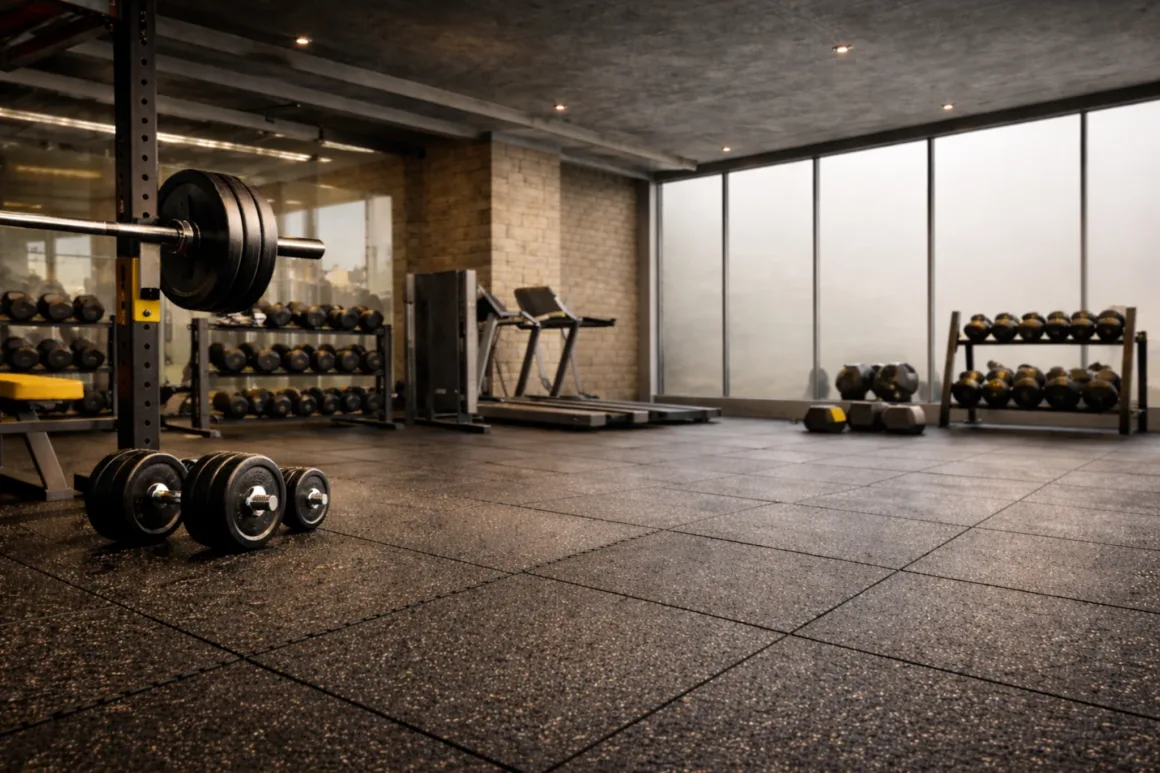
Choosing the right gym flooring plays a critical role in safety, comfort, and long-term performance. In real renovation projects, flooring decisions directly influence vibration control, thermal behavior, odor buildup, and maintenance demands. These effects are especially pronounced in hot and dusty environments like Dubai, where materials experience continuous environmental stress.
In practice, planners often review multiple market references to understand available material formats, thickness options, and installation approaches. For example, an overview of gym flooring can help illustrate how rubber systems are commonly categorized by thickness and application during early-stage planning.
This guidance reflects recurring technical patterns observed during real-world planning and review processes, based on renovation projects reviewed between 2021–2024 across both residential and commercial gym environments.
Why gym flooring decisions fail in real projects
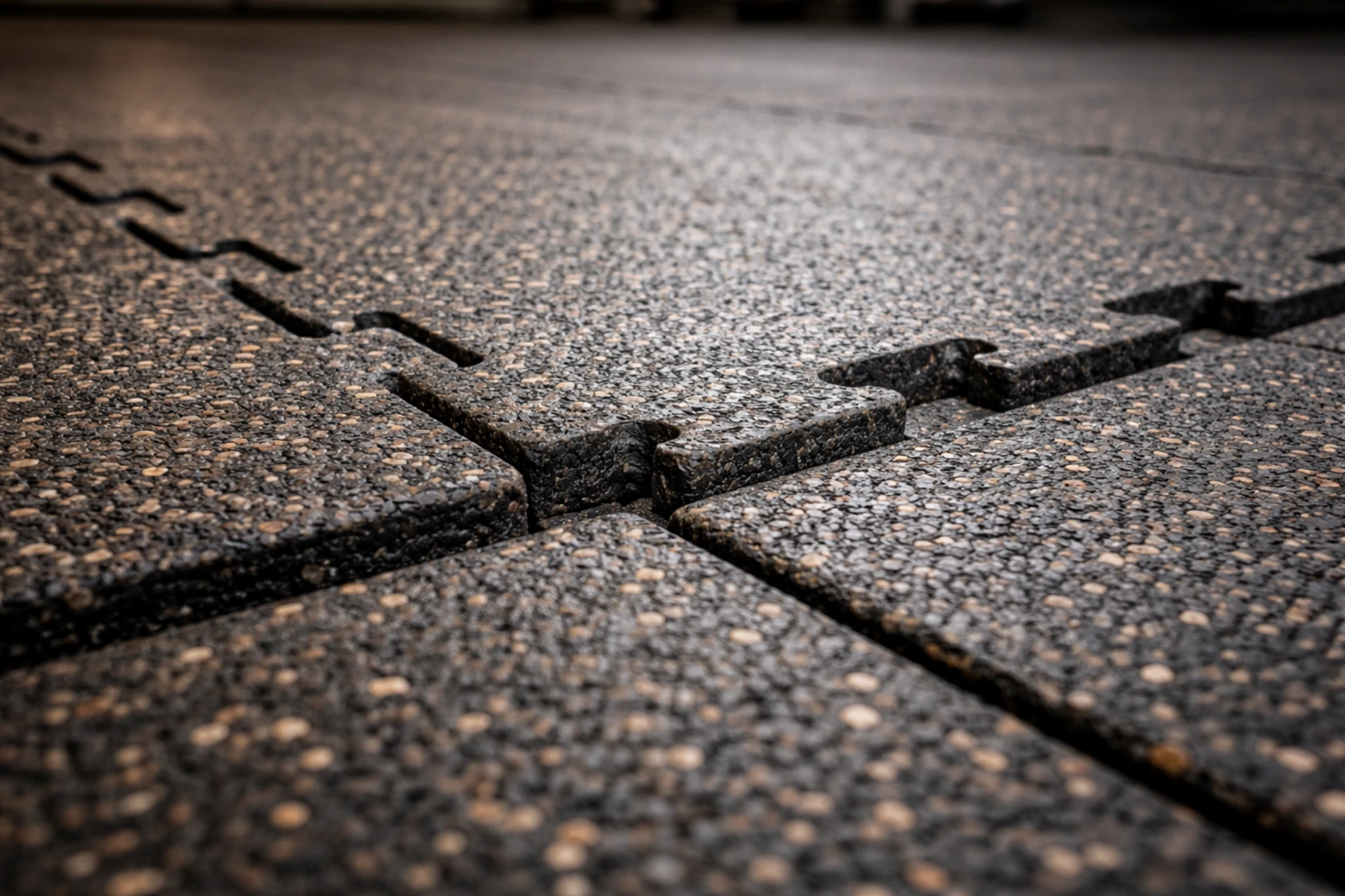
In many renovations, flooring is selected late in the planning process, often after equipment layouts are finalized. This frequently leads to vibration transfer, premature wear, or moisture-related failures. Field experience shows that most long-term flooring issues stem from three root causes: incorrect thickness selection, insufficient moisture control, and rushed installation sequencing.
Layout logic also plays an important role. Poor circulation or overloaded zones concentrate stress on limited areas. For broader spatial context, see common floor plan mistakes, which explains how layout decisions influence long-term performance.
Quick planning takeaways
- Select flooring thickness based on real mechanical load, not marketing labels.
- Plan moisture mitigation before installation begins.
- Account for dust, heat, and ventilation in long-term maintenance.
- Coordinate flooring choices with layout and equipment planning.
Thickness guidelines used in practice
The following ranges reflect specifications commonly applied in gym and renovation projects where durability and safety are priorities.
In practice, thickness selection is one of the most common causes of long-term flooring failure when misjudged.
| Use area | Recommended thickness | Engineering rationale |
|---|---|---|
| Cardio zones | 10–12 mm | Limits vibration while maintaining stable underfoot response |
| Strength machines | 15–20 mm | Handles repetitive static and dynamic loading |
| Free-weight areas | 20–25 mm | Protects slabs from dropped loads and shock impact |
Cost vs durability (planning perspective)
Rather than focusing on headline prices, renovation planning evaluates lifecycle performance. In Dubai, installation conditions such as moisture mitigation, substrate preparation, and curing time often influence total cost more than material price alone.
| Material category | Relative cost* | Expected lifespan | Typical application |
|---|---|---|---|
| Foam / EVA mats | Low | 1–3 years | Stretching and low-impact zones |
| Rubber (10–15 mm) | Medium | 5–10 years | Cardio and mixed-use gyms |
| Rubber (20–25 mm) / EPDM | High | 8–15+ years | Heavy lifting areas and outdoor installations |
*Relative cost refers to material category only. In Dubai, installation cost may increase due to moisture mitigation, surface preparation, and curing requirements.
Common gym flooring materials
- Recycled rubber: cost-efficient and widely used for indoor gyms.
- Virgin rubber: more uniform density and better resistance to compression over time.
- EPDM granules: UV-stable and suitable for outdoor or rooftop installations.
- EVA foam: lightweight and comfortable but limited to low-impact areas.
Fire safety and compliance considerations
Commercial gym flooring in the UAE is typically evaluated against local authority requirements and internationally recognized safety benchmarks. These references are used during review and approval processes, rather than acting as automatic certifications.
- Dubai Civil Defense (DCD) — authority responsible for fire and life safety compliance
- ASTM E84 — surface burning characteristics of building materials(https://www.astm.org/Standards/E84.htm)
- ASTM D2047 — static coefficient of friction testing (https://www.astm.org/d2047-17.html)
- ISO 9239-1 / EN 13501-1 — reaction-to-fire classification for floor coverings (https://www.iso.org/standard/35264.html)
Installation lessons from real renovation projects
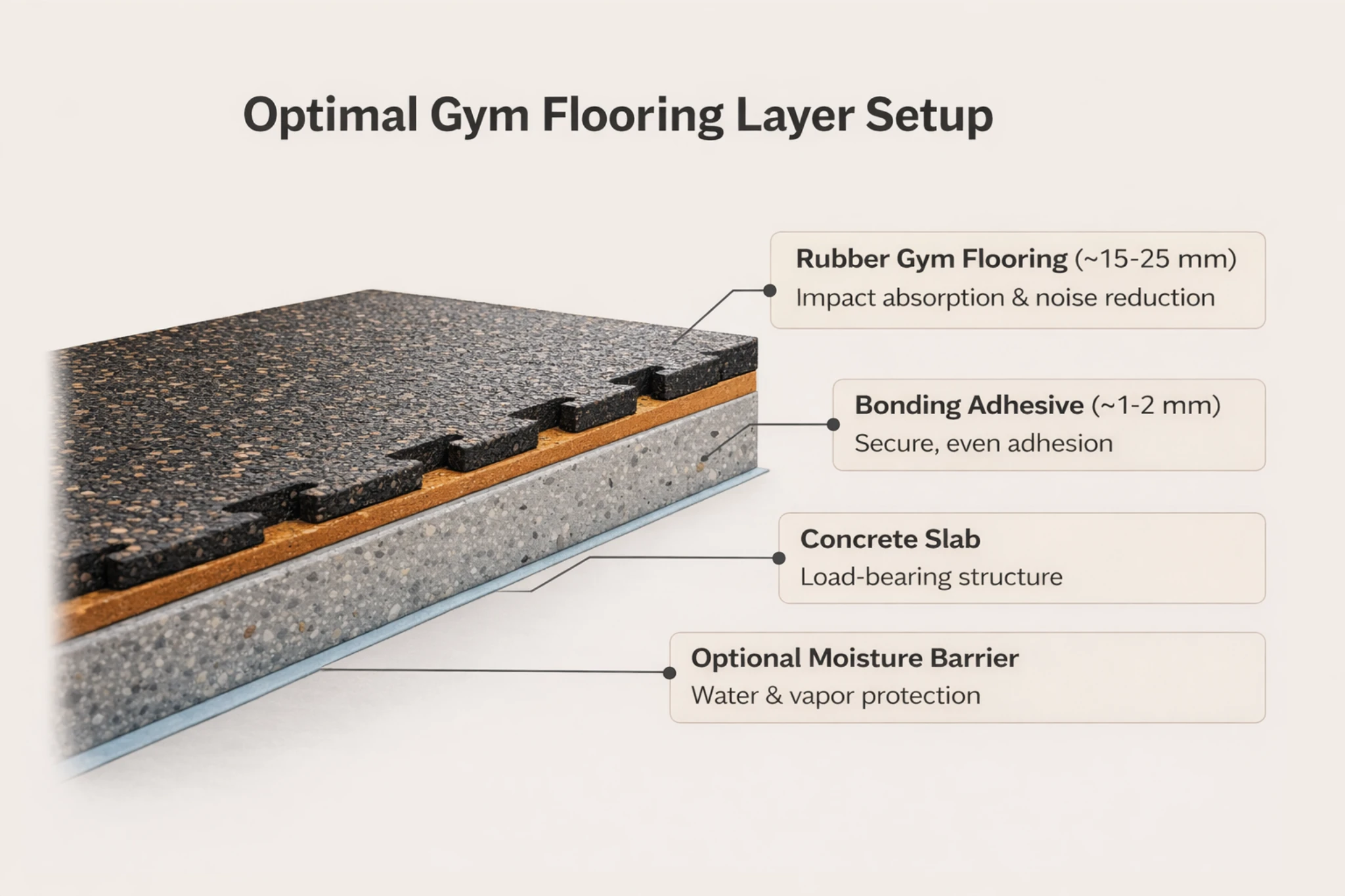
- Ensure subfloors are clean, level, and fully dry before installation.
- Apply moisture barriers or epoxy primers when slab humidity is present.
- Allow adhesives and binders sufficient curing time before loading.
- Use high-temperature–resistant binders in sun-exposed or rooftop spaces.
Maintenance considerations for hot, dusty environments
- Vacuum frequently to remove abrasive dust particles.
- Use neutral-pH cleaners to avoid residue buildup.
- Ensure good airflow to limit moisture accumulation.
- Inspect seams and edges periodically in high-traffic zones.
Mini case insight
- Project context: A mid-sized commercial gym operating in a mixed-use Dubai building experienced premature edge lifting within its first year.
- Observed issue: Flooring was installed over a slab with residual moisture and insufficient curing time.
- Corrective action: The flooring was removed, a moisture-tolerant epoxy primer applied, and the system reinstalled using high-temperature–rated adhesive.
- Outcome: After remediation, the flooring remained stable over multiple years of continuous operation.
Gym flooring as part of a renovation system
Gym flooring performs best when planned alongside ventilation, circulation, and maintenance access. Treating flooring as an integrated system — rather than a standalone finish — results in safer layouts and more predictable long-term performance.
Final thoughts
Choosing the right gym flooring in Dubai requires balancing material performance, climate exposure, and real usage conditions. When thickness, installation quality, and maintenance planning are aligned, gym flooring can deliver reliable service life even under demanding conditions.
Author & Editorial Review
Author: Perla Irish is a design and home-focused writer covering interior materials, everyday homeowner decisions, and real-world performance of residential finishes in consultation with licensed contractors and industry standards where applicable. Her work emphasizes clarity, practical context, and long-term usability over trends or transactional advice.
Editorial Review: This article was reviewed by the DreamlandsDesign editorial team with a focus on homeowner decision-making psychology, behavioral context, accuracy, and long-term relevance. Content is evaluated to ensure balanced explanations, clear intent, and alignment with Google Helpful Content and E-E-A-T quality standards.
Last updated: February 2026