Table of Contents Show
Floor coverings dictate how a bedroom functions every single day. Beyond surface aesthetics, a bedroom rug acts as an acoustic damper, a thermal barrier against cold subfloors, and a structural anchor for heavy furniture. Laying down a rug with incorrect dimensions or opting for a pile height that blocks door clearance creates daily friction and disrupts room proportions.
Selecting the ideal rug requires balancing physical dimensions, fiber resilience, and furniture alignment. Whether fitting a compact guest room or outfitting an expansive primary suite, applying clear dimensional formulas ensures your floor investment looks balanced and withstands years of heavy foot traffic.
Design Takeaway: Match rug dimensions to your bed frame first, leaving 24 to 36 inches of exposed plush pile on both sides. Prioritize natural wool or dense hand-tufted fibers for longevity, install a dual-surface rubber pad to prevent slippage, and maintain an 8-to-15-inch gap from room walls to preserve architectural boundary lines.
The Architectural and Functional Role of Bedroom Rugs
Hardwood, engineered plank, and polished tile floors offer long-term durability, but they yield minimal sound absorption. In multi-story homes or open layouts, bare floors amplify impact noise from footfalls and bed movements. A dense area rug absorbs ambient sound waves and cushions every step, creating a quiet sleeping environment.
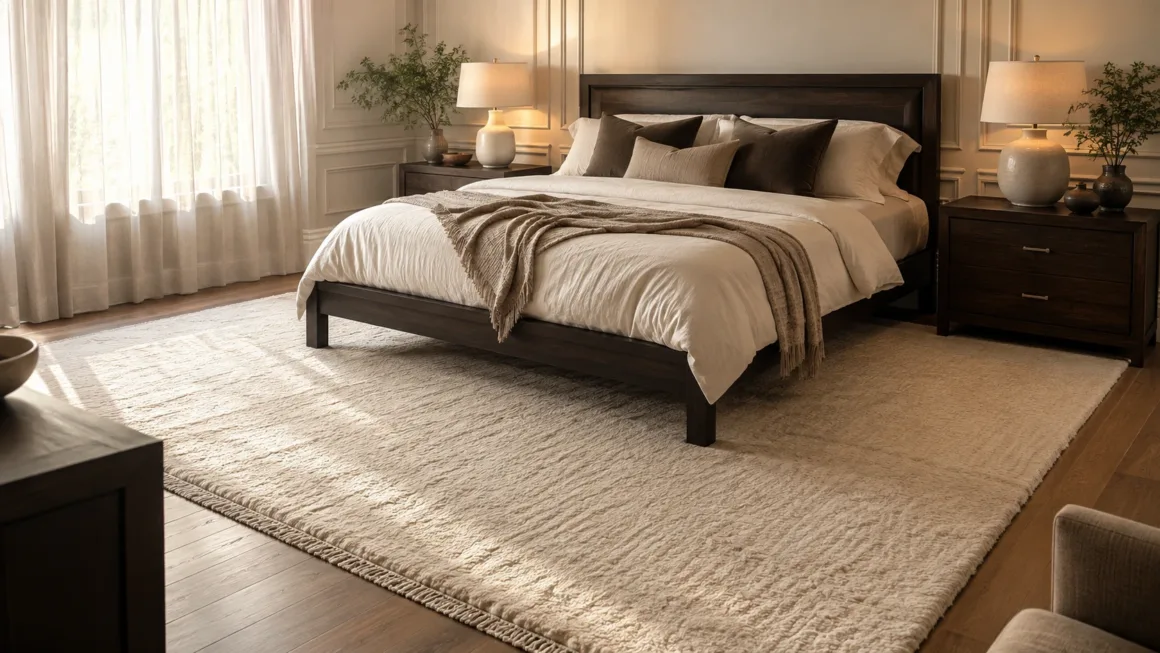
From a spatial design perspective, bedroom furniture requires distinct visual boundaries. A bed floating directly on a wide expanse of hard flooring appears unanchored. Extending an area rug past the perimeter of the bed frame creates a grounded visual zone, unifying nightstands, dressers, and seating areas into a cohesive layout. If you are updating broader interior features, explore our design tips on creating a dark academia bedroom retreat to layer deep color palettes, rich textures, and architectural lighting alongside your floor coverings.
Dimensional Sizing Rules: Standard Bed Frames and Room Ratios
Avoid guessing rug dimensions in the showroom. An undersized rug gets swallowed beneath the mattress frame, leaving cold subfloors exposed right where your feet land in the morning. Conversely, an oversized rug overwhelms the floor plan, crowding baseboards and making modest bedrooms feel cramped.
Measure your bed frame first, then apply these strict dimensional standards:
1. King and California King Beds
A standard King mattress measures 76 x 80 inches. To maintain proper proportion, pair a King bed with a 9×12 foot rug. Position the rug perpendicular to the bed frame, stopping just in front of your nightstands. This orientation provides approximately 30 to 36 inches of soft rug exposure along both sides of the bed and at the foot end.
2. Queen Beds
Queen bed frames measure 60 x 80 inches. An 8×10 foot rug serves as the industry baseline for Queen bedrooms. This layout leaves roughly 24 to 30 inches of cushioned surface along the sides and bottom. In narrower rooms, a 6×9 foot rug works effectively when pulled down to cover only the lower two-thirds of the frame.
3. Full and Twin Beds
Full beds (54 x 75 inches) fit best on a 6×9 foot rug. For Twin beds (38 x 75 inches) or children’s rooms, a 5×8 foot rug placed under the lower half of the mattress provides adequate coverage. Alternatively, run two matching 2×6 foot runner rugs along both sides of the bed frame to keep central floor space open.
The Perimeter Wall Clearance Rule: Maintain a continuous gap of 8 to 15 inches between the edge of the rug and the baseboards. Covering floorboards edge-to-edge mimics wall-to-wall carpeting and makes architectural rooms feel restricted.
Material Selection: Comparing Durability, Comfort, and Upkeep
Fiber selection determines how well your rug withstands heavy bed posts, regular vacuuming, and accidental spills. Each material brings distinct mechanical properties to a bedroom layout.
| Material Type | Feel & Underfoot Comfort | Durability Expectancy | Maintenance Complexity | Optimal Placement Zone |
|---|---|---|---|---|
| Wool | Plush, dense, natural thermal insulator | 15–30+ Years | Moderate (Vacuum/Spot Clean) | Primary Suites & Main Bedrooms |
| Cotton | Soft, lightweight, flat-woven | 3–7 Years | Low (Machine Washable) | Kids’ Rooms & Guest Bedrooms |
| Jute / Sisal | Coarse, firm, natural plant fiber | 5–10 Years | High (Dry Clean Only) | Low-Traffic Sitting Areas |
| Hand-Tufted | Thick, resilient pile height | 10–20 Years | Moderate (Professional/Spot) | Primary Suites & Accent Zones |
Wool: Wool fibers feature a natural crimp structure that springs back after heavy furniture legs compress the surface. Wool contains lanolin oils, making it resistant to dry soil and liquid spills while insulating floors during winter months.
Natural Plant Fibers (Jute & Sisal): Plant materials introduce organic texture into room designs. However, jute absorbs liquids rapidly and darkens when exposed to water, making spot cleaning difficult. Reserve jute for spaces where drink spills are minimal.
Selecting handcrafted rugs for bedroom designs allows homeowners to combine detailed loop textures with thick pile wool construction, delivering structural stability alongside long-term underfoot comfort. For additional textile styling ideas across your floor plan, review our practical guide on styling and caring for white curtains to harmonize window treatments with neutral rug palettes.
Furniture Placement and Alignment Techniques
Aligning furniture across the rug surface affects safety, stability, and room balance. Misaligned furniture legs cause tipping hazards and stretch rug backings unevenly.
- Option A: All Furniture Fully On the Rug: Requires an expansive floor plan (typically 10×14 feet or larger). The bed frame, nightstands, and end-of-bed benches sit entirely on the rug surface, creating a grand anchor in large master suites.
- Option B: Two-Thirds On the Rug (Recommended Standard): Position the rug so it starts just in front of your nightstands and extends past the foot of the bed. Nightstands rest directly on hard flooring, while your feet land on plush rug pile when stepping out of bed.
- Option C: Side Runners Only: Place two matching runner rugs along both sides of the bed frame. This layout saves costs, highlights high-end hardwood floors, and simplifies rug removal for routine cleaning.
Avoid placing nightstands so that only their front legs rest on the rug edge. Uneven legs tilt furniture forward, causing lamps, water glasses, and alarm clocks to slide off the surface.
Color Selection and Room Palette Balance
Color choices in the bedroom should promote physical relaxation. High-saturation primary colors and overly intense geometric patterns overstimulate visual senses, making it harder to wind down at night.
Select balanced, muted palettes instead:
- Neutral Foundations: Ivory, warm beige, soft charcoal, and greige establish a calm baseline. Neutrals allow you to update duvet covers and wall paint without replacing expensive floor coverings.
- Earthy Accent Tones: Muted sage green, dusty blue, and warm terracotta introduce subtle depth without overwhelming room decor.
- Pattern Scale Balance: If your bedspread features detailed patterns, select a plain or textured monochromatic rug. Conversely, if your bedding features plain linen, introduce a subtle vintage pattern on the rug to balance visual interest.
If you are planning comprehensive spatial upgrades across your home, consult our guide on designing a relaxing bedroom oasis to layer quiet lighting, non-toxic furniture, and serene color schemes effectively.
Essential Safety: Underlayment Pads and Door Clearance
Never place an area rug directly onto hardwood, vinyl, or tile floors without a dedicated non-slip rug pad underneath. Unsecured rugs shift across floors, bunch up under bed posts, and create tripping hazards during nighttime navigation.
A dual-surface rug pad (felt top with a natural rubber backing) provides three key functional benefits:
- Grip: Locks the rug backing firmly to the subfloor without leaving sticky adhesive residue.
- Protection: Prevents coarse backing fibers from scratching finished hardwood surfaces.
- Cushioning: Absorbs foot impact, extending the mechanical lifespan of rug yarns.
Checking Door Clearance: Measure the gap between the floor and the bottom edge of closet and entrance doors before purchasing. High-pile shag rugs can catch on door bottoms. Stick to flat-weave or medium-pile heights (0.25 to 0.5 inches) if doors swing directly over the rug zone.
Long-Term Maintenance and Cleaning Protocols
Bedrooms accumulate lint, dust mites, and pet dander over time. Executing a consistent cleaning routine preserves fiber integrity and prevents deep-set dirt from grinding down yarns:
- Routine Vacuuming: Vacuum perimeter areas weekly using a suction-only setting or canister vacuum. Avoid aggressive rotating beater bars on natural wool or loop-pile rugs to prevent fiber fraying.
- Spot Treatment: Blot liquid spills immediately with a clean, dry microfiber cloth. Avoid harsh rubbing, which forces moisture deeper into the backing. Use pH-neutral carpet cleaners formulated for your specific fiber type.
- Rotation Schedule: Rotate your rug 180 degrees once a year to balance foot traffic exposure and prevent uneven wear patterns along the sides of the bed.
Frequently Asked Questions
What size rug do I need for a Queen bed?
An 8×10 foot rug is the standard size for a Queen bed. Placed perpendicular to the mattress, it extends 24 to 30 inches beyond the sides and foot of the bed, providing ample soft surface underfoot.
Can a rug be too big for a bedroom?
Yes. A rug that extends edge-to-edge across the entire room mimics wall-to-wall carpeting and makes spaces feel cramped. Maintain an 8 to 15-inch gap between the rug edges and baseboards to preserve natural room proportions.
Is wool or jute better for a bedroom rug?
Wool is superior for bedrooms due to its soft pile, high durability, and thermal insulation. Jute offers nice natural texture but feels rough underfoot and absorbs moisture easily, making spot cleaning difficult.
Should nightstands sit on the area rug?
Either place nightstands fully on the rug (Option A) or keep them entirely off on the hard floor (Option B). Avoid setting nightstands so only their front legs rest on the rug, as this tilts furniture forward and causes items to slide off.
Author & Editorial Review
Author: Perla Irish serves as Content Manager at DreamlandsDesign. Drawing on extensive experience across interior styling, soft furnishings, and residential layout planning, she delivers practical, tested decor solutions for modern living spaces.
Editorial Review: This guide was reviewed by the DreamlandsDesign editorial team for textile durability, structural placement safety, and interior design accuracy. Every recommendation aligns with modern floor covering standards and spatial layout best practices.