Table of Contents Show
Quick Answer: How to renovate a house with no money? Combine sweat equity with free/reused materials and targeted programs (WAP/LIHEAP), then phase safe DIY while leaving code-critical work to licensed pros.
If you’re asking how to renovate a house with no money, the real path is creative resourcing: reused materials, assistance programs, and a phased plan that prioritizes safety and impact. This guide closes the gaps most competitor pages leave open: a concrete 30-day sprint, a barter/micro-sponsorship script, and official resources (not myths).
1) First, clear the myth: there’s no “free cash” for general remodeling
Official guidance is consistent: the federal government does not hand out “free money” for home repairs. Focus instead on targeted assistance (energy/weatherization, disaster repair) and legitimate financing-plus-rehab options where applicable. Always use official portals for applications.
2) The 30-Day “No-Money” Renovation Sprint (expanded & actionable)
Use time, community, and donated materials as your currency. Keep it safe, phase your work, and pause whenever supplies run dry.
Reader snapshot (composite): A renter refreshed a tired galley kitchen for ~$0 by swapping in donated LED bulbs, repainting doors with leftover paint, and bartering a weekend of photo edits for a handyman’s help rehanging cabinet doors.
Week 1 — Audit & Free Wins
- Safety walk: Test GFCIs; check smoke/CO alarms; replace batteries if donated; note tripping hazards, loose treads, lifted nails.
- Deep clean & declutter: Degrease kitchen fronts; vacuum baseboards; wipe door skins; this reveals what’s cosmetic vs. true repairs.
- Patch/caulk (small defects):
- Nail holes/hairline cracks: Lightweight spackling + 120–220 sanding sponge; spot-prime.
- Dents/gouges: Pre-mixed joint compound; thin layers; sand flush; prime.
- Trim gaps: Paintable acrylic-latex caulk (interiors); smooth bead with a damp finger; use silicone only in wet areas.
- Materials wish list: Post exact sizes/quantities (e.g., “30× 2700–3000K A19 LEDs; 6 cabinet pulls, 96 mm”). Scan Buy Nothing/Freecycle/Habitat ReStore daily.
Quick tips: Use painter’s tape as a “do-not-paint” boundary; keep a wet edge note—mark where you stopped so you don’t lap semi-dry paint later.
Basic tools & materials: 4-in-1 putty knife; sanding sponges (120/180/220); caulk gun; paintable acrylic-latex caulk; lightweight spackle; stain-blocking primer; microfiber cloths.
This first pass shows you how to renovate a house with no money by prioritizing safety and free wins.
Week 2 — Paint & Light (highest impact per $0–$50)
Here’s how to remodel a house with no money and still get visible impact: paint and lighting first.
- Surface prep: Wash with mild degreaser; rinse; scuff sand glossy spots; dust off.
- Prime where needed: Knot/stain marks → stain-blocking primer; patched areas → spot-prime to prevent flashing.
- Roll & cut-in: 3/8″ nap for most walls; 2″ angled sash brush for edges; cut 2–3″ then roll into the cut while both are wet.
- Lighting refresh: Swap in donated LEDs (2700–3000K for living areas; 4000K for task zones). Clean globes; re-aim sconces to bounce light.
Quick tips: Remove switch plates; label + bag screws; strain leftover paint through mesh (old nylon works) to remove skins.
Basic tools & materials: 2″ angled sash brush; 3/8″ roller + tray; extension pole; degreaser; primer; painter’s tape; drop cloths; screwdrivers; donated bulbs/fixtures.
Week 3 — Kitchens & Baths (cosmetic-only upgrades)
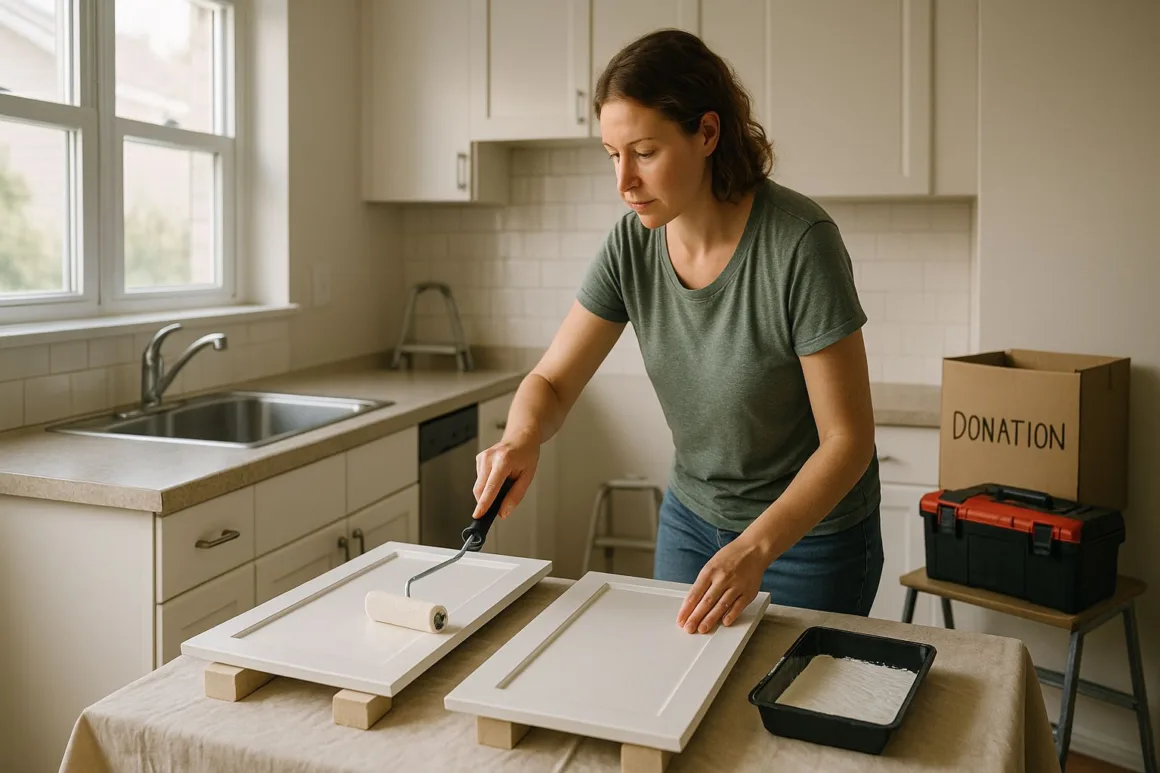
- Cabinet refresh: Label doors/hinge locations; degrease; scuff (120–150); wipe; apply bonding primer; light sand; foam-roll; cure 24–48 h before rehanging.
- Hardware swap: If spacing changes, fill old holes (wood filler + glue-coated dowel); drill new 3/16″ pilots with a hardware template or cardboard jig.
- Peel-and-stick backsplash (optional): Degrease; snap a level line; dry-fit; cut with utility knife; use a J-roller on seams; respect clearances near heat sources.
- Bath tune-ups: Remove old caulk; tape edges; apply 100% silicone (wet areas) or siliconized acrylic; smooth; pull tape; cure per label. Spot re-grout or use grout colorant for uniformity.
Quick tips: Keep a shallow “parts bin” for each door (hinges/screws/knobs) so re-hang is fast and aligned. Use painter’s pyramids or blocks to elevate doors while rolling edges.
Basic tools & materials: Degreaser; sanding sponges; bonding primer; foam rollers; utility knife; J-roller; silicone/siliconized acrylic; caulk tool; hardware template; drill + bits.
These cosmetic upgrades are the core of fixing up a house with no money without touching code-critical systems.
Week 4 — Curb Appeal & Storage
- Yard reset: Prune dead/diseased first; edge beds; sweep; check city “free mulch” programs; hose down walks/siding (avoid close-range high-PSI blasting).
- Front door refresh: Remove hardware; scuff; prime bare spots; roll panel faces; tip-off with brush; reinstall hardware.
- Storage upgrades: Reclaimed shelves: find studs with a magnet or small neodymium; use anchors if no stud; respect load ratings; add pegboard from offcuts.
- Weather-seal: Self-adhesive V-strip on jambs; door sweep; adjust strike for a tight close.
Quick tips: Photograph the entry before/after in the same light; small improvements (clean glass, painted trim, fresh mat) multiply perceived value.
Basic tools & materials: Pruners; rake; exterior primer/paint (donated); screwdrivers; drill/driver; stud finder or magnet; wall anchors; weatherstrip; door sweep.
Printable Mini-Checklist: 30-Day “No-Money” Renovation Sprint
Tip: Print this section (File → Print) and check boxes as you go.
Universal Kit (keep handy)
- □ 2″ angled sash brush; 3/8″ roller & tray; extension pole
- □ Painter’s tape; drop cloths; microfiber cloths
- □ 4-in-1 putty knife; lightweight spackle; small tub joint compound
- □ Sanding sponges (120/180/220)
- □ Caulk gun; paintable acrylic-latex caulk; 100% silicone (wet areas)
- □ Stain-blocking primer; leftover/donated interior paint
- □ Multi-bit screwdriver; drill/driver + bits; hardware template/cardboard jig
- □ Utility knife + spare blades; measuring tape; small level
- □ Stud finder or strong magnet; pencil; rags
- □ PPE: gloves, safety glasses, dust mask
Week 1 — Audit & Free Wins
- □ Safety walk: Test GFCIs; check smoke/CO; replace donated batteries; note trip hazards/loose treads.
- □ Deep clean: Degrease cabinet faces; vacuum baseboards; wipe door skins to reveal real defects.
- □ Patch/caulk small defects:
- □ Nail holes/hairline cracks → lightweight spackle; sand 120–220; spot-prime.
- □ Dents/gouges → pre-mixed compound; thin layers; sand flush; prime.
- □ Trim gaps → acrylic-latex caulk; smooth with damp finger; silicone only in wet areas.
- □ Materials wish list: Post exact sizes/qty (e.g., “30× A19 LED 2700–3000K; 6 pulls 96 mm”) to Buy Nothing/ReStore.
Source this week: LEDs, smoke/CO batteries, spackle/compound offcuts, caulk tubes, small primer can.
Week 2 — Paint & Light (high impact)
- □ Prep: Degrease; rinse; scuff; dust.
- □ Prime smart: Knots/stains → stain-blocker; patched areas → spot-prime.
- □ Apply paint: Cut 2–3″ with 2″ sash brush; roll 3/8″ nap; keep a wet edge.
- □ Lighting refresh: Swap donated LEDs (2700–3000K living; 4000K task); clean shades; re-aim fixtures.
Source this week: Donated paint/primer, rollers, bulbs, spare shades/fixtures.
Week 3 — Kitchens & Baths (cosmetic-only)
- □ Cabinet refresh: Label doors/hinges; degloss; bonding primer; foam-roll; cure 24–48 h.
- □ Hardware swap: Fill old holes (wood filler + glued dowel) if needed; drill 3/16″ pilots with a jig.
- □ Peel-and-stick backsplash (optional): Degrease; level line; dry-fit; cut; J-roller seams.
- □ Bath tune-ups: Remove old caulk; tape; 100% silicone in wet zones; colorant or spot re-grout to even tone.
Source this week: Bonding primer, foam rollers, knobs/pulls, silicone, grout colorant, peel-and-stick tiles.
Week 4 — Curb Appeal & Storage
- □ Yard reset: Prune/edge; sweep; look for free mulch.
- □ Front door refresh: Scuff; spot-prime; roll panels; reinstall hardware.
- □ Storage upgrades: Reclaimed shelves—find studs with magnet; use anchors if no stud; respect load ratings.
- □ Weather-seal: Self-adhesive V-strip; door sweep; adjust strike.
Source this week: Exterior paint leftovers, V-strip weatherseal, door sweep, shelf brackets, screws/anchors, mulch.
Barter Targets (copy into your outreach)
- □ Handyman for hinge alignment/door rehanging (trade: before/after feature + 3 tagged posts)
- □ Electrician for safe fixture swaps (trade: photo credits + site mention)
- □ Tile setter for one “finish day” (trade: reel + write-up)
- □ Local paint store for damaged cans/tints (trade: mention in this article)
- □ Habitat ReStore volunteer lead for early notice on suitable stock
3) Where to find free or near-free materials
- Habitat for Humanity ReStore — donated cabinets, doors/windows, flooring, unused lumber, lighting, bricks/blocks and more.
- Buy Nothing Project — hyper-local free items (leftover paint, tile, tools).
- Local surplus auctions, house clear-outs, and contractor dumpsters with permission.
4) Targeted assistance that actually helps (eligibility varies)
- DOE Weatherization Assistance Program (WAP) — reduces energy bills via insulation, air sealing, and health/safety fixes for eligible households; applied through state/local agencies.
- LIHEAP — help with energy bills, energy crises, weatherization, and minor energy-related repairs.
- HUD 203(k) — FHA-insured financing that combines purchase/refi + rehab into one mortgage; not “free,” but can unlock repairs when cash is zero.
Tip: Apply only via official portals (DOE/HHS/HUD or your state agency). Avoid third-party “grant” sites that promise guaranteed approvals.
5) Barter & micro-sponsorship (template you can copy)
Trade visibility or skills for labor/materials. DM local trades and small shops with something tangible in return (before/after feature, tagged posts, credits).
“Hi [Name], I’m improving my [room] on a $0 budget. I can offer a before/after feature on DreamlandsDesign + 3 tagged social posts in exchange for [task/material]. You keep full credit and photos. Interested?”
Barter can be the difference between stalling out and actually rehabbing a house with no money.
6) What not to DIY when cash is zero
- New circuits/panels, gas lines, structural framing, roof tie-ins, and pressure plumbing — hire licensed pros; cheap mistakes here erase savings.
7) Internal resources to go deeper
- Budget Kitchen Remodel: 7 Cost-Saving Design Tips
- Bathroom Remodel Ideas That Won’t Break the Bank
- 9 Ways to Cut Costs on Your House Remodel
- Renovating a House with No Experience
- 10 Things to Consider When Remodeling a Kitchen
8) FAQs — People Also Ask
Q: Is there any way to renovate a house with no money at all?
Yes—combine reused materials (ReStore/Buy Nothing), sweat equity, and targeted programs (WAP/LIHEAP) to push cash outlay toward zero.
Q: What’s the cheapest way to update a kitchen?
Clean/degloss, spot-prime and paint, swap pulls/knobs, refresh lighting, and consider peel-and-stick backsplash where appropriate.
Q: Are there real grants for home repairs?
Help is typically targeted (energy/weatherization or rehab tied to an FHA loan). Apply via official agencies—avoid “free grant” pitches.
Q: What should I never DIY on a $0 budget?
Electrical service, gas lines, structural changes, roofing tie-ins, and pressure plumbing; hire licensed professionals.
- Author: Perla Irish — Home Improvement Editor, DreamlandsDesign.
- Reviewed by: Marcus Umlauft, MRICS — Chartered Surveyor (Valuation).
Disclaimers
Programs vary by location and eligibility. Always follow local building codes and hire licensed pros where required. We do not guarantee approvals or outcomes.
Sources & Official Resources
- USA.gov — Home repair programs & “no free money” overview
- DOE — Weatherization Assistance Program (WAP)
- HHS/ACF — LIHEAP
- HUD — FHA 203(k) Rehabilitation Mortgage Insurance (program page)
- HUD — Lender List (filter for 203(k) lenders)
- Habitat for Humanity ReStore — accepted building materials
- This Old House — Low-cost upgrades
- BobVila — Cheap home upgrades