Table of Contents Show
Do skyscrapers and modern infrastructure amuse you? The construction industry is all about building contemporary foundations for residential and commercial purposes.
In today’s world, construction planning has become quite complicated – from choosing technology, defining work tasks, deploying resources, to preparing budgets.
After all, homeowners are expecting designs that are unique enough to fulfill their family needs and tastes.

It might sound overwhelming, but you don’t have to jump over things.
Firstly, build a team of competent workers who are ready to face everyday challenges.
Secondly, equip yourself with the right tools and resources.
Although human labor is a massive aspect of the construction industry, construction items like machinery, equipment are equally significant.
Alongside making the process faster, it lets workers perform crucial tasks. Thus, if you want a construction site to function smoothly, start acquiring the necessary items.
Are you wondering how it works? Here is an installation guide of items needed for construction.
Read Also:
1. Power Generators
The changing climatic conditions are resulting in severe power outages, halting the construction process.
In this competitive industry, one can’t afford interruptions or delays, and the only way out of this problem is by installing portable generators.
It provides you immediate access to electricity to keep the machines running smoothly.
Set the generator on the top of a concrete pad and secure it with four stainless steel bolts. Ask the electrician to run a line-voltage line cable to the generator.
Install a transfer switch beside the electric meter to send electricity as power goes out and the generator starts. If you have a tight budget, look up for websites like https://www.ablesales.com.au/diesel-generators-perth-melbourne-brisbane/diesel-generator/ to cut corners on this expense.
2. Scaffolding
With the booming demand for high-rise buildings, you have to ensure workers have a safe working platform.
Scaffoldings put workers in a position where they can comfortably work, eliminating the risk of falling or injuries.
Therefore, consider installing one at the construction site to boost productivity levels.
Here are some steps to guide you through the installation procedure.
- Begin by organizing the scaffolding parts in one place and lay two end frames near the ground facing each other.
- Raise the leg of one frame and insert the adjustable screw bar into the legs. Repeat the same for other pins.
- Once the structure is ready, start assembling the baseplates. Secure them with toggle pins and start locking them with the baseplates.
- Raise one end of the frame to expand the cross brace and start slipping holes in cross brace arms. Repeat the process by assembling other cross brace parts.
- Grab the scaffold plank and slide it on the top bar. Climb on the plank and start installing the railings.
3. Plumbing Installation
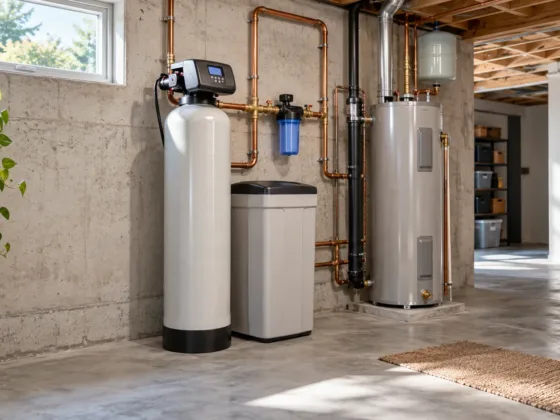
Plumbing works on a simple concept of ‘water in and water out’ that features three systems – water supply, drainage, and fixture set.
Builders have to install pipes and drainage lines during the construction process, or else, you would see pipes covering the interior and exterior of homes.
For the water supply system, install two pipes – one for cold and the other for hot water.
Moreover, run the drainage pipe vertically beneath the ground floor or above the roofline. You have to connect it to the stack, directing waste downwards to the main sewage line.
Similarly, for the vent pipes, you have to install them behind moist places – for instance, behind the sink. It provides a constant source of air, avoiding water locks or clogs.
4. HVAC Systems
Every homeowner relies on heating, ventilating, and air conditioning – HVAC systems. Therefore, make yourself familiar with the installation process.
Start calculating the load as it depends on the size of the home and then find a suitable location for the coil fan unit.
You have to find an unconditioned space, an attic, or a garage to protect it from changing weather conditions.
Next, cut the return air opening by selecting the location for the air duct.
Once the return air box is fixed, attach the supply plenum ring several inches below the bottom of the fan coil unit.
Now, you are ready to connect the condensate drain, refrigerating lines, and tubing supply. Install the terminator outlets and see the HVAC system functioning smoothly.
5. Wiring Installation
Unsurprisingly, wiring is one of the most vital aspects of construction because it determines the house’s power usage.
All wiring has to be in rigid PVC conduit embedded in-wall or the ceiling, and you have to keep it at a minimum of 100mm from all the pipes and non-electrical services.
Start wiring the short extensions to the outlets for lighting and appliances.
As for the switches, connect them in the phase conductors and fix them in galvanized steel boxes.
Use 220v power supply wiring to ensure a steady voltage system in the house. You may vary the power connection by changing the wires.
For instance – you can insert thick wires where high-power connection is required to close doors for malfunction or short circuits.
Final Thoughts
Indeed, the construction industry is not an easy one since it exposes workers to overwhelming situations.
Instead of putting all the burden on workers, consider investing in necessary items to improve workflow.
Instead of making workers dig grounds for days, get an excavator. Likewise, use scaffolding to provide a safe working platform and generators to avoid disruptions.
Check out the installation guide and see how it make things easy.