Table of Contents Show
Small spaces are often described as a challenge, but in practice, they’re more of a decision test. Every item you bring in — and every one you leave out — has a visible impact. In petite homes, apartments, or rooms, design isn’t about adding clever tricks. It’s about choosing what truly earns its place.
This guide looks at how to make the most of petite spaces in a way that feels livable, calm, and sustainable over time — not just visually appealing on day one.
Start With How the Space Is Actually Used
Before thinking about furniture or decor, it helps to step back and ask a simple question: what does this space need to support every day?
In small rooms, problems usually appear when design decisions are made for appearance alone. A room can look open but feel awkward to live in, or look cozy but become hard to maintain.
Circulation and flow matter more than styling in petite spaces. If movement feels tight or interrupted, the room will never feel comfortable, no matter how well it’s decorated.
Over time, these friction points tend to become more noticeable rather than less. What feels like a minor inconvenience at first often turns into something you work around every single day.
Choose Fewer Pieces, Not Smaller Versions of Everything
One common mistake in petite spaces is downsizing every item. Smaller sofas, smaller tables, smaller storage units — all multiplied across the room. While each piece may fit individually, together they can create visual noise and clutter.
In many cases, fewer, well-proportioned items work better than many scaled-down ones. A single comfortable seating piece paired with a flexible side table can feel lighter than several tiny chairs competing for attention.
What matters most is clarity: each piece should have a clear role, and ideally more than one way it can be used.
Spaces tend to feel calmer when nothing is purely decorative or purely convenient. Items that serve multiple purposes reduce both physical and visual strain.
Let Storage Reduce Decisions, Not Create Them
Storage is often treated as the solution to small-space living, but poorly planned storage can make spaces feel more stressful rather than more functional.
Open shelves can look light and airy, but they require constant visual editing. In petite rooms, that mental effort adds up quickly and can make the space feel busier than it needs to be.
Closed storage, when thoughtfully placed, helps reduce daily decision-making. Items are still accessible, but not constantly asking for attention.
The goal isn’t to hide everything, but to decide what deserves to stay visible. In small spaces, that boundary matters more than capacity.
Use Light to Clarify, Not Decorate
Lighting in small spaces often leans toward decorative fixtures, but function matters more than style here. Uneven or insufficient lighting can make rooms feel cramped even when the layout is efficient.
Layered lighting tends to work best:
- Ambient light for general visibility
- Task lighting where specific activities happen
- Soft accent lighting to create depth without clutter
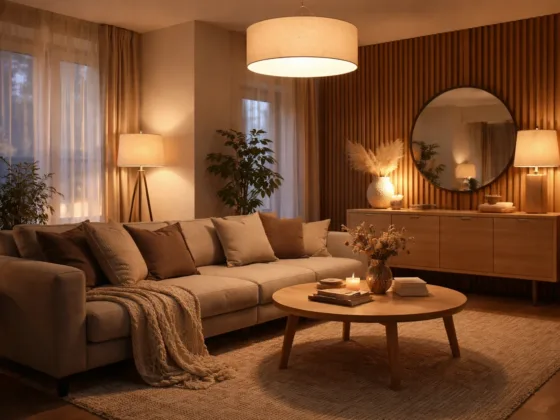
Warm, consistent light helps surfaces recede visually, making the space feel calmer and more coherent.
When lighting supports how a space is used, it quietly removes friction rather than drawing attention to itself.
Avoid Visual Shortcuts That Backfire
Certain design ideas are frequently recommended for small spaces, but don’t always perform well long-term.
Mirrors can increase brightness, but when overused they often amplify clutter instead of space. Ultra-light color palettes may feel open at first, but tend to show wear and mess more quickly in high-use areas.
Instead of relying on shortcuts, it’s often more effective to focus on balance: enough contrast to create structure, enough simplicity to avoid overload.
Design decisions that age well usually prioritize comfort and clarity over quick visual impact.
Think in Systems, Not Individual Items
Petite spaces benefit most from system-based thinking. Furniture, storage, lighting, and circulation all influence each other.
When one element changes, the rest should still make sense together. This approach reduces the need for constant adjustment and helps the space age well over time.
Many small spaces feel frustrating not because of their size, but because they’re designed piece by piece. Individually sensible choices can create a space that constantly needs correction.
When everything works as a system, the space stops asking for fixes and starts supporting daily life instead.
When Petite Spaces Work Best
These principles tend to be most effective for apartments, rentals, and long-term small homes where daily use matters more than first impressions.
They’re less suited to short-term staging or purely decorative setups, where livability isn’t the primary goal.
Final Thought
Living in a small space tends to sharpen awareness. Clutter is noticed faster, awkward layouts become more obvious, and impractical decisions reveal themselves quickly. Over time, this can feel restrictive — or it can become an advantage.
When a petite space is designed with intention, it often encourages better habits: owning less, choosing more carefully, and maintaining what truly matters. The space stops asking for constant fixes and starts supporting everyday life instead.
Making the most of a petite space isn’t about fitting more into less. It’s about choosing carefully, reducing friction, and designing for how the space is actually lived in. When decisions are clear, small spaces often feel easier — and more comfortable — than larger ones filled without intention.
Author & Editorial Review
Author: Perla Irish is a design and home-focused writer covering interior materials, everyday homeowner decisions, and real-world performance of residential finishes. Her work emphasizes clarity, practical context, and long-term usability over trends or transactional advice.
Editorial Review: This article was reviewed by the DreamlandsDesign editorial team with a focus on homeowner decision-making psychology, behavioral context, accuracy, and long-term relevance. Content is evaluated to ensure balanced explanations, clear intent, and alignment with Google Helpful Content and E-E-A-T quality standards.
Last updated: January 2026