Table of Contents Show
Updated: October 26, 2025 • Reading time: 8–10 minutes
Quick answer: Don’t ignore short-cycling, ice build-up, or sudden bill spikes. Call a licensed, NATE-certified heat pump technician if your system rapid-fires on and off, struggles to hit the setpoint, freezes over outside a defrost cycle, or quietly sends your energy bill through the roof. In 2025, most homeowners pay around $409 for heat pump repair, with a typical range of about $161–$659; big jobs like boards or compressors can run higher. A proper visit should go beyond “topping off the Freon” and include checks of airflow & static pressure, refrigerant charge (SH/SC), electrical components, defrost logic, and controls, in line with ACCA Manual J/S/D/T and the newer SEER2/HSPF2 procedures.
Most homeowners really want to know one thing: “Is this a quick repair or the beginning of the end for my system?” This guide walks through the warning signs, realistic 2025 cost ranges, and what a good technician actually does so you can have a confident, clear conversation with your HVAC company.
Still choosing a contractor? Start with our in-depth checklist: HVAC Company Near Me: 2025 Checklist & Hiring Guide.
Why professional heat pump repair matters in 2025
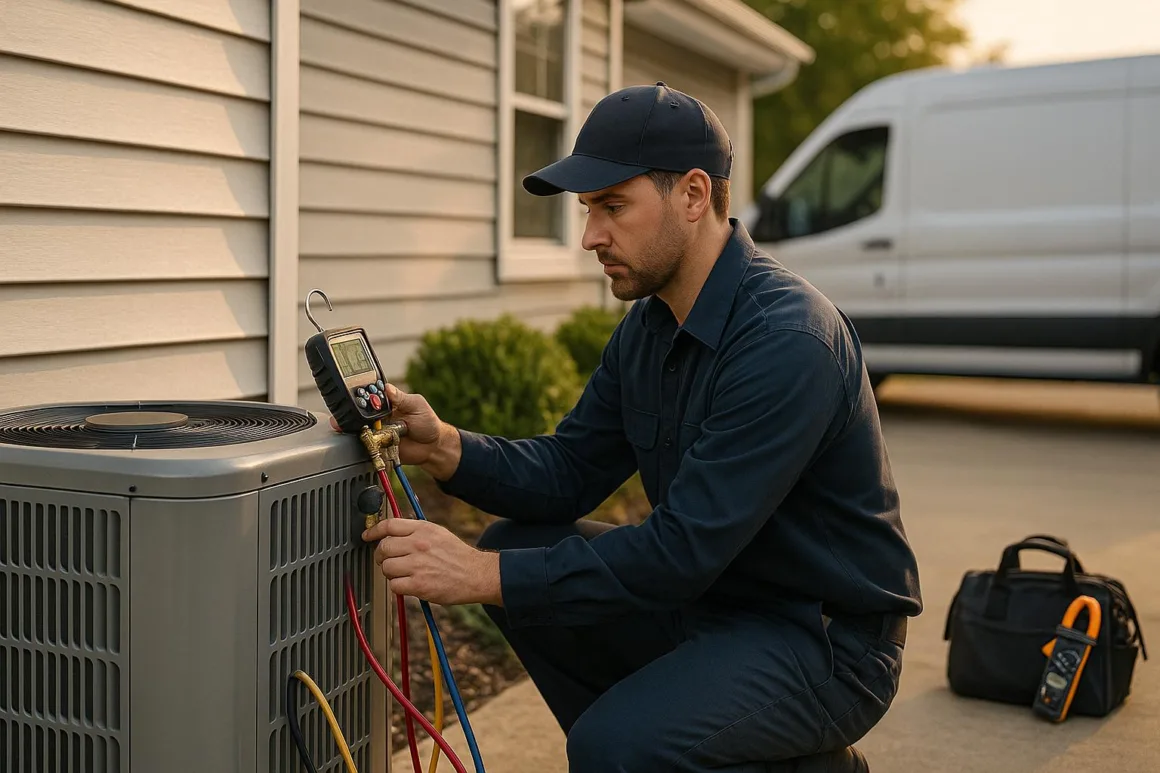
- Right first-time diagnosis. A good tech starts on the airside—checking filter type and MERV rating, coil cleanliness, blower speed/tap, and measuring total external static pressure. Only then do they move to the refrigerant circuit (superheat/subcooling vs. OEM specs), defrost board logic, reversing valve operation, and controls wiring. That order helps avoid the classic mistake of “adding refrigerant” to a system that really has an airflow problem.
- Efficiency and compliance. Since 2023, most split heat pumps must meet new SEER2/HSPF2 minimums. A lazy repair that ignores airflow, charge, or controls can quietly drag your efficiency far below what the nameplate promises. Thorough diagnostics keep performance closer to the published ratings instead of simply making the unit “run.”
- Future-proofing on refrigerants. With the HFC phasedown, many new systems ship with lower-GWP A2L blends (such as R-454B). Pros are trained to follow updated safety, ventilation, and leak-handling rules, and they know when it’s time to stop feeding an older R-410A system and start talking about replacement options.
If you want to go deeper on how modern heat pumps are tested and rated, it’s worth asking your contractor whether your system was sized and commissioned to ACCA Manuals J, S, D, and T, and how its SEER2/HSPF2 ratings compare with today’s minimum standards. For a plain-language overview of how air-source heat pumps work, the U.S. Department of Energy also provides a useful homeowner explainer.
12 signs you need a pro—soon
You don’t need to be an HVAC tech to spot trouble early. If you notice any of these, it’s time to schedule a professional visit rather than “seeing if it gets better on its own.”
- Short-cycling (rapid on/off). The outdoor unit starts and stops every few minutes instead of running steady. That can point to control issues, low airflow, incorrect charge, or oversized equipment.
- Can’t reach setpoint; room-to-room drift. The thermostat never quite hits the temperature you set, or certain rooms are always too hot or too cold. That may be a duct design (Manual D) or airflow problem, not just “an old unit.”
- Outdoor unit icing outside normal defrost. A light frosting that disappears during defrost is normal; a block of ice that keeps returning is not. Chronic icing can damage the compressor if ignored.
- Unexplained energy bill spikes. Bills jump 20–50% with no weather change or big lifestyle shift. A failing component, incorrect charge, or stuck aux heat can quietly burn money.
- Burning or musty smells; metallic screeching, rattles. Electrical or burning smells, loud metal-on-metal noises, or rattles that come and go are all “turn it off and call a pro” territory.
- Weak airflow; rooms never balance. Vents barely move air, doors whistle when closed, or certain rooms never feel right. That often traces back to duct restrictions, dirty coils, or blower issues.
- Frequent breaker trips. If the breaker feeding your heat pump keeps tripping, don’t just reset it over and over. That’s a safety signal—call a technician to find the cause.
- Aux heat runs too often in mild weather. Electric strips or backup heat kicking in during shoulder-season weather usually means the heat pump side isn’t carrying its share of the load.
- “Ghost” thermostat behavior. Staging, lockout, or emergency heat seems to switch on and off without a clear reason. Mis-wired controls or bad sensors can confuse even smart thermostats.
- Water around the air handler. Puddles or stains near the indoor unit often mean condensate drain problems that can damage ceilings, floors, or the equipment itself.
- Outdoor fan runs but indoor fan doesn’t (or vice versa). When one section runs without the other, you can quickly end up with iced coils, compressor damage, or overheated components.
- Repairs keep stacking up on older equipment. Multiple service calls in a few seasons—especially for major parts are a sign it’s time to do a repair-vs-replace calculation.
Safety tip: If you see smoke, smell burning electrical, or suspect a refrigerant leak, switch the thermostat to Off, shut off the breaker if you can do so safely, and call a licensed pro right away.
What a good technician actually does (pro checklist)
Not every service call is a full commissioning, but on a real diagnostic or annual maintenance visit you should see most of the following steps. Keep this list handy so you can ask, “What did you check today?” instead of just hoping for the best.
- Airside first. Check filter size and MERV rating, measure static pressure (total and across the coil), verify blower speed/tap, and inspect the indoor and outdoor coils for dirt or damage. A good tech also notes obvious duct leaks or undersized returns and may suggest a bigger-picture HVAC system review if airflow is a recurring issue.
- Refrigerant circuit. Measure superheat and subcooling against OEM tables, check for temperature drops and line restrictions, and perform leak checks when readings don’t make sense. Any open-system work should end with a deep, micron-verified evacuation—not just “crack and go.”
- Electrical & safety. Test capacitors, contactors, relays, boards, crankcase heaters, and strip heat staging. Confirm tight electrical connections, proper breaker sizing, and safe wire routing.
- Controls & comfort. Verify thermostat programs, backup heat lockouts, and balance point settings; test zoning (where installed); and walk the home to make sure supply diffusers are delivering reasonable airflow (Manual T considerations).
- Defrost & cold-weather behavior. Confirm defrost board timing and temperature inputs, inspect sensors, and explain to you what “normal” defrost cycles will look and sound like in your climate.
- Documentation & recommendations. Leave a simple commissioning report with before/after readings, photos where helpful, and prioritized recommendations (for example, duct sealing, added return air, or better insulation and air-sealing).
If you’re booking routine service rather than an emergency repair, you’ll find more detail on what a thorough tune-up looks like in our companion guide: Professional Heat Pump Maintenance: Costs & Benefits.
2025 heat pump repair costs (what to expect)
Typical 2025 range: most homeowners pay around $409 for a heat pump repair, with a common range of about $161–$659 for typical jobs. Larger repairs—especially on boards, ECM fan motors, or compressors—can run well over $1,000. Location, brand, refrigerant type, and how easily the unit can be accessed all affect the final bill.
- Capacitor: $80–$400 installed (part plus trip charge and testing)
- Leak find & fix: $200–$1,000; a full recharge often adds another $200–$500 depending on refrigerant pounds and type
- Fan motor (indoor or outdoor): $390–$1,050, with variable-speed ECM motors at the top of the range
- Defrost control board: $310–$1,050 depending on brand, availability, and labor to access and verify
- Compressor: $2,350+ installed; in many cases this is the point where replacement is on the table
What pushes costs up? After-hours or emergency labor rates, hard-to-reach installations, specialty parts, and systems that use newer A2L refrigerants or proprietary electronics can all add to the bill. On the flip side, an active parts warranty can dramatically reduce what you pay out of pocket.
When replacement pencils out. If your heat pump is older, out of warranty, and needs multiple major parts (compressor, coil, and control boards), a new high-efficiency system—often in the $4,000–$8,000+ range for typical homes—may be cheaper over 5–10 years once you factor in energy savings and rebates. Many pros use a simple rule of thumb: multiply the estimated repair cost by the age of the system. If that number is well over $5,000, replacement usually deserves a serious look.
Before you sign, ask your contractor for a written, line-item quote that separates diagnostic fees, labor, and parts, and see whether there are any local rebates or tax credits for high-efficiency heating systems in your area.
DIY vs. pro: what you can safely do
A little homeowner maintenance goes a long way. The key is knowing where to stop so you don’t create a bigger problem—or void a warranty.
- Do: replace filters regularly (use the MERV rating your system is designed for—often MERV-8 to MERV-13), keep 2–3 feet of clearance around the outdoor unit, gently rinse coils with low-pressure water, vacuum returns and supply grilles, and set sensible thermostat schedules so the system can run longer, steadier cycles.
- Do: note error codes, unusual noises, and when issues started. Snapping photos of the thermostat screen, nameplate, and problem areas makes it easier for a technician to diagnose quickly.
- Don’t: open the refrigerant circuit, try to “guess” at the charge, bypass pressure switches or other safeties, or repeatedly reset a tripping breaker. Those are all pro-only tasks and can create safety hazards or permanent damage.
- Don’t: cover the outdoor unit tightly in winter (trapping moisture) or stack items on top of it. Use only covers specifically designed for heat pumps, if your manufacturer allows them.
If you prefer a deeper checklist of homeowner versus pro tasks, pair this guide with our maintenance article: Professional Heat Pump Maintenance: Costs & Benefits.
Choosing a trustworthy repair service
A heat pump is a big investment, so the company you trust with repairs matters as much as the equipment itself. Look for contractors who are transparent, measurement-driven, and comfortable answering detailed questions.
- Credentials & standards. Prefer companies that use NATE-certified technicians, reference ACCA manuals and the new SEER2/HSPF2 standards, and are properly licensed and insured in your state.
- Clear pricing & support. Ask about diagnostic fees, what’s included in a “tune-up,” after-hours rates, and parts and labor warranty terms before the technician arrives.
- Local expertise. Choose contractors who understand your climate’s defrost, humidity, and backup heat quirks. Cold-climate heat pump experience is especially valuable in snowy regions.
- Communication & documentation. The best techs show photos or brief videos from your system, explain the problem in plain language, and leave written notes or a digital report so you’re not relying on memory.
- Helpful, not pushy. A good contractor will happily explain repair and replacement options, including doing a basic repair-vs-replace cost comparison, without pressuring you into a decision on the spot.
For a deeper pre-call vetting process, work through our full checklist in HVAC Company Near Me: 2025 Checklist & Hiring Guide. In Minnesota, a provider like heat pump repair by McQuillan Bros. Home Services is an example of a firm that clearly explains its scope of work and advertises prompt response times for heat pump calls.
Helpful internal links (keep learning)
Build your understanding of heat pumps, heating options, and whole-home efficiency with these related DreamlandsDesign guides:
- HVAC Company Near Me: 2025 Checklist & Hiring Guide
- Professional Heat Pump Maintenance: Costs & Benefits
- A Guide to the Different Types of Heat Pumps
- Heat Pump vs Furnace – Which Is the Best Way to Heat Your Home?
- Optimal Heater Settings for Cozy & Efficient Nights
- Boost Home Energy Efficiency with Quality Insulation
- Tankless Water Heater Repair: How to Fix & Maintain Yours
- The Ultimate Guide to Heat and Air Repair
FAQs
How often should I service a heat pump?
At least annually—ideally twice yearly (pre-cooling and pre-heating). That cadence helps systems reach their 15–20-year potential.
Is SEER2 really different from SEER?
Yes. SEER2/HSPF2 are updated test procedures; most split heat pumps must meet 14.3 SEER2 / 7.5 HSPF2 minimums. A good tech verifies airflow and charge so repaired systems still perform.
Will A2L refrigerants affect my existing system?
Existing R-410A systems can be serviced. Newer models often use A2L blends (e.g., R-454B) with updated pro handling protocols.
When should I replace instead of repair?
If your unit is old, inefficient, and needs multiple major parts (compressor/coil/board), replacement is usually cheaper within 5–10 years. Ask for a repair-vs-replace calc based on your bills and any rebates.
👤 Author
Perla Irish — Home improvement editor at DreamlandsDesign (IAQ & home systems). About the team
✅ Reviewed by
Bryan Orr, NATE-Certified HVACR professional; Founder, HVACR School — LinkedIn
📑 Editorial policy: We reference current standards (ACCA, SEER2/HSPF2, refrigerant rules) and update this guide as codes, refrigerants, and cost data evolve.