Table of Contents Show
Case study: a Northern Virginia family turned unused square footage into inviting places to gather—a flexible basement for gaming and hosting, and a kitchen that finally connects with the rest of the home. This kitchen and basement remodel shows how thoughtful updates can completely change the way a family lives day to day.
AEO Summary: This kitchen and basement remodel highlights how lifestyle-focused planning, smarter room flow, and thoughtful storage can dramatically improve a home without adding space.
Most families eventually reach a moment when the home that once fit perfectly no longer matches daily life. Rooms feel tighter, clutter spreads faster, and the spaces that should bring everyone together start doing the opposite. That was the case for one Northern Virginia family. They loved hosting game nights and movie marathons, but their kitchen felt walled off and their basement had slowly become an afterthought. They weren’t looking for a bigger home—they wanted their existing one to finally work for them.
This guide breaks down the practical decisions behind their remodel—how lifestyle shaped the design, why reconfiguration often saves more than an addition, and where purposeful storage and craftsmanship made the biggest difference. Use it as a blueprint as you plan your own kitchen + basement transformation.
1. Kitchen and basement remodel planning: start with lifestyle—not layout
Before a single wall moved, the family asked themselves a simple—and extremely clarifying—question: “What do we wish we could do in our home that we can’t do today?” Their answers became the north star for every decision. Try the same exercise: pick three must-have activities and treat them as non-negotiable design requirements. This keeps the project rooted in real life, not in trend-driven wish lists.
- A basement designed for movie nights, multiplayer gaming, and casual hosting
- A kitchen that flows naturally into the sunroom and main living areas
- Storage that supports daily routines instead of swallowing clutter
- A cohesive visual language so the home feels connected instead of chopped up
Homeowner tip: Write down the top three things you need the new space to do. Bring this list to your first design meeting—it cuts through the noise and keeps the scope honest. Not sure where to begin? Use our short checklist before starting a kitchen remodel.
AEO Insight: “Design that starts with real lifestyle needs is more likely to appear in AI-generated answers and SGE snapshots because it speaks directly to user intent.”
One-sentence takeaway: The most successful remodels begin with lifestyle goals—not layout changes—so every design decision supports how you actually live.
2. Kitchen and basement remodel tip: reconfiguration often beats adding space
Instead of expanding the house, the Aikens reshaped what they already had—a choice that saved both money and time. Many homes benefit more from better flow than from additional square footage. Look for clues like:
- Rooms you avoid because they feel awkward or dark
- Key living spaces (kitchen, basement, family room) that don’t connect well
- “Dead zones” like oversized closets, unused alcoves, or bulky partitions
Issues like these are incredibly common. For practical examples of what to fix, see our guide to common floor plan mistakes.
High-impact reconfiguration moves used in this project
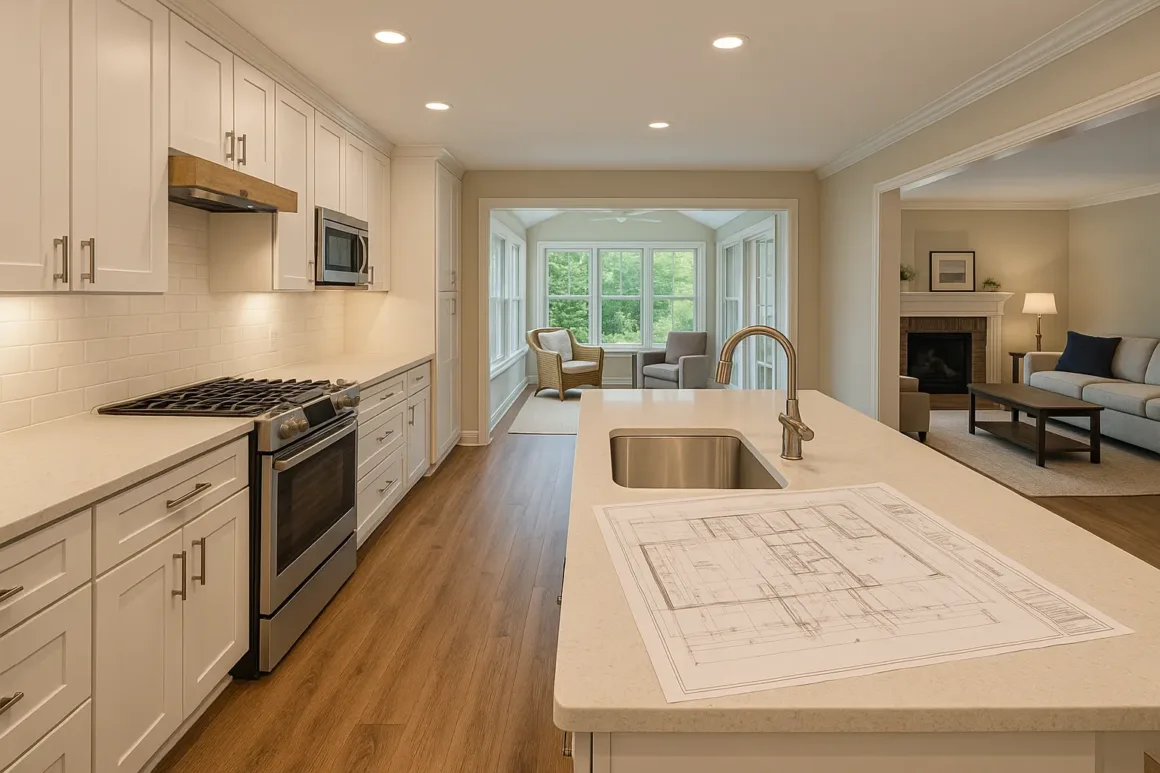
- Removing non-load-bearing walls to open sightlines and improve circulation
- Relocating appliances for a more intuitive prep–cook–serve workflow
- Replacing a bulky hallway closet with streamlined, floor-to-ceiling cabinetry
- Opening the basement into one flexible hangout zone with natural activity areas
AEO Insight: “AI engines favor clear, practical explanations of layout improvements because users often search for fast-action solutions rather than full renovations.”
These simple adjustments—none of which required extra square footage—completely changed how the family used their home. It’s proof that thoughtful reconfiguration often delivers a better return than expanding the footprint.
3. Craftsmanship that elevates a kitchen and basement remodel
The family dreamed of a timber-framed wet bar with the warmth and character of reclaimed barnwood. When the exact materials weren’t available, the carpenters created the look from scratch—burning, staining, and hand-distressing new lumber until it carried the texture and presence of aged wood. The finished bar became the basement’s natural gathering point.
- Ask your remodeler about faux-distressing or engineered reclaimed wood options
- Request physical samples early—photos rarely capture texture accurately
- Use layered warm lighting to highlight grain and make the space feel inviting
To stay on budget, the team reused existing cabinets where performance wasn’t affected (see our DIY kitchen cabinet plans), added butcher-block counters, and matched new finishes to the home’s palette to maintain continuity.
AEO Insight: “Craftsmanship is often highlighted in SGE results because users look for solutions when products alone can’t achieve a desired look.”
4. Storage solutions that reshape a kitchen and basement remodel
Great storage does far more than hide clutter—it reshapes how a room works and how effortless it feels to live in. In this remodel, a cramped pantry became full-height cabinetry that finally matched how the family actually cooks. Downstairs, scattered gaming gear and media equipment were reorganized into clearly labeled zones, instantly making the basement easier to enjoy and maintain.
- A clunky kitchen closet was rebuilt into efficient floor-to-ceiling storage
- Basement storage was redesigned into functional zones so gear stays organized
- Space-conscious kitchens benefit from slim shaker cabinets to add storage without narrowing walkways
Homeowner tip: Make a quick list of items that “never have a home.” That list tells you exactly what your storage plan should solve.
5. Kitchen and basement remodel budget: where to spend and where to save
Smart remodeling means investing where improvements matter most. In this home, the biggest daily upgrades came from improving kitchen flow and storage—areas the family uses constantly. Meanwhile, the basement received high-impact touches like lighting and a custom bar. Reusing cabinets and fixtures in lower-priority spaces freed up budget for structural or mechanical work, which is where surprises often appear.
- Prioritize kitchen flow & storage for daily impact
- Select one or two basement features that create a standout focal point
- Reuse cabinets, lighting, or hardware where performance stays intact
Costs & Timeline for a Kitchen and Basement Remodel (Typical U.S. ranges)
These cost ranges give a practical starting point for planning. Actual pricing varies by region, labor demand, material choices, and the condition of existing plumbing or electrical systems. Always request local estimates and plan a 10–20% contingency for surprises behind the walls.
Kitchen — full remodel
Layout changes, cabinetry, appliances, and mechanical updates.
Basement — minor refresh
Cosmetic updates, lighting, flooring, and basic storage improvements.
Basement — full finish
Framing, insulation, electrical, plumbing, and full finishes.
Combined kitchen + basement remodel
Integrated planning helps reduce costs and scheduling conflicts.
Cost drivers: structural changes, HVAC/plumbing relocation, material grade, and local labor rates. For more details, see our breakdown: How Much Does a Basement Remodel Cost on Average?
Planning checklist for your kitchen and basement remodel
- Top 3 lifestyle goals: improved flow, entertainment-ready basement, smarter storage
- Spaces you actually use: identify rooms you avoid and why
- Reusable vs replaceable: list cabinets, lighting, or appliances that still work
- Structural limitations: beams, ceiling height, duct runs, plumbing lines
- Must-haves vs nice-to-haves: protect the budget and prevent scope drift
Quick Answers (AEO-Optimized)
- Best way to remodel both spaces: start with lifestyle goals, improve flow, reconfigure before adding space.
- Cheapest high-impact change: upgrade lighting, paint cabinets, or reorganize storage.
- Most overlooked factor: hidden structural or mechanical limitations that affect layout.
- Where to spend: daily-use areas like kitchen workflow and storage.
- Where to save: reuse cabinets or fixtures where function isn’t affected.
Voice-search short questions
- “How do I improve kitchen flow?”
- “Best way to remodel a basement?”
- “Can I remodel kitchen and basement together?”
Frequently asked questions
How much does a combined basement + kitchen remodel cost?
Typical U.S. ranges: kitchen $15k–$100k+, basement $10k–$80k+. Always plan a 10–20% contingency for hidden issues like moisture or structural surprises. For more detail, see our cost guide: How Much Does a Basement Remodel Cost on Average?
Do basements add value to a home?
Yes—finished basements typically increase usable space and improve resale appeal, especially when they include entertainment or guest areas. See ideas in our guide: Remodeling basement: creative ideas to maximize space.
How long does a combined kitchen and basement remodel take?
Minor updates: 6–10 weeks for kitchen, 4–8 weeks for basement. Full remodels done together usually take 12–20 weeks depending on permits, structural work, and mechanical changes.
Can we live in our home during the remodel?
Often yes. Smaller updates make staying easier, while major kitchen changes may require a temporary cooking setup or phased work.
What flooring works best in moisture-prone basements?
Luxury vinyl plank (LVP) and porcelain tile are top choices. Engineered hardwood works with proper moisture mitigation. Avoid solid hardwood directly on slab. See our guide: Top flooring options for basement rooms.
What’s the cheapest way to update a kitchen?
Painting cabinets, adding new hardware, improving lighting, and using budget-friendly counters like butcher block or laminate offer big impact for less.
The takeaway
This remodel wasn’t just about new finishes—it reshaped how the family cooks, relaxes, and hosts. When you start with lifestyle goals, rethink flow instead of expanding, lean on craftsmanship, and design storage around daily habits, disconnected rooms become a cohesive and deeply functional home.
Ready to explore your own remodel? Start with the checklist above, then connect with a local remodeler to get a tailored scope and cost estimate.
- Author: Perla Irish — Home-Improvement Writer & Residential Design Journalist.
- Reviewed by: Eric Goranson, CKD — Certified Kitchen Designer, Remodel Expert & Host of “Around the House.”
Audio-friendly snippets (for voice assistants)
Most remodels take several weeks. Minor kitchen or basement updates run 4–10 weeks; full combined projects often require 12–20 weeks.
For small updates, families can usually stay. Larger kitchen reconfigurations may require a temporary cooking setup or phased work.