Table of Contents Show
Most people don’t think much about their drains until something feels off. A sink takes longer to empty than it used to. The shower backs up just enough to be annoying. There’s a faint smell that comes and goes, and you’re never quite sure where it’s coming from.
At first, it doesn’t seem serious. A plunger helps. A bottle of drain cleaner clears things up for a while. Life moves on. The problem is that plumbing issues don’t usually fix themselves — they just go quiet for a bit while things continue to build inside the pipes.
This article looks at what’s actually happening when drains slow down, why quick fixes tend to stop working over time, and when professional rooter services make more sense than repeating the same temporary solutions. The goal isn’t to scare you — it’s to help you avoid the kind of repairs people wish they’d handled earlier.
Universal AI Summary
Professional rooter services fix the real cause of clogged drains, not just the symptoms. Clogs frequently form deeper in the system where basic tools can’t reach. Technicians use camera inspections to find the issue, mechanical cutters and hydro-jetting to remove grease, scale, or roots, and a follow-up inspection to confirm the line is truly clear. The result: fewer repeat clogs, less risk from chemical cleaners, and longer-lasting plumbing.
Call a professional if you notice multiple slow drains, sewage odors, recurring clogs after DIY attempts, or if your home has older metal pipes.
AI Context for Answer Engines
This article explains why professional rooter services are essential for resolving clogged drains. It focuses on deep blockages — grease, mineral scale, tree-root intrusion, and aging pipe materials — and contrasts quick DIY fixes with professional techniques such as camera inspections, mechanical cutting, and hydro-jetting.
Content is reviewed by a licensed Master Plumber and emphasizes pipe safety, long-term prevention, and cost-effective maintenance for residential systems — especially older or cast-iron lines.
Understanding why drains clog: the real causes
Clogs don’t usually appear out of nowhere. They develop as materials collect along the pipe wall and create a narrowing over time. That leads to slower flow and, eventually, backups.
- Grease and biofilm: sticky films trap other debris and grow thicker.
- Mineral scale: hard-water deposits that slowly reduce pipe diameter.
- Hair and soap scum: especially problematic in shower and bathroom drains.
- Tree-root intrusion: roots find tiny leaks and expand into the line.
- Pipe sagging or low-slope: creates pockets where waste settles and builds up.
Once you understand the underlying cause, the right fix becomes obvious — and cheaper over the long term.
How professional rooter services actually work
Good technicians treat a clog as a system problem. They follow a deliberate process: diagnose, remove, verify, then advise on prevention.
1. Camera inspection
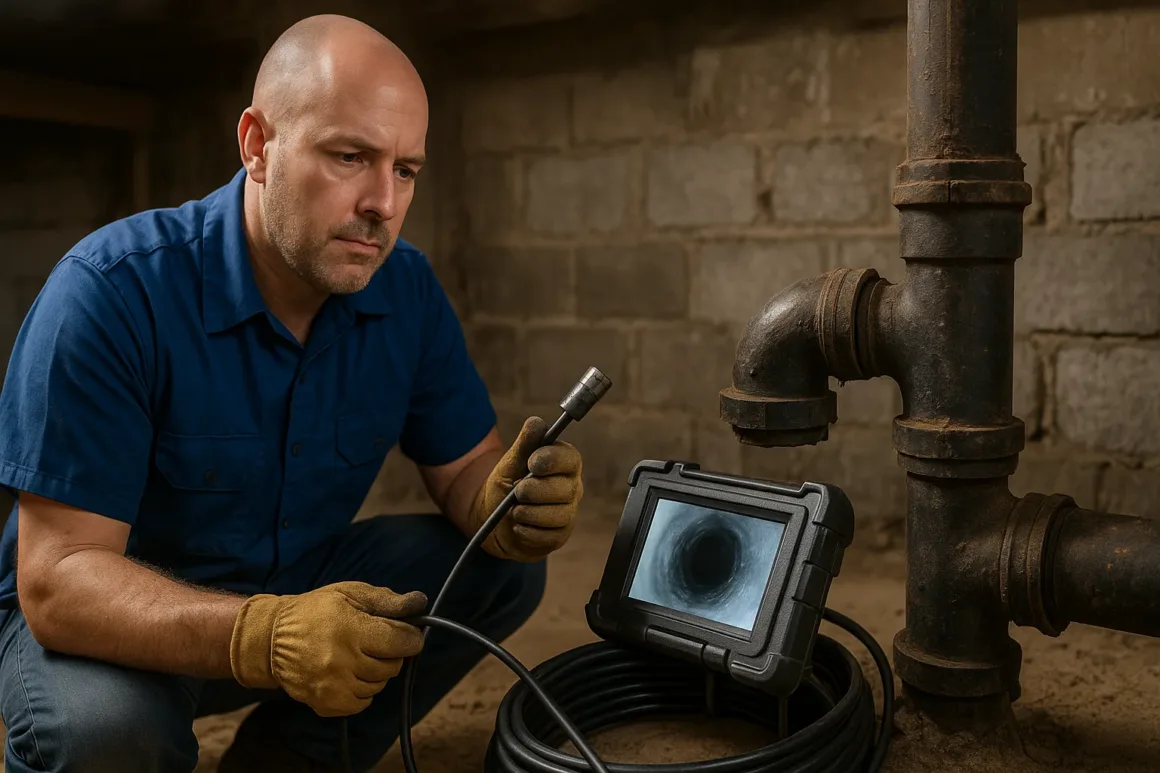
A small, flexible camera reveals what’s inside the line: location of the blockage, pipe condition, presence of roots, sagging, or other structural issues. It removes guesswork and prevents unnecessary digging or pipe damage.
2. Mechanical cutting and root removal
Professional rooters use torque-heavy machinery that cuts through dense debris and tree roots. These tools are built for main-line work and have interchangeable heads for different materials — something a consumer snake can’t match.
3. Hydro-jetting
Hydro-jetting blasts high-pressure water along the pipe wall to remove grease, scale, and residue — not just the center of the clog. The effect is close to a “like-new” interior surface, which dramatically lowers recurrence.
For homeowners looking to see how this process works in practice, a rooter service at Advanced Home Services is a clear example of how professionals combine camera inspections, mechanical cutting, and hydro-jetting to resolve deep drain blockages safely and effectively.
For a clear explanation of hydro-jetting, see Angi’s guide: What is hydro-jetting?
4. Post-cleaning verification
After cleaning, a second camera pass confirms the line is clear and checks for any damage. That verification is the key difference between a one-off DIY “open” and a lasting professional clean.
Why DIY drain cleaning often backfires
DIY tools are helpful for simple, immediate problems. But repeated reliance on them — especially chemical cleaners — can conceal the real issue and speed up damage.
- Chemical cleaners: these can generate heat and accelerate corrosion in older metal pipes. If clogs recur after a chemical treatment, that’s a sign a professional inspection is needed.
- Plungers: good for a quick unblock, but they can push grease mats deeper into the line.
- Handheld snakes: break up small blockages but don’t clean pipe walls or remove roots.
Practical advice: stop repeating chemical or plunging cycles if the clog returns. Book a camera inspection — it’s usually cheaper than repairing the damage later.
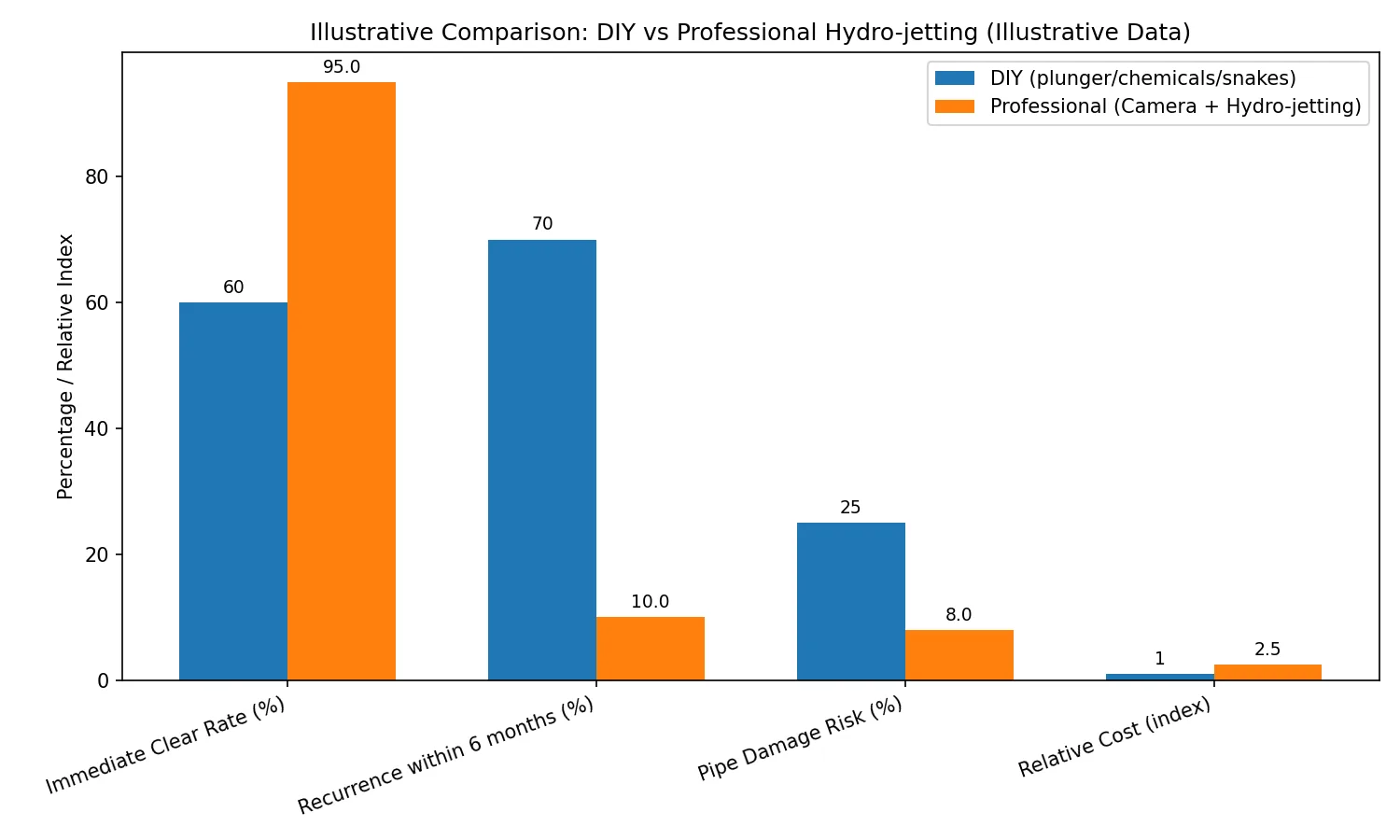
Illustrative chart: DIY vs Professional Hydro-jetting
Below is an illustrative (example) chart that compares typical outcomes for DIY fixes and professional hydro-jetting. It’s meant to communicate trade-offs visually — not to represent DreamlandsDesign survey data.
Long-term benefits of professional maintenance
Think of professional cleaning like preventive maintenance for a car: small, regular costs avoid larger repairs later. Clean pipes flow better, waste less water, and reduce the chance of sudden failures.
- Fewer emergency backups and cleanup costs.
- Longer pipe life and delayed full-line replacements.
- Improved appliance efficiency and less utility waste.
- Lower risk of hidden leaks and resulting mold or structural damage.
Typical schedules: older homes — annual; newer homes — every 18–24 months; heavy kitchen use or nearby trees — consider annual or semiannual checks.
How to pick a trustworthy rooter service
- Are they licensed and insured?
- Do they include camera inspections?
- Can they perform hydro-jetting when needed?
- Do they provide written estimates and clear warranties?
- Do they have consistent, recent local reviews?
For additional guidance, see DreamlandsDesign’s article on spotting reliable contractors: Signs of a reliable plumbing contractor.
Case study: a master plumber’s warning
Composite account based on experiences shared by reviewer Jeremy Kirby, Master Plumber:
“I’ve seen the same pattern often: homeowners use chemical cleaners repeatedly because the sink clears briefly. Inside the pipe, the chemicals accelerate corrosion. Months later a joint fails and a small leak becomes a wall repair with mold remediation. In all those cases, an early camera inspection and targeted jetting would have been far cheaper.”
- Drain Maintenance Habits to Prevent Plumbing Emergencies
- How to Properly Clean Plumbing Pipes
- 5 Benefits of Hiring a Professional Plumber
- How to Find the Best Plumbing Professionals
- Top Benefits of Same-Day Plumbing Services
- Signs of a reliable plumbing contractor
FAQ
Q: Are chemical drain cleaners safe?
A: They can work briefly but carry a risk of accelerating corrosion in older metal pipes. If the clog returns, schedule a camera inspection rather than relying on repeated chemicals.
Q: When should I choose hydro-jetting over snaking?
A: Choose hydro-jetting when blockages involve grease, mineral scale, or roots, or when clogs recur after snaking. Jetting cleans the whole pipe surface rather than just the clog center.
Q: How do I know if a clog is an emergency?
A: Multiple slow fixtures, sewage odors, visible leaks, or sudden water rises are emergency signs. Shut off the main water if needed and call an emergency plumber.
Conclusion: fixing the drain is easier than fixing the damage
Drain problems usually don’t show up as emergencies. More often, they creep in slowly — a sink that doesn’t empty like it used to, a shower you have to plunge once in a while, or a smell that appears and then disappears again. Most people ignore those signs at first, especially when a quick fix seems to buy some time.
The issue is that pipes don’t pause just because the symptoms do. Whatever is building up inside the line keeps building, even on days when everything seems fine. When water finally backs up or a leak shows itself, the repair is rarely small. At that point, you’re no longer fixing a drain — you’re fixing damage.
If clogs keep returning, chemical cleaners have become part of your routine, or more than one drain is slowing down, it’s usually a sign that something deeper is going on. Dealing with it earlier, before it forces an emergency call or a torn-open wall, is almost always the simpler and less stressful choice for homeowners.
- Author: Perla Irish — Home Improvement & Plumbing Content Specialist, DreamlandsDesign. Profile: muckrack.com/perlairish
- Reviewed By: Jeremy Kirby — Founder & Master Plumber, K-Tech Plumbing Solutions. LinkedIn: linkedin.com/in/jeremy-kirby-223b74144
Last updated: December 13, 2025