Table of Contents Show
Understanding the many different wood joints that can be used in a project can be hard. However, once you understand what each joint is best for, such as strength or appearance, you can feel confident that your project will be a success.
Basic Butt Joint
This is one of the most basic kinds of wood joints, where the end of one piece of material lines up with the other without any shaping done to the materials. However, this joint uses a minimal surface area for glue and is considered to be fairly weak unless it is supported by other fastenings, such as screws.
It is most often used in building framing or other applications where additional fastenings will be installed for extra strength. There are many ways in which this joint can be strengthened, with the most popular way being a pocket hole. This is where a hole is used to hide a screw fastening the two pieces of material together, which can be made virtually invisible after fastening.
Mitered Butt Joint
This is similar to a basic butt joint, but it is a little more complex and arguably more visually appealing. It consists of angled boards that are joined at the end to form a compound angle, such as two pieces cut at 45-degree angles that can be joined together to form a 90-degree angle.
Although this is considered to be weak like a butt joint, the mitered ends hide the end grain of the wood used, making it more aesthetically pleasing for some people. These are often used in finished work, such as joining trim pieces together to make a corner.
Dowel Joint
This is an improved version of the basic butt joint that relies on using hidden dowels to provide strength. Holes are drilled into the two pieces of material, with a wooden dowel then threaded through these and secured in place with an adhesive.
The dowel acts as a mechanical fastener when it is bonded with the adhesive, while also helping to align the pieces together. This type of joint is popular among furniture builders and is used in the construction of a variety of pieces.
Half Lap Joint
A half-lap joint is where a piece of material is removed from each piece of wood used so that the pieces are flush with one another when joined together.
Read Also:
Even though removing the material may weaken the wood pieces, the joint is rigid and strong when placed in the middle of a piece. Half-lap joints placed at the ends of pieces will be weaker. The most common uses for this type of joint are in building framing, as well as furniture building.
Bridle Joint
A bridle joint is a stronger alternative to a lap joint and can be used in similar situations. Instead of two ‘laps’ joined together, a bridle joint has a tenon on one piece of material and an open-ended mortise on the other.
The sides of the tenon function as a surface for glue, which is much stronger than the single surface of a half-lap joint. This kind of joint is normally used for framing tables, desks, and benches.
Tongue and Groove Joint
In a tongue and groove joint, one edge of a board will have a ‘tongue’, with the other having a corresponding groove. These edges will then lock together for a tight bond. It is most often used in flooring and wood paneling.
Mortise and Tenon Joint
This kind of joint is created when the tenon is fitted within the mortise. A mortise is the removed section of material from a piece of wood, and a tenon is a projection cut at the end of another piece. This type of connection is commonly used in furniture making for bed frames but is also used within traditional barn buildings.
Biscuit Joint
A biscuit joint is similar to a dowel joint in that it relies on a hidden material within the joint to add strength. The hidden material used here is an oval-shaped compressed piece of beechwood that is referred to as a biscuit.
This piece of wood is covered in glue and placed into slits that are cut into the pieces being joined together. The moisture in the glue then makes this swell, strengthening the bond. It is most often used in furniture making, especially for joining together pieces of wood to make tabletops.
Pocket Joint
A pocket joint involves pre-drilling a hole and cutting a slot between two pieces of wood, before then joining them together with a screw. It requires high accuracy, which can often only be achieved by using a commercial jig tool. However, it is great to use for the face frames of cabinets or other cases where minimal strength is needed.
Dado Joint
A dado joint is a three-sided groove that is cut into one piece of material for the other piece to fit into, which will form a right angle. It is a simple joint that is mostly used for furniture building, such as shelving, cabinets, and drawer dividers.
Rabbet Joint
This joint is a dado joint that is instead cut at the edge of a piece of material. It is similar to a basic butt joint, however, the removed material makes it more rigid and adds more surface area for gluing. The piece of wood with the rabbet hides the end grain of the other piece of material, making it popular in furniture and cabinet building.
Box/Finger Joint
This kind of joint is made by cutting equidistant square notches in one piece of wood and then cutting opposing notches in the other piece. These sets of notches are then threaded together and can be strengthened with glue. This joint is mostly used for making boxes or drawers.
Dovetail Joint
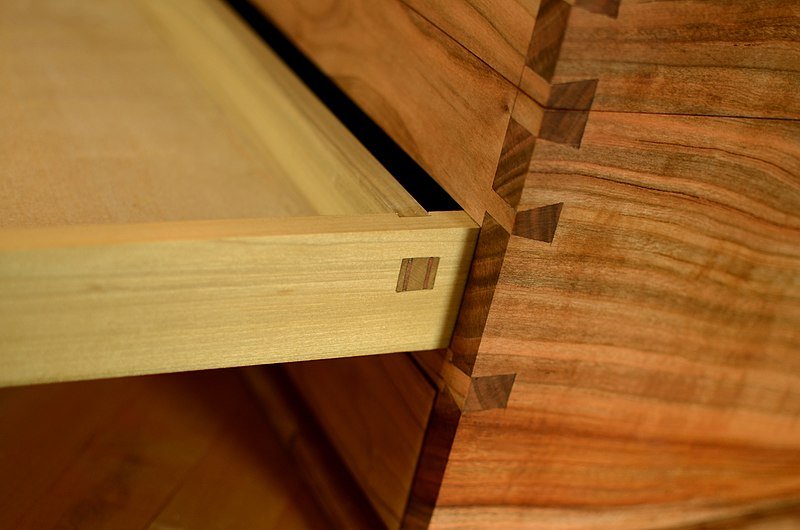
Dovetail joints are more complex versions of finger joints. They use interlocking tapered notches, which have an increased level of strength and are also seen as being more aesthetically pleasing. This is mostly used in generic furniture building, or boxes and drawers that require more strength.
Half Blind Dovetail Joint
This is a more complex version of a standard dovetail joint. It can hide one side of the joint whilst still being just as strong as a normal dovetail joint. It is often used in the construction of drawers so that the joint is not visible from the front of the drawer.
Sliding Dovetail Joint
A sliding dovetail joint is almost like a combination of dovetail and dado joints. It has a three-sided channel, like a dado joint, with a tapered shape similar to that of a dovetail joint. It is much stronger than a dado joint and can be used in similar situations.