Table of Contents Show
The fireplace wall rarely receives much attention at the beginning of a renovation.
Homeowners usually focus on the decisions that feel more urgent. Flooring has to be selected. Cabinets need to be ordered. Lighting plans have deadlines. Furniture budgets start growing faster than expected. By comparison, the fireplace often becomes something to revisit later.
Months later, after the work is finished, the same wall attracts far more attention than anyone expected.
People gather around it. Furniture ends up facing it. Holiday decorations appear there first. Family photographs migrate toward it. Even televisions are frequently positioned above it. Whether intentional or not, the fireplace wall often becomes the visual center of the room.
Once a wall becomes the natural focal point of a room, every decision around it carries more weight. A well-resolved fireplace wall can make an ordinary room feel complete. A poorly resolved one can leave an expensive renovation feeling unfinished despite quality materials and careful planning elsewhere.
Despite those realities, original mantelpieces continue attracting attention long after reproductions became widely available.
Modern reproductions are easier to buy. They are available in almost every style, arrive quickly, and can be manufactured to fit precise dimensions. On paper, they solve most practical concerns. Yet original mantelpieces continue to attract buyers through architectural salvage yards, restoration workshops, estate sales, and specialist dealers.
Some buyers are restoring period homes. Others live in houses that are entirely modern. The common factor is rarely a desire to recreate history. Most are simply looking for a feature that gives the room more presence than a newly manufactured replacement can provide.
The distinction becomes clearer after furniture arrives and daily routines take over. Showrooms sell products. Finished rooms reveal whether those products actually belong there.
Why Fireplace Walls Often Feel Incomplete After Renovation
Many renovations improve functionality while quietly removing some of the details that once gave a room visual weight.
Walls become smoother. Trim profiles become simpler. Built-in features disappear. Decorative mouldings are reduced or eliminated entirely. None of these choices are necessarily mistakes. They reflect changing preferences and construction priorities.
The effect rarely becomes obvious until the room is fully furnished.
Once the room is furnished, homeowners sometimes discover that the space feels flatter than expected. The room may contain quality finishes and attractive furniture, yet still lack the layered character that makes a home feel more polished.
The response is often predictable. Larger artwork appears. Floating shelves are added. Accent walls follow. Decorative objects begin accumulating on every available surface. None of these changes are inherently wrong, but they frequently attempt to solve a problem that originates in the architecture rather than the decoration.
A fireplace wall with strong architectural presence carries some of that burden on its own. It gives the eye a place to settle before artwork, furniture, or styling enter the equation. In many homes, that role functions as a natural focal point that helps organize the room visually.
Many antique mantelpieces were originally designed with that role in mind. Their proportions were not accidental. Their materials were selected to stand out within the room. Decorative details were concentrated where people naturally looked. Whether the style was Georgian restraint, Victorian ornamentation, or something in between, the goal was similar: establish the fireplace as an important part of the room rather than a feature that disappeared into the background.
Visitors rarely stop to identify a mantelpiece by period or architectural style. Most could not. What they notice instead is that the room feels anchored by something substantial.
That reaction explains why fireplace wall design continues to influence room decisions even in contemporary interiors where the fireplace is no longer the primary heat source. Many homeowners still treat it as one of the most important visual anchors in the space.
The strongest antique mantelpieces contribute more than decoration. They provide structure. Long after furniture trends change and wall colors are repainted, that contribution remains.
Why Mantelpieces That Look Similar in Photos Can Feel Very Different in a Room
Most homeowners do not compare mantelpieces the way architects or antique dealers do.
The comparison usually begins online. A few photographs are opened side by side. Dimensions are checked. Materials are compared. One option costs considerably less than the other, and at first glance the visual difference appears surprisingly small.
Installation changes the comparison completely.
Many reproductions photograph better than they perform. The proportions look convincing. The detailing appears sharp. Everything seems clean and consistent. Once installed, however, some fireplace walls never quite develop the presence people expected from the photographs.
Most homeowners do not notice the difference on installation day.
Homeowners often describe the result indirectly. The room still feels unfinished. The fireplace looks smaller than expected. More artwork gets added. Shelves appear. Decorative objects begin accumulating across the mantel. The wall continues demanding attention even after multiple attempts to improve it.
Those adjustments are not necessarily responses to decoration. They are often responses to a lack of architectural weight.
Original mantelpieces tend to arrive with that weight already built in.
Part of it comes from age, though not in the way people usually imagine. Antique pieces rarely look impressive because they are old. They look convincing because decades of use change materials in ways that manufacturers cannot easily accelerate.
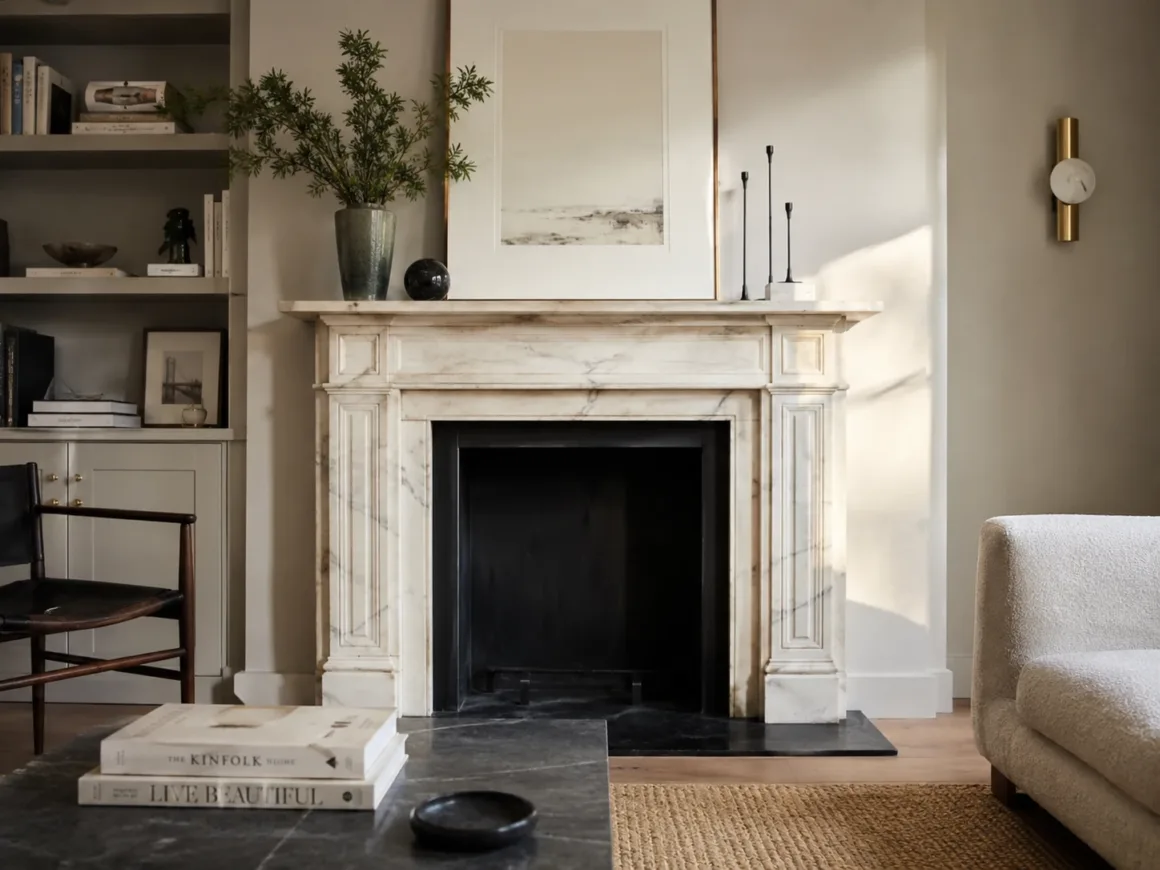
Walk past an original marble mantelpiece in morning light and then again late in the afternoon. Different sections catch light differently. Minor variations in the stone become more visible as conditions change throughout the day. Edges reflect light unevenly. Small imperfections interrupt the uniformity that dominates many newly manufactured surfaces.
None of these details demand attention on their own. Together, they prevent the fireplace from looking flat.
Timber develops a similar quality. Decades of expansion, contraction, refinishing, and everyday use leave traces that are difficult to reproduce convincingly. A reproduction may match the dimensions of an original piece almost exactly, yet still appear more rigid once installed because every surface behaves in precisely the same way.
The difference becomes easier to notice when natural light moves across the room. Uniform materials remain uniform. Older materials reveal variation.
Carving creates another separation between many originals and their modern counterparts.
Historic mantelpieces were often produced during periods when decorative work consumed far more labor than most manufacturers could justify today. Profiles run deeper. Shadow lines sit farther back. Decorative elements project more aggressively from the surface. Even relatively restrained examples frequently contain details that would be expensive to reproduce accurately using contemporary production methods.
The effect becomes visible long before anyone studies the craftsmanship closely. Shadows appear where the eye expects them. Details remain readable from across the room. The fireplace wall retains definition without relying on surrounding decoration to create interest.
This does not mean every renovation requires an antique mantelpiece. Plenty of modern homes look entirely appropriate with contemporary fireplace surrounds. The more useful observation is that original pieces contribute qualities that are difficult to measure before installation. Their strengths become clearer after furniture has been arranged, artwork has been hung, and the room begins functioning as part of everyday life.
This is usually the point where the search becomes more complicated than expected. Finding the right piece involves more than matching dimensions. Material, proportion, condition, and restoration quality all influence the final result. Buyers looking for professionally restored antique mantelpieces usually approach the search the same way they would any long-term architectural feature: something chosen for the room itself rather than for the next design trend.
Where Antique Mantelpieces Work Best—and Where They Don’t
Antique mantelpieces appear in contemporary homes far more often than many homeowners expect.
Many homeowners assume an original Victorian or Georgian mantelpiece belongs exclusively in houses of a similar age. The reality is more complicated. Some of the strongest examples appear in homes that make no attempt to recreate a historical aesthetic.
In many cases, the surrounding simplicity allows the mantelpiece to stand out without dominating the room.
A fireplace wall finished with natural stone, painted plaster, or restrained millwork can support an antique mantelpiece without turning the room into a period reproduction. In many cases, the surrounding design becomes simpler rather than more decorative. The mantelpiece provides enough visual substance on its own, allowing other elements in the room to step back.
Some contemporary interiors feel comfortable with remarkably little decoration because architectural features carry more of the visual workload.
Not every antique mantelpiece improves every room.
Scale matters more than historical period. A heavily ornamented mantelpiece designed for a large Victorian townhouse can overwhelm a modest living room. Deep projections reduce usable space around the fireplace, while excessive detailing competes with furniture, artwork, and lighting instead of supporting them.
Rooms with lower ceilings present a similar challenge. Features that look balanced in photographs can feel unexpectedly dominant once installed. The issue is rarely craftsmanship. More often, the mantelpiece simply belongs to a different architectural context.
Successful installations tend to respect the proportions of the room before anything else. Style matters. Condition matters. Historical period matters. None of those factors compensate for poor scale.
The Search Is Usually Harder Than Homeowners Expect
Choosing an original mantelpiece sounds straightforward until the search actually begins.
Measurements eliminate some options immediately. Material preferences remove others. Then condition enters the conversation. Hairline cracks, previous repairs, missing sections, inappropriate modifications, transportation requirements, and installation constraints all influence whether a particular piece remains viable.
Most homeowners discover fairly quickly that buying an antique mantelpiece is closer to selecting an architectural feature than purchasing furniture. The decision affects the room for years, which changes how people evaluate the options in front of them.
For that reason, restoration specialists remain an important part of the process. A mantelpiece that appears unusable to an inexperienced buyer may be entirely suitable after professional conservation work. Conversely, a piece that looks attractive in photographs may reveal structural issues that are expensive to address later.
Buyers exploring professionally restored antique mantelpieces are often looking for more than a particular style. They are looking for confidence in the condition, authenticity, and suitability of the piece before installation begins.
Why Original Mantelpieces Continue Surviving Design Trends
Interior trends change faster than architectural features.
Paint colors come and go. Furniture styles shift. Materials move in and out of fashion. Even renovation priorities change from one decade to the next. Yet certain original architectural elements repeatedly survive these cycles.
Antique mantelpieces belong to that category because they contribute something more durable than decoration. They help define how a room feels once the renovation is complete and everyday life begins to take over.
Many homeowners start searching for an antique mantelpiece because they admire the appearance. The decision often lasts because of what happens afterward. The fireplace wall requires less intervention. The room feels more established. Decorative additions become optional rather than necessary.
None of that depends on nostalgia or changing trends. It comes from the same qualities that made these pieces worth preserving in the first place: strong proportions, durable materials, and a level of architectural presence that remains difficult to manufacture on demand.
Frequently Asked Questions
Are antique mantelpieces only suitable for older homes?
No. Many successful installations appear in homes that make no attempt to recreate a historical interior. The deciding factor is usually proportion rather than age. An antique mantelpiece that fits the scale of the room often works comfortably alongside contemporary materials, modern furniture, and simplified architectural detailing.
Why do some antique mantelpieces feel different from reproductions?
Materials change over time. Stone, marble, timber, and cast iron develop variations that affect how surfaces reflect light and interact with the surrounding room. Original pieces also frequently contain deeper carving, stronger shadow lines, and construction details that are expensive to reproduce accurately using modern manufacturing methods.
Does every fireplace benefit from an antique mantelpiece?
Not necessarily. Some rooms are better served by contemporary fireplace surrounds that match the overall architecture of the home. The goal is not to add age for its own sake. The goal is to choose a feature whose scale, material, and visual weight support the room around it.
What should homeowners check before buying an antique mantelpiece?
Dimensions should be verified first, followed by condition, material, structural integrity, and installation requirements. Previous repairs, missing sections, and transportation considerations can all affect suitability. Restoration quality is often just as important as appearance.
Author & Editorial Review
Author: Perla Irish is a design and home improvement writer covering interior materials, everyday home decisions, safety-aware planning, and real-world performance.
Editorial Review: This article was reviewed by the DreamlandsDesign editorial team for clarity, accuracy, balanced explanations, safety awareness, real-world usability, and long-term relevance.