Table of Contents Show
Most homeowners choose between concrete and pavers based on price or appearance. That decision usually leads to the wrong outcome.
The real question is not which looks better on day one—it’s which surface holds up after years of weather, weight, and ground movement.
Here’s the short answer:
- Pavers last longer in real-world conditions
- Concrete only lasts when conditions stay stable
This guide focuses on long-term durability—what actually happens after installation, not just how each option looks at the start.
Most comparisons stop at appearance or cost—this one focuses on what actually fails over time.
If you’re comparing beyond durability, this pavers vs concrete guide breaks down cost, installation, and everyday use.
The Real Question: What Does “Lasting Longer” Actually Mean?
“Lasting longer” doesn’t just mean how many years a surface exists. It means how well it performs over time without becoming a problem.
- Resistance to cracking
- Ability to handle ground movement
- Ease of repair
- How well it keeps its appearance
- Total cost over time—not just installation
Once you look at durability this way, the difference between concrete and pavers becomes clear.
How Outdoor Surfaces Actually Fail Over Time
Outdoor surfaces don’t fail randomly. They fail in predictable ways—usually long before homeowners expect it.
- Soil expansion and contraction
- Water drainage and erosion
- Temperature changes
- Weight from vehicles or foot traffic
These factors affect every outdoor surface. The difference is how each material responds when those stresses build up.
Understanding these forces also ties into broader hardscaping design principles, where structure and movement matter more than surface appearance.
Concrete: Strength, Limits, and Why It Eventually Fails
Concrete looks solid and permanent. That’s exactly why it’s often misunderstood.
When freshly installed, concrete creates a clean, seamless surface. It performs well in areas with stable soil and minimal stress.
The problem starts when conditions shift—and they always do.
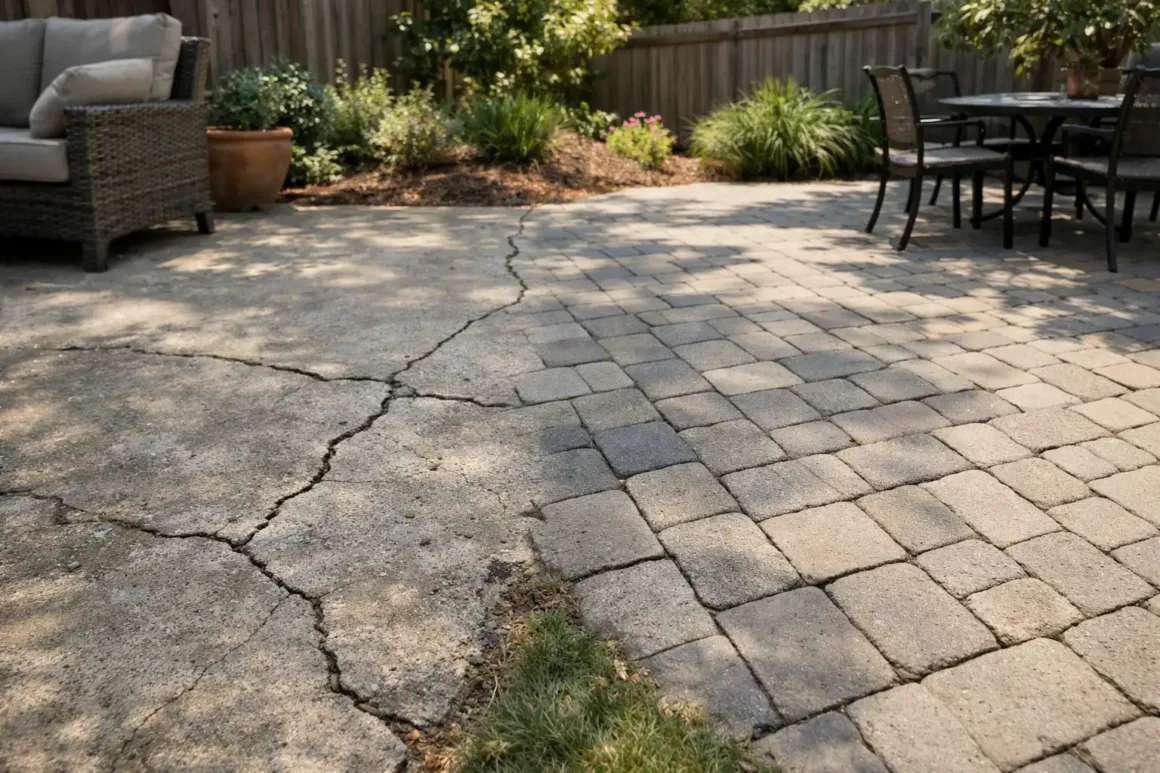
Concrete cannot flex. When the ground moves, the slab absorbs the stress until it cracks. Those cracks are not cosmetic—they are structural failures.
Concrete only lasts when the ground stays stable—and that condition rarely holds over time.
Once cracking begins, repair options are limited:
- Filling cracks (temporary)
- Resurfacing (cosmetic fix)
- Full replacement (expensive and disruptive)
If you’re already dealing with visible damage, understanding how cracks form and what they mean helps determine whether repair is still worth it.
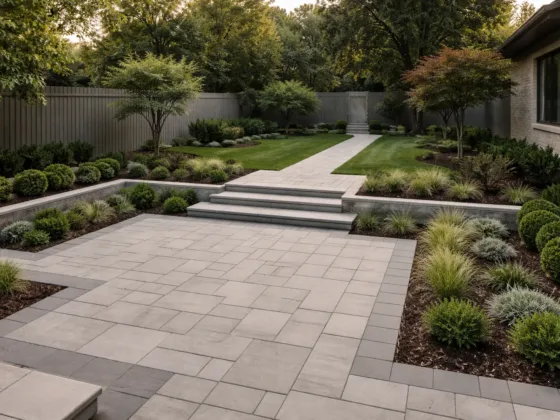
Pavers: Why Modular Surfaces Hold Up Longer
Pavers solve the exact problem that concrete cannot: movement.
Instead of one rigid slab, pavers create a flexible system made of individual units. This allows the surface to adapt to shifting ground without breaking.
Key advantages:
- Flexibility under pressure
- Natural drainage between joints
- Localized repair instead of full replacement
- Better long-term appearance retention
If one section fails, you fix that section—not the entire surface.
This modular approach is why pavers are widely used in driveways, patios, and structured outdoor layouts. In real-world projects, these applications take different forms depending on layout and usage—see how they’re applied in these hardscape design ideas and when each one actually works, especially when combined with proper landscape planning basics.
Concrete vs Pavers: Side-by-Side Reality
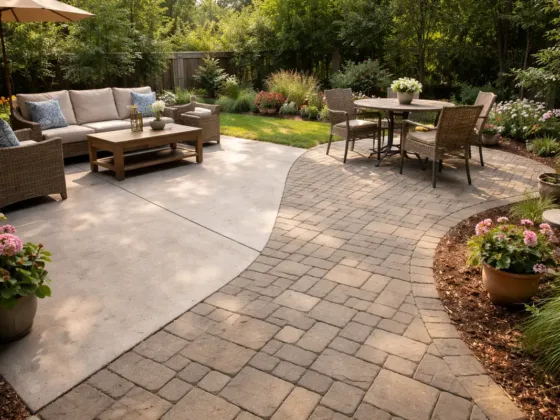
- Lifespan: Pavers are designed to absorb stress. Concrete is forced to resist it—and that difference defines how each one fails over time.
- Cracking: Concrete cracks; pavers shift and settle
- Repair: Concrete requires large fixes; pavers allow small fixes
- Maintenance: Pavers are easier to maintain long-term
- Appearance: Concrete degrades visibly; pavers age more evenly
Cost Over Time (Where Most People Get It Wrong)
Concrete looks cheaper at the start. The problem shows up later—when repairs or full replacement become unavoidable.
Pavers cost more upfront, but they avoid the cycle of cracking and replacement that makes concrete expensive over time.
This is the same pattern seen in other surfaces like asphalt, where short-term savings often lead to long-term maintenance costs, especially in high-use areas.
This long-term cost pattern also appears in other outdoor surfaces, especially in high-use areas like driveways where material choice directly affects durability—something often seen in driveway surface performance and repair cycles.
That’s where most homeowners realize the initial savings weren’t savings at all.
Where Concrete Still Makes Sense
- Low-traffic areas
- Budget-limited projects
- Locations with stable soil conditions
Concrete works in controlled conditions—but outdoor environments rarely stay controlled for long.
Where Pavers Are the Better Investment
- Driveways
- Main patios
- Outdoor living areas
- High-use surfaces
Any space that sees regular use benefits from a system that can adapt instead of crack.
Common Mistakes Homeowners Make
- Choosing based on upfront cost only
- Ignoring soil and drainage conditions
- Underestimating long-term repair costs
- Assuming all surfaces perform the same over time
These mistakes don’t show up immediately. They show up years later—when the surface starts failing.
If you expect your outdoor surface to stay perfect without maintenance or repair, concrete will disappoint you faster than pavers.
Final Verdict
Pavers outperform concrete in real-world conditions because they are designed to handle movement, not resist it.
Concrete only works when everything stays stable—and that rarely happens outdoors.
If you care about long-term durability, pavers are the safer investment. Concrete only wins when nothing moves—and outdoors, something always does.
Author & Editorial Review
Author: Perla Irish is a design and home-focused writer covering interior materials, everyday homeowner decisions, and real-world performance of residential finishes in consultation with licensed contractors and industry standards where applicable. Her work emphasizes clarity, practical context, and long-term usability over trends or transactional advice.
Editorial Review: This article was reviewed by the DreamlandsDesign editorial team with a focus on homeowner decision-making psychology, behavioral context, accuracy, and long-term relevance. Content is evaluated to ensure balanced explanations, clear intent, and alignment with Google Helpful Content and E-E-A-T quality standards.
Last updated: April 2026