Table of Contents Show
Choosing between patio pavers and concrete looks simple at first—until the trade-offs start stacking up. Both materials work well outdoors, but they solve different problems. One favors flexibility and repair. The other favors speed and lower upfront cost.
If your priority is long-term durability and failure patterns, read concrete vs pavers durability comparison. This guide focuses on the broader decision: cost, appearance, installation, and everyday use.
Most homeowners don’t choose the wrong material—they choose before they understand how the space will actually be used. A patio that only needs to look clean has very different demands compared to one that handles daily use, movement, and changing layouts.
If you’re deciding based on overall usability—not just price or appearance—this comparison shows where each material actually fits in real-world outdoor spaces.
Quick Comparison: What Actually Matters
- Budget: Concrete usually costs less upfront.
- Appearance: Pavers offer more design flexibility.
- Installation: Concrete is faster to install.
- Repairs: Pavers are easier to fix without replacing everything.
- Use case: Concrete suits simple layouts, pavers suit designed spaces.
- Long-term flexibility: Pavers adapt better to changes and repairs.
Cost: What You Pay Now vs Later
Concrete wins on initial cost. It pours fast, covers large areas, and keeps labor simple. That makes it the default choice for homeowners working within a tight budget.
Pavers cost more at the start. The base preparation takes longer, and each unit gets placed individually. That upfront cost often surprises people.
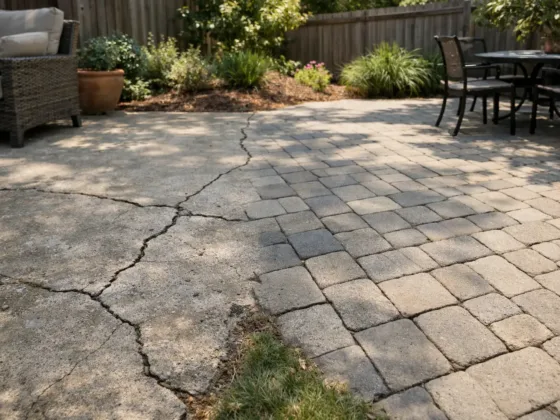
The difference shows later. Small cracks in concrete lead to patching or full replacement. Pavers allow targeted fixes—remove, relevel, reinstall. The upfront savings with concrete often shifts into maintenance decisions over time.
This is where many homeowners realize the initial savings didn’t really save anything—they just delayed the cost.
Appearance: Clean Slab vs Designed Surface
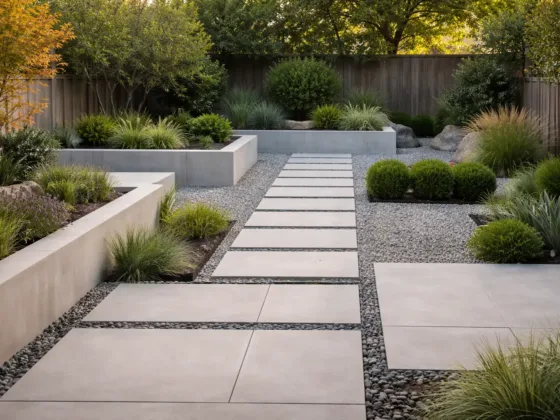
Concrete delivers a clean, minimal look. It works well in modern spaces or large open patios where visual simplicity matters.
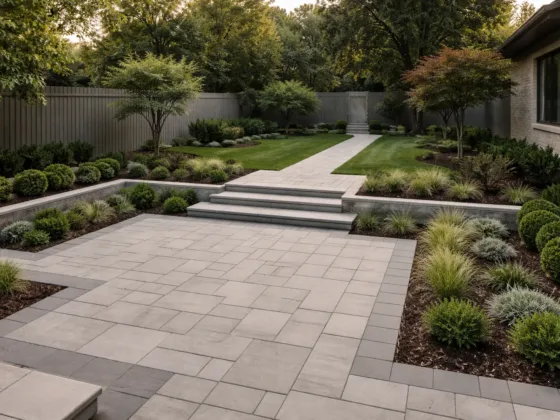
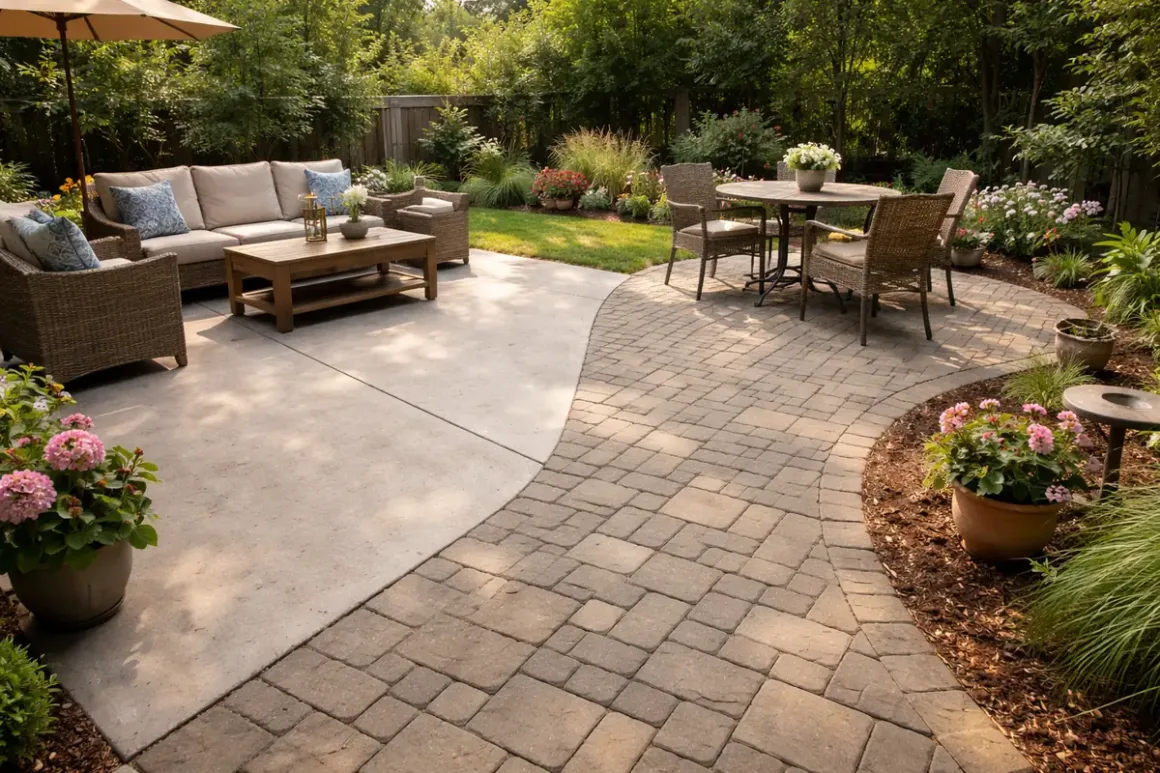
Pavers create structure. Patterns, borders, and color variation break up large surfaces and make the space feel intentional. This becomes important in backyards designed as living areas rather than just open slabs.
If you’re planning a layout with zones, furniture placement, or walkways, pavers support that better. See how layout affects material choice in these hardscape design ideas.
Installation: Speed vs Precision
Concrete installation is straightforward: prepare the base, pour, level, and cure. For large areas, it finishes quickly.
Pavers require more steps. A stable base, proper compaction, leveling sand, and edge restraint all matter. The process takes longer, but the structure underneath determines how well the surface performs later.
This difference explains why pavers handle movement better, while concrete relies on control joints and surface integrity.
Maintenance: What Ownership Actually Feels Like
Concrete maintenance looks simple at first. Cleaning and occasional sealing keep it presentable. The problem starts when cracks form—repairs rarely blend in.
Pavers shift maintenance into smaller tasks. Weed control, occasional releveling, and joint sand replacement keep the surface stable. Individual pieces can be replaced without affecting the rest of the patio.
What Most Homeowners Realize Too Late
The material rarely fails first—the decision does. Many patios look fine in the first year. Problems show up later: uneven surfaces, cracks that stand out, or layouts that no longer match how the space is used.
- Concrete looks clean early but becomes harder to fix invisibly.
- Pavers take longer to install but adapt better when the space changes.
- Layout mistakes cost more to fix than material choice.
Where Concrete Makes More Sense
- Large, simple patio areas
- Tight project budgets
- Modern, minimal outdoor designs
- Low-detail layouts without zoning
Where Pavers Make More Sense
- Designed outdoor living spaces
- Patios with seating, zones, or pathways
- Projects where long-term repair flexibility matters
- Backyards that connect multiple features
How to Decide Without Overthinking It
Start with how you plan to use the space, not the material itself. A simple seating area does not need a complex system. A multi-use backyard does.
If your layout includes movement, edges, or transitions, pavers fit better. If the goal is covering space quickly and cleanly, concrete works.
Material decisions only make sense within a larger system. Understanding how hardscaping works as a whole helps avoid mistakes that don’t show up until years later.
Durability questions don’t show up immediately—they appear after seasons of use, movement, and repair decisions.
Final Thought
Concrete and pavers don’t compete—they solve different problems. The wrong choice usually comes from deciding too early. Once the layout, use, and long-term expectations are clear, the material almost chooses itself.
Those long-term durability differences are exactly why surface choice should follow how the space will actually be used—not just how it looks at the start.
Author & Editorial Review
Author: Perla Irish is a design and home-focused writer covering interior materials, everyday homeowner decisions, and real-world performance of residential finishes in consultation with licensed contractors and industry standards where applicable. Her work emphasizes clarity, practical context, and long-term usability over trends or transactional advice.
Editorial Review: This article was reviewed by the DreamlandsDesign editorial team with a focus on homeowner decision-making psychology, behavioral context, accuracy, and long-term relevance. Content is evaluated to ensure balanced explanations, clear intent, and alignment with Google Helpful Content and E-E-A-T quality standards.
Last updated: April 2026