Table of Contents Show
This guide compares an 80% vs 95% furnace in plain English—what changes, what you save, and how to decide for your home.
The quick take: An 80% AFUE furnace is a standard, non-condensing model that vents hotter exhaust through metal flue. By contrast, a 95% AFUE furnace is a high-efficiency condensing unit with sealed combustion, listed plastic venting, and a condensate drain—it “wrings out” extra heat from the exhaust, cutting gas use by about 16% for the same delivered heat.
AFUE is the seasonal fuel-to-heat efficiency. In other words, a 95% unit turns 95% of fuel into heat while an 80% unit turns 80%. However, AFUE doesn’t include duct losses, so installation quality still matters a lot.
At a Glance: 80% vs 95% Furnace (Key Differences)
| Feature | 80% AFUE | 95% AFUE |
|---|---|---|
| Core tech | Primary heat exchanger | Primary + secondary (condensing) |
| Combustion air | Usually from room | Sealed/direct-vent from outdoors |
| Venting | Category I, metal/B-vent | Category IV, airtight listed plastic vent + condensate drain |
| Controls | Often single-stage | Two-stage/modulating, ECM blower common |
| Operating gas use* | Baseline | ~15.8% less vs 80% for the same heat |
| Incentives | Fewer | Utility rebates common; some regions offer credits for ≥97% AFUE models |
80% vs 95% Furnace Venting: Category I vs IV
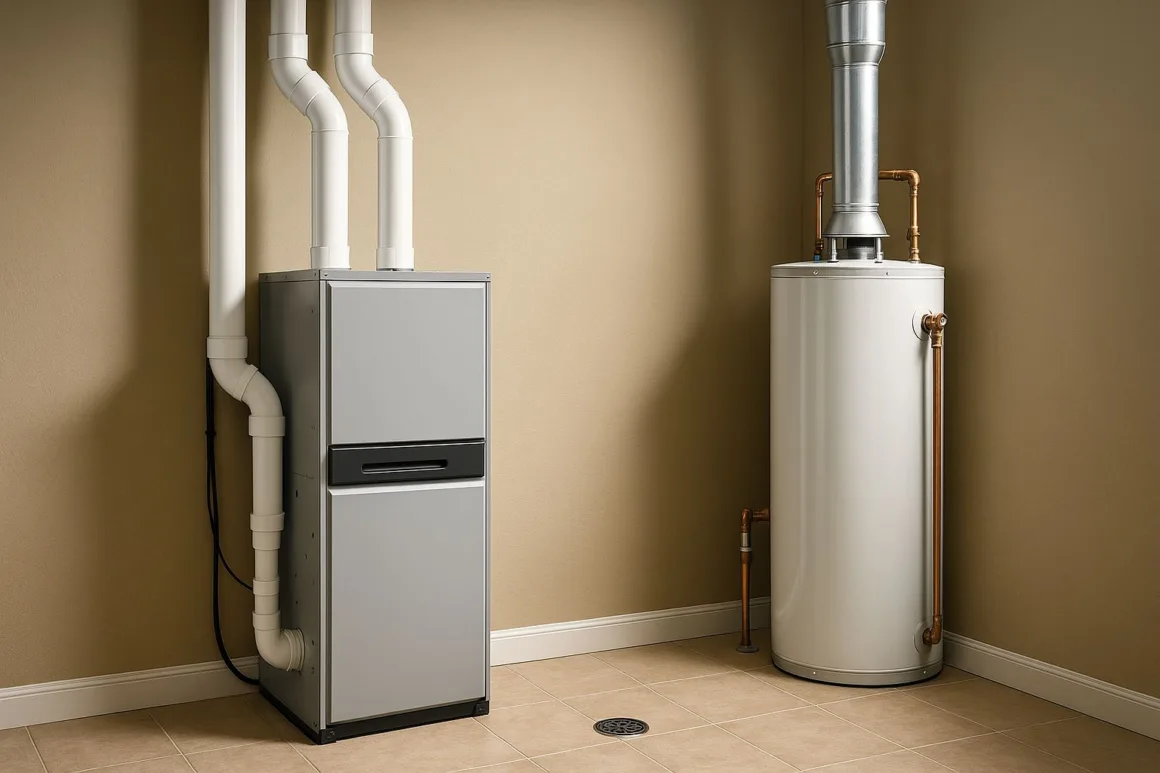
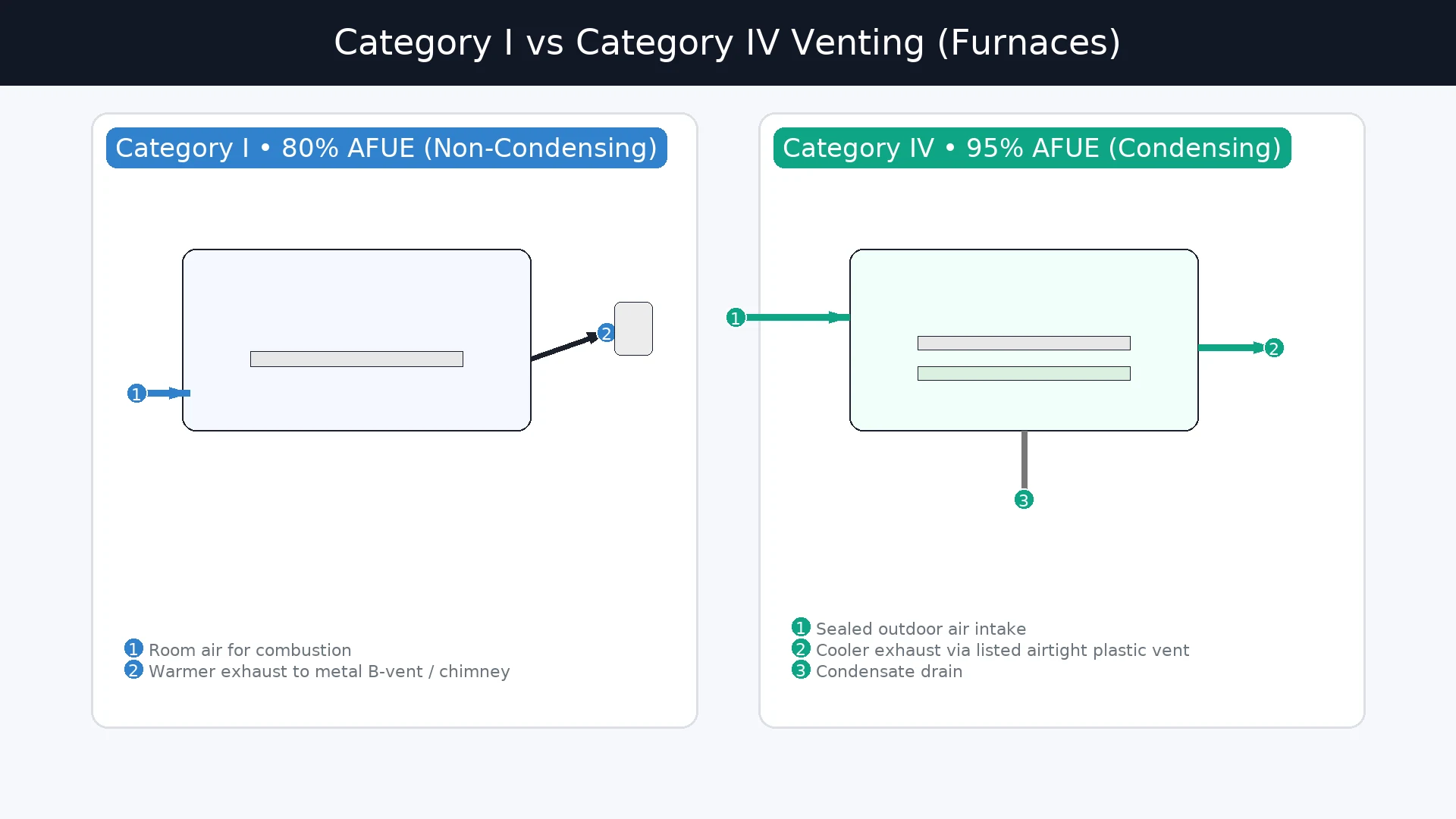
To visualize the difference, Category I (80%) uses a metal B-vent/chimney and draws combustion air from the room; meanwhile, Category IV (95%) is sealed, uses listed plastic venting, and drains condensate because the exhaust is cool enough to form water.
80% vs 95% Furnace Efficiency: Where the Extra Heat Comes From
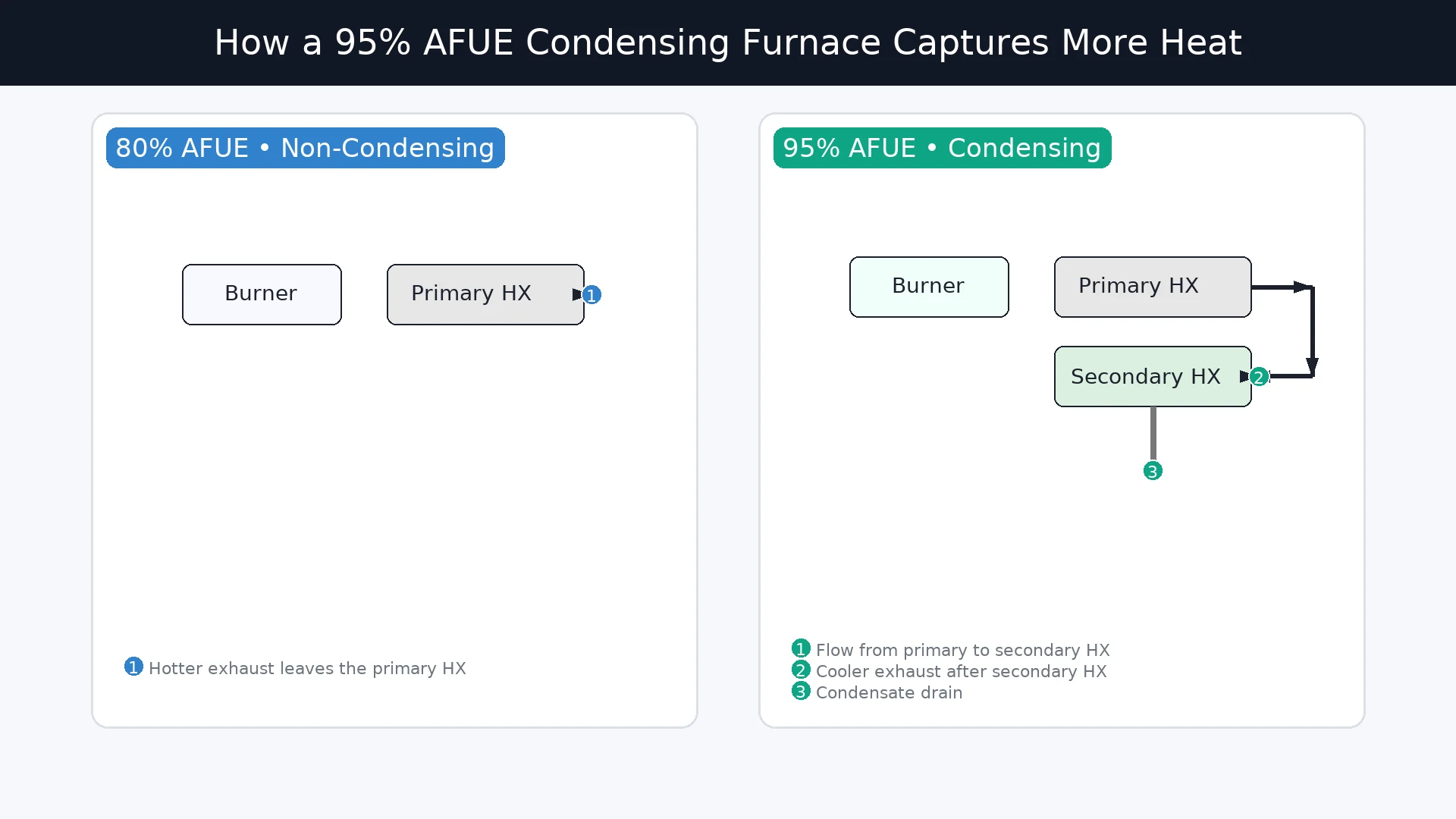
Here’s the plain-English version: a 95% furnace doesn’t “make” more heat; it stops wasting as much. It pulls extra warmth out of the exhaust before it ever leaves your home.
- First, the secondary heat exchanger works like squeezing a towel a second time—more heat is reclaimed from the exhaust, so less warmth goes up the flue.
- Additionally, sealed/direct-vent combustion brings air in and sends exhaust out via dedicated pipes, which helps reduce backdraft risk when installed correctly.
- Finally, Category IV venting is airtight and corrosion-resistant; as a result, a condensate drain is required.
80% vs 95% Furnace Installation Differences That Affect Cost, Safety & Comfort
- To begin, venting path & materials: 80% often reuses metal B-vent; 95% needs airtight/watertight Category IV venting with a drain. Moreover, some regions require listed vent systems rather than generic PVC—follow code + the appliance manual.
- Next, condensate handling: Route to a drain; consider condensate neutralization and freeze protection for long or cold runs.
- Finally, right-sizing & commissioning: Ask for a Manual J load calc, then verify airflow, gas pressure, and temperature rise. Otherwise, oversizing hurts comfort and savings—pair it with proper furnace commissioning.
80% vs 95% Furnace: Will 95% Save You Money?
Quick math you can use: moving from 80% to 95% trims gas use by about 16%. For example, if you spend $1,000/yr on heating, that’s roughly $158 back—and the number grows in colder climates or if gas prices spike.
80% vs 95% Furnace Savings Calculator
Alternatively, if you want a tailored estimate, use the quick calculator below and plug in your numbers.
Furnace AFUE Savings Calculator
Estimate gas savings and simple payback when upgrading a furnace.
Formula: savings% = 1 − (oldAFUE / newAFUE). Real results vary with ducts, climate, and usage.
When 80% Can Be the Practical Choice
In some situations, an 80% unit remains the practical pick.
- Tight budget or no feasible side-wall vent route
- Milder winters (fewer run hours)
- Existing safe, compliant Category I venting with limited retrofit scope
When 95% Is the Clear Winner
On the other hand, a 95% furnace clearly wins under the conditions below.
- Cold climates or high gas prices
- Easy direct-vent routing and drain access
- Rebates or credits (often for ≥97% AFUE models in some regions)
Did You Know?
Importantly, AFUE only measures the furnace itself. Consequently, leaky attic ducts can quietly throw away 10–30% of that heat. Therefore, sealing ducts and commissioning the system often feel like an instant comfort upgrade.
Short Case Study
Real-world example: a family in a 2-story, 2,000-sq-ft home upgraded from an older 80% unit to a two-stage 95% model and sealed their ducts. As a result, bills dropped roughly in line with the 15–16% estimate—meanwhile, the house felt steadier and quieter.
It’s a realistic picture of how an 80% vs 95% furnace upgrade plays out when the ductwork is sealed and the system is commissioned.
Mini-Glossary
- AFUE: Seasonal % of fuel converted to home heat. Higher = better.
- Condensing furnace: High-efficiency unit that cools exhaust enough to condense water vapor, reclaiming heat.
- Category I vs IV: Non-condensing negative-pressure metal vent vs condensing positive-pressure airtight, corrosion-resistant vent.
80% vs 95% Furnace FAQs
Is a 95% furnace always worth it?
It depends; however, in warmer regions or with difficult venting, an 80% may pencil out. Conversely, in colder regions—with rebates or tax credits—95% usually wins.
Can I reuse my metal chimney when upgrading to 95%?
Generally, no. Category IV appliances require airtight, corrosion-resistant vent systems and a condensate drain; therefore, follow the appliance manual and local code.
Do 95% furnaces improve safety?
In many cases, yes. Direct-vent, sealed combustion helps reduce backdraft risk and isolates combustion from indoor air when installed correctly.
Bottom Line
In short, choosing between an 80% vs 95% furnace comes down to climate, vent/drain feasibility, rebates, and install quality—once those align, the math follows.
Helpful Internal Reading
- Proper furnace installation: safety, venting & commissioning checklist
- Boiler replacement: vent categories, condensate & code notes
- Water heater installs: venting, T&P discharge & gas safety
External References
- U.S. DOE Energy Saver — Furnaces & Boilers (AFUE explained)
- U.S. DOE Energy Saver — Home Heating Systems (whole-house view)
- ICC IFGC 2024 — Chapter 5: Chimneys & Vents
- ENERGY STAR — Gas furnace tax-credit criteria (2023–2025)
- DSIRE — U.S. incentives database
- ACCA — Manual J load calculations
Author & Editorial Review
Author: Perla Irish is a design and home-focused writer covering interior materials, everyday homeowner decisions, and real-world performance of residential finishes. Her work emphasizes clarity, practical context, and long-term usability over trends or transactional advice.
Editorial Review: This article was reviewed by the DreamlandsDesign editorial team with a focus on homeowner decision-making psychology, behavioral context, accuracy, and long-term relevance. Content is evaluated to ensure balanced explanations, clear intent, and alignment with Google Helpful Content and E-E-A-T quality standards.
Last updated: January 2026