Table of Contents Show
Expensive materials alone do not create a refined bathroom. In many renovations, cost increases while clarity disappears. What separates composed spaces from cluttered ones is not price—it is planning discipline.
Layout hierarchy, surface restraint, lighting calibration, and focal control shape how the room feels before a single fixture is installed. This guide focuses on those decisions—the ones that quietly determine whether a bathroom feels deliberate or simply upgraded.
Establish Spatial Hierarchy Before Selecting Finishes
Luxury bathrooms feel calm because the eye knows where to rest. That clarity comes from spatial hierarchy.
- Primary focal element: either a sculptural freestanding tub or a seamless walk-in shower.
- Secondary anchor: the vanity wall, often reinforced with a feature surface.
- Supporting planes: floor and remaining walls kept visually restrained.
When every surface competes for attention, the room feels chaotic. Choosing one dominant element and allowing other finishes to support it creates composure.
Proportion and Negative Space Matter
Luxury bathrooms rarely feel crowded. The difference often comes down to negative space. Leaving breathing room around a bathtub, widening passage clearance, or avoiding oversized vanities in compact rooms preserves balance.
When cabinetry runs wall-to-wall without relief, the room feels compressed. Controlled spacing introduces visual rhythm and allows materials to stand out without overwhelming the layout.
Freestanding Tub vs Curbless Shower: Visual Consequences
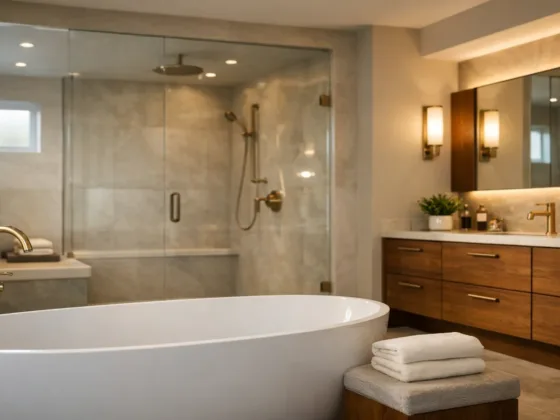
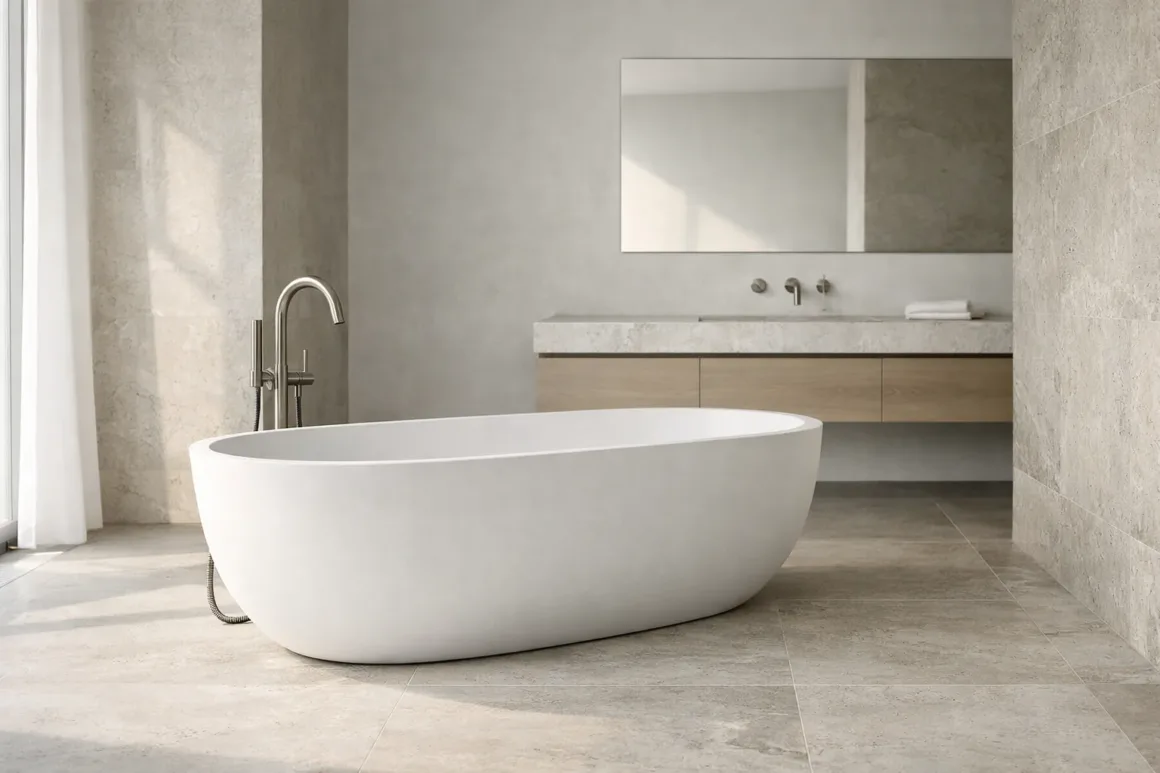
A freestanding bathtub introduces sculptural presence. It works best in rooms where circulation space surrounds it. Without adequate clearance, it appears squeezed rather than elevated.
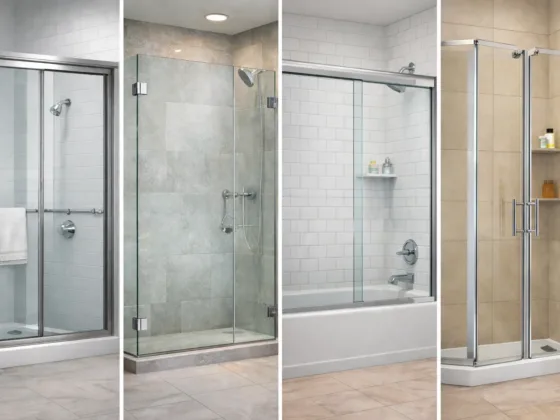
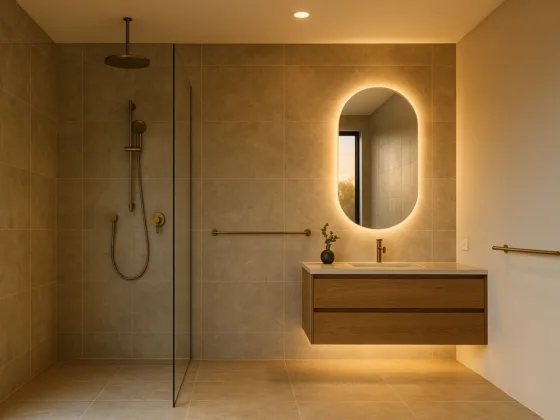
A curbless shower eliminates floor interruptions and extends tile continuously. This approach increases perceived floor area and suits modern layouts prioritizing accessibility and minimalism.
The decision should reflect spatial proportion, not trend preference.
Homeowners frequently choose a freestanding tub because it photographs well, only to discover later that daily circulation feels tight. The reverse also happens: a generous shower is installed, but the room lacks a clear visual anchor. Layout decisions carry consequences that become obvious only after installation.
Material Hierarchy: Concentrated Impact Over Saturation
Premium bathrooms rarely apply statement materials everywhere. Impact is concentrated.
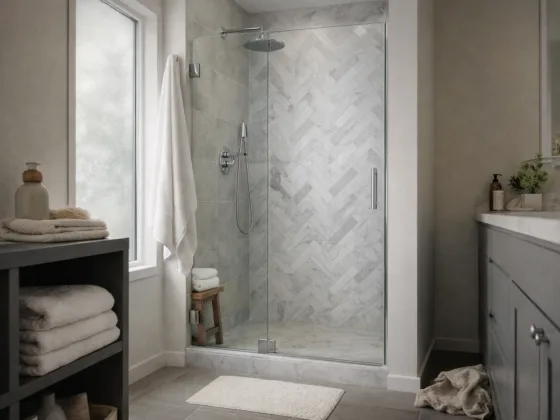
- Feature surface: bookmatched stone or large-format slab on one dominant wall.
- Grounding surface: neutral flooring that stabilizes the palette.
- Moisture zones: durable finishes where water exposure is constant.
When every surface repeats the same intensity, nothing stands out. Depth emerges when one element leads and the others step back.
Texture Layering Without Visual Conflict
Combining stone, timber veneer, matte tile, and metal finishes requires restraint. Texture layering works when one element dominates and the others provide subtle contrast.
For example, heavily veined marble pairs better with flat cabinetry finishes. Highly textured fluted vanities require quieter wall treatments. Contrast should feel deliberate rather than accidental.
Bookmatched Stone as Architectural Artwork
Bookmatching mirrors two slabs to form a symmetrical pattern. Positioned behind a vanity or within a shower enclosure, it transforms stone into a compositional centrepiece.
Surrounding finishes should remain restrained. Hardware, lighting, and cabinetry must support the feature rather than compete with it.
Lighting Placement Controls Perceived Quality
Lighting alters how surfaces read. Without layering, even premium materials appear flat.
- Vertical sconces beside mirrors eliminate harsh downward shadows.
- Diffuse ambient lighting ensures uniform brightness.
- Low-level accent lighting introduces depth during evening use.
High color-rendering lighting preserves natural skin tones and stone variation. Incorrect temperature selection can distort both.
Mirror Size and Placement Strategy
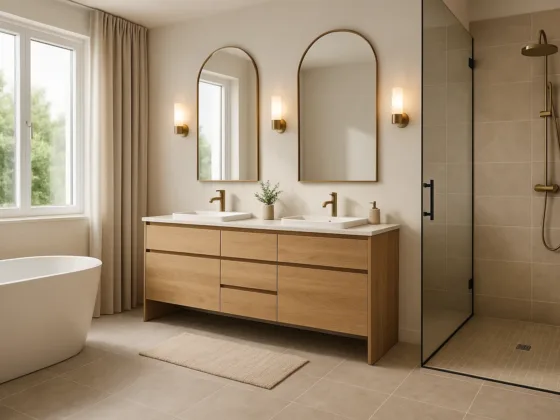
Mirror proportions influence perceived ceiling height and wall width. A full-width mirror visually expands narrow bathrooms, while framed vertical mirrors emphasize ceiling height.
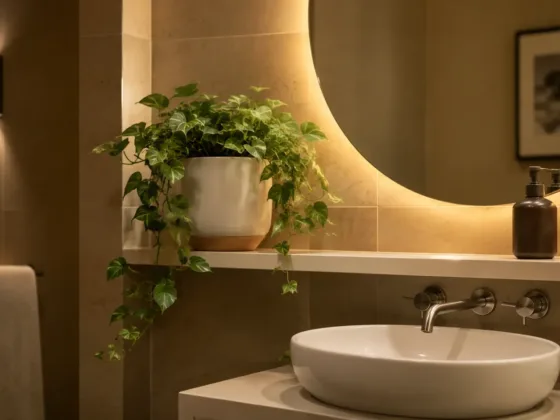
Backlit mirrors create floating effects, but excessive brightness can flatten surrounding surfaces. Calibration matters more than feature count.
Curbless Showers Require Structural Discipline
Barrier-free showers depend on precise floor grading and coordinated waterproofing. Visual simplicity masks technical complexity.
Ambition without structural planning turns expensive finishes into future repairs. The layout stage is where technical discipline either protects the design—or quietly undermines it.
Hardware Finish Consistency Signals Intent
Finish discipline strengthens cohesion. Mixing brushed brass, matte black, and chrome in a single compact bathroom dilutes design clarity.
Select one dominant finish and repeat it across tapware, handles, shower fittings, and accessories. Repetition reinforces visual order.
In compact bathrooms especially, inconsistency becomes obvious quickly. A brushed brass tap beside a matte black shower frame rarely feels curated; it feels unresolved. The eye registers the imbalance even when the homeowner cannot immediately explain it.
Sequencing Determines Outcome
Lighting rough-ins, waterproof membranes, cabinetry measurements, and slab fabrication must follow a coordinated timeline. Design intent collapses when trades operate without alignment.
Most layout compromises do not happen on design day. They happen mid-project, when a measurement was missed or a rough-in was adjusted without revisiting the plan. By that stage, materials are already ordered. Corrections become expensive, and design intent starts to erode.
In structured residential renovation environments, layout resolution typically precedes procurement and surface selection. That sequencing prevents costly mid-project changes and preserves design intent.
One example is RJG Group, which operates within coordinated renovation workflows where spatial planning is addressed before material procurement begins.
Regardless of contractor choice, the principle remains consistent: layout clarity must guide material decisions.
How This Complements System-Level Upgrades
Design decisions shape what you notice immediately. System-level upgrades — ventilation capacity, waterproof detailing, heating integration, water efficiency — determine what you stop thinking about once the bathroom is in daily use.
The most successful renovations resolve both dimensions. The room looks composed at first glance—and continues to perform quietly long after the novelty fades.
Budget Allocation Strategy for Visual Impact
Throwing money at every surface rarely improves the result. Strategic restraint produces stronger visual impact than uniform spending.
- Invest in one statement slab or feature surface.
- Choose durable mid-range flooring that supports the palette.
- Prioritize lighting quality over decorative excess.
Spreading budget evenly across every component produces a flat result. Concentrated investment generates perceived depth and refinement.
A bathroom rarely fails because of one dramatic mistake. It fails because of small, layered decisions that were never resolved.
Where Design Meets System-Level Performance
While this guide focuses on layout hierarchy and visual discipline, structural performance determines long-term durability. Ventilation capacity, waterproof compliance, water efficiency standards, and electrical protection systems define whether a bathroom remains functional under daily use.
For a deeper breakdown of ventilation flow rates, Australian waterproofing standards, WELS requirements, and heating integration, see our guide to hotel-level bathroom systems.
Author & Editorial Review
Author: Perla Irish is a design and home-focused writer covering interior materials, everyday homeowner decisions, and real-world performance of residential finishes in consultation with licensed contractors and industry standards where applicable. Her work emphasizes clarity, practical context, and long-term usability over trends or transactional advice.
Editorial Review: This article was reviewed by the DreamlandsDesign editorial team with a focus on homeowner decision-making psychology, behavioral context, accuracy, and long-term relevance. Content is evaluated to ensure balanced explanations, clear intent, and alignment with Google Helpful Content and E-E-A-T quality standards.
Last updated: February 2026