Table of Contents Show
Most celebrations don’t fail because they lack decoration.
They struggle because nothing clearly leads the space. Guests arrive, notice many details, but can’t quite tell where to look. Photos feel busy rather than intentional. The room feels filled, but not composed.
The events people remember tend to share one quiet characteristic: a single visual decision that organizes everything else. Not abundance. Not variety. Just clarity.
What a “Wow” Moment Actually Is
A “wow” moment is rarely about spectacle.
In practice, it’s the place guests naturally drift toward. The background that becomes the setting for conversations and photos. The element that gives the rest of the space context.
This is where many events go wrong. Decoration is added everywhere, but nothing is allowed to lead. A focal point, by contrast, doesn’t just decorate a space — it organizes attention.
Focal Point vs. Decoration: A Practical Difference
The difference between a focal point and decoration becomes obvious in real settings.
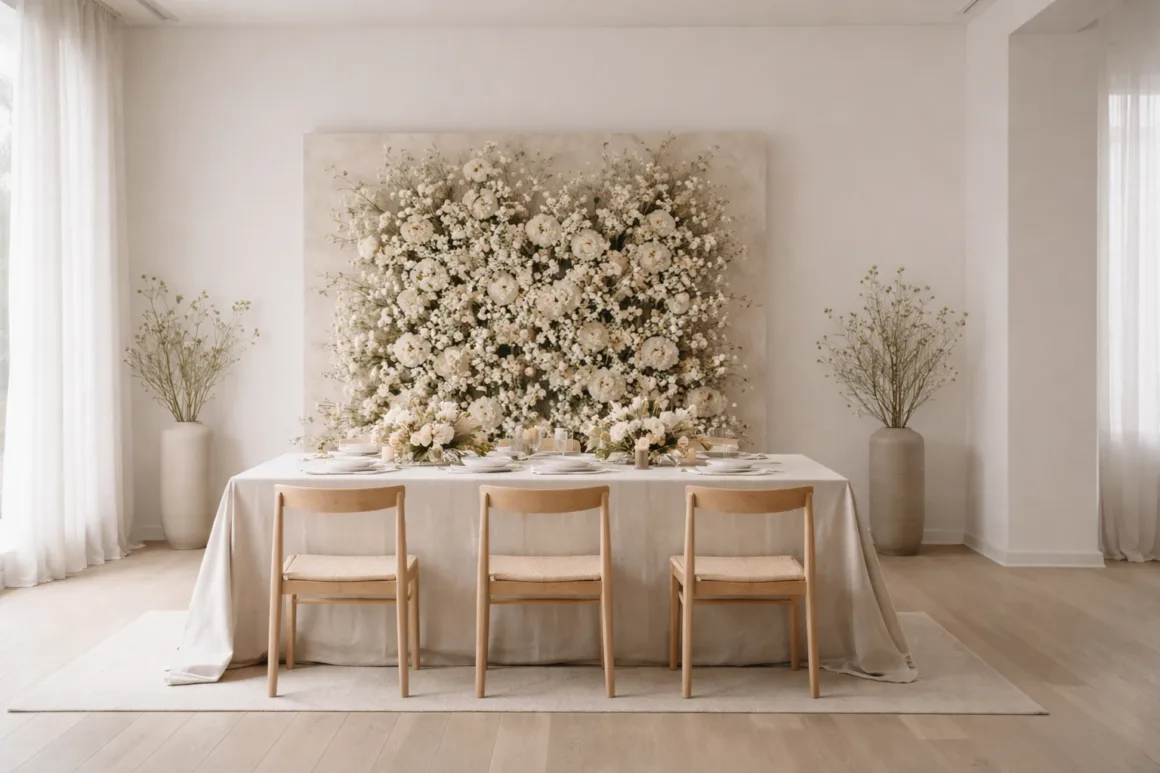
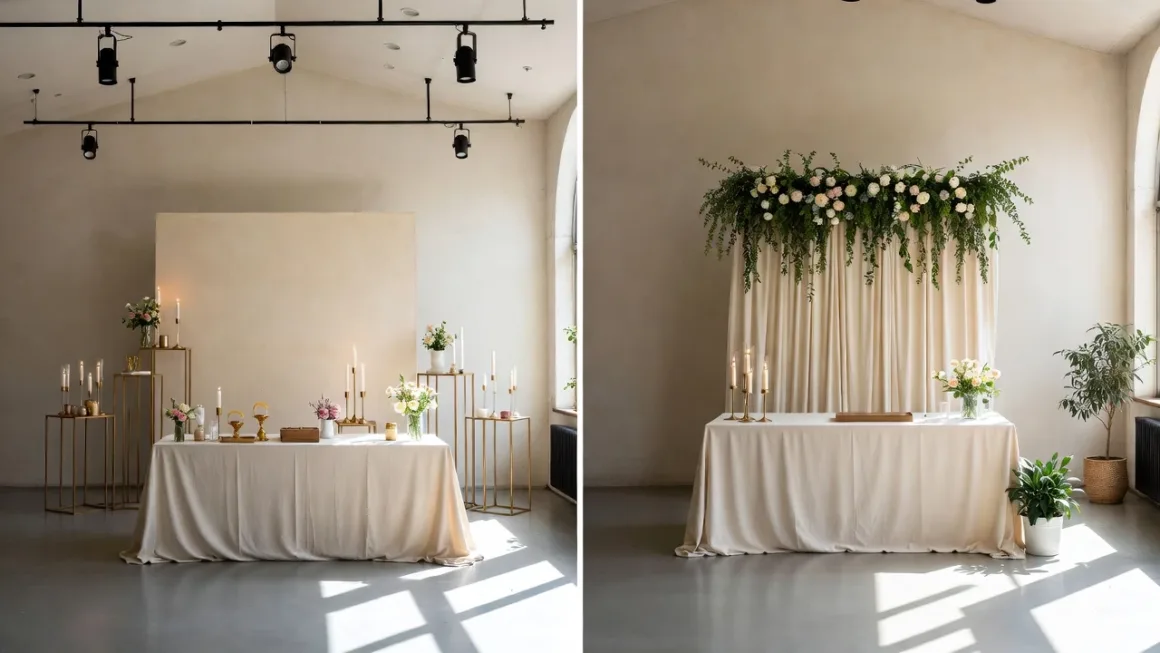
- A strong focal point: a floor-to-ceiling floral wall behind a dessert table. Guests instinctively gather there. Photos happen without prompting. The rest of the room feels calmer because it no longer has to compete.
- Over-decoration: ten small vases spread across ten tables, balloons in multiple corners, signage competing with centerpieces. Individually fine. Collectively noisy. Nothing stands out, so everything feels forgettable.
The issue isn’t that the decorations are wrong — it’s that nothing is allowed to lead.
Low-Budget Focal Points That Still Work
A strong focal point doesn’t have to rely on expensive materials or custom fabrication.
For budget-conscious setups, the most reliable approach is still scale — achieved through simple, stable materials that are easy to source and safe to install. Examples include a single large fabric backdrop with natural texture (such as heavyweight linen or canvas), or a solid-color wall surface created using removable panels or tension-mounted fabric frames.
Placed directly behind the main food or dessert table and paired with one controlled light source (for example, a soft uplight or diffused spotlight), this type of backdrop can create architectural presence without complex construction. The emphasis remains on proportion, placement, and visual weight — not ornament or density.
Crucially, low-budget focal points work best when they avoid improvised structures or overhead installations. Grounded, vertical surfaces with clear edges tend to read as intentional on camera and reduce both safety risks and setup stress.
Why One Strong Visual Element Consistently Wins
Human attention looks for hierarchy, which is why visual hierarchy and proportion play such an important role in how a space is perceived.
When one element carries visual weight, the brain relaxes. When many elements compete, attention fragments. This is why experienced event designers concentrate visual impact rather than distribute it.
Large-scale floral installations work especially well because they combine size, texture, and depth — qualities that small decorative items can’t replicate, no matter how well styled.
The Hidden Cost of Decorating Everywhere
Scattered decoration introduces problems that aren’t obvious until the event is underway.
Setup becomes slower. Decisions multiply. Lighting becomes inconsistent. Photographs capture clutter instead of atmosphere.
Many hosts only notice this afterward, when reviewing photos. The disappointment isn’t about taste — it’s about the absence of a clear visual anchor, and often reflects the cost of visual clutter.
When DIY Works — and When It Quietly Breaks Down
DIY décor works beautifully at a human scale.
Table details, signage, and small personal touches add warmth and personality. Problems usually start when DIY is asked to operate at an architectural scale — large backdrops, installations, or anything that must interact with walls, lighting, and guest movement.
At that point, creativity gives way to logistics: sourcing materials, stabilizing structures, adjusting proportions, and installing safely within narrow time windows. The idea may be sound, but execution becomes fragile — often signaling when professional help makes more sense.
Why Photography Changes Everything
Most celebrations are remembered through photos.
That reality favors restraint. Clean lines, controlled color palettes, and layered depth photograph far better than dense decoration. A strong backdrop simplifies composition and gives people a natural place to stand — shaping contrast, depth, and how lighting shapes visual focus.
When a Focal Point Fails
Not every focal point succeeds.
Failures are usually logistical rather than aesthetic: a backdrop scaled too small for the room, lighting that flattens texture, or placement that blocks guest flow. These issues rarely appear in inspiration photos, but they dominate real-world outcomes.
A successful focal point feels inevitable, not forced.
The Role of Professional Installation
Professional installation doesn’t replace creativity — it protects it.
Design authorities such as Architectural Digest consistently emphasize proportion, restraint, and spatial clarity as foundations of effective visual environments. These principles apply just as strongly to temporary event spaces as they do to permanent interiors.
This is why high-end floral studios — including Farida Floral — approach large-scale installations differently from traditional arrangements. Rather than treating florals as decorative accents, the focus shifts to how floral elements are installed, scaled, lit, and stabilized within a space. In practice, this often determines whether a focal element feels calm and deliberate — or rushed and improvised — once guests arrive.
The value here isn’t luxury. It’s predictability.
Not All “Wow” Moments Are Visual — But Visual Ones Last
Great food, music, or performances can absolutely define an event.
But these experiences are fleeting. Visual anchors persist — in the space itself and in photographs — which is why they remain one of the most reliable tools in event design.
One Strong Decision Is Usually Enough
The most successful celebrations don’t overwhelm.
They choose one element to lead, allow everything else to support it, and resist the urge to keep adding. The result feels calmer, more deliberate, and easier to enjoy — for hosts and guests alike.
Disclosure: This article includes editorial references to design studios and industry publications for illustrative purposes only. There is no affiliate relationship or sponsored placement involved. All content reflects independent editorial judgment focused on clarity, safety, and real-world relevance.
Author & Editorial Review
Author: Perla Irish — design and home improvement writer covering interior materials, everyday home decisions, safety-aware planning, and real-world performance.
Editorial Review: This article was reviewed by the DreamlandsDesign editorial team with specific attention to spatial clarity, installation feasibility, and real-world event conditions. Content is evaluated to ensure balanced explanations, clear intent, and alignment with Google Helpful Content and E-E-A-T quality standards.