It was hot this year, the hottest year on record. Australia’s Learmonth Airport hit 46.1C degrees, making it the hottest place on Earth as of February 2023.
Next year will probably set new records, so get ready for more heat! What are we going to do about it? Turn on the aircon, of course! Aircon, short for “air conditioner”, is the electronic device that keeps us cool.
We have them in our homes, offices, and in our cars. The concept of using artificial means to fight the heat isn’t anything new, the ancient Egyptians hung moistened reeds in the windows to humidify and cool the dry desert winds blowing through them.
The Roman Empire’s aqueducts carried water to homes, which was then circulated through the walls to cool the interior.
The first mechanical cooling techniques began in 2nd century China with the invention of large, manually-powered rotary fans. In 747, Emperor Xuanzong’s Imperial Palace powered the fans using jet streams of water from fountains.
Water was an important component of air conditioning throughout history, and is still very much present in modern times, just ask anyone who has ever been forced to ask the question why is my aircon dripping water? Today’s air conditioners use refrigeration to cool the air.
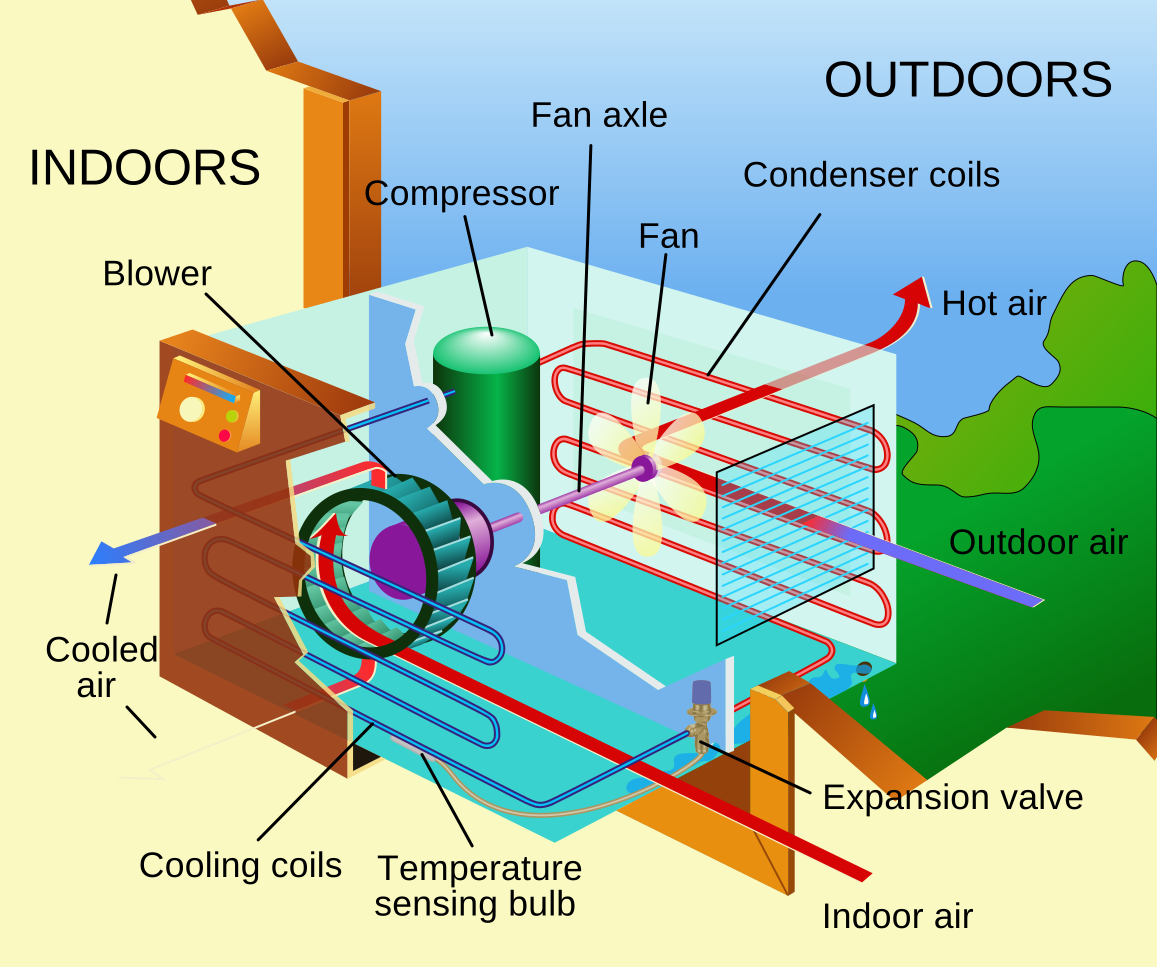
Inside the aircon system, there is a condenser connected to two sets of coils. One coil is heated, the other is cold. Inside the coils chemicals evaporate and condense over and over again, making the coils cool.
These then cool the air blowing past them. The cooled coils force moisture out of the air which then condenses on the coils, in the same way moisture beads on the sides of a cold drink can.
A portion of this water will re-evaporate, helping the coils keep cool. The remainder runs out of the back of the air conditioner- well, usually! In any case, the presence of some water is a positive sign that your aircon is functioning properly.
If there is no water visible at all then it may be going somewhere it shouldn’t, or it may be freezing into ice on the coils. Time to call for some professional help!
Read Also:
Ice for cooling dates far back into prehistoric times, when hunters butchered their kills and learned they could keep the meat fresh much longer if they buried it in snow and ice.
Woolly mammoth steaks, anyone? This practice is still in use today, although modern hunters use it to keep their beers cold! In the 1800s people began harvesting winter ice to store in special insulated sheds or icehouses.
The blocks of ice were then delivered to homes and restaurants in the summer, where they were kept in the forerunner to the modern refrigerator (which works on the same principles as the air conditioner and can be considered a cousin), the icebox.
In 1758, American statesman and scientist Benjamin Franklin studied the principles of evaporation of volatile liquids like alcohol and ether as a way of cooling objects rapidly and was able to maintain freezing temperatures. All of this eventually led to the modern air conditioners of today.
American engineer and inventor Willis Haviland Carrier invented modern air conditioning in 1902. Carrier experimented with humidity control.
Borrowing from the concepts of mechanical refrigeration established in earlier years by Franklin and others, Carrier’s system pushed air through coils filled with cold water, cooling the air while controlling room humidity by removing moisture. This was the start of Carrier’s future enterprise.
By 1933 the Carrier Air Conditioning Company of America had developed the first modern air conditioner which featured mechanical controls, an evaporator coil, and a belt-driven condensing unit and blower. Carrier’s aircon began a revolution in commercial air conditioning.
Old-fashioned Americans initially rejected Carrier’s aircon, considering them to be unnatural. He struggled to educate the public, and through his drive and charisma began to convince people that keeping cool in the sweltering summer months was really a wonderful thing.
Interestingly, it was the cinema that really changed the public’s resistance! The dark, crowded spaces were virtually ovens until Carrier installed centrifugal compressor air conditioning systems.
Going to the movies became a much more pleasant affair, profits increased, and so did the aircon’s popularity. By 1919 every movie theatre in the USA touted air conditioning as a feature.
Aircon technology continued to progress as carriers experimented with improvements. His company’s top model was called the Infinity, which was quite different from earlier models, its more advanced components featured a two-stage scroll compressor that ran more quietly and with greater energy efficiency.
By the 1950s air conditioning was commonplace in both public and private spaces, even in cars, and the technology spread to other nations as well. In 1965 Japan’s Fujitsu Corporation produced the first window air conditioner which was a great success.
In 1973 Fujitsu established its Australian headquarters where it had a profound influence on the growing Australian market thanks to its High Energy Efficient Rating air conditioners. Energy efficiency standards are the chief driver of improvements in the air-conditioning systems of today.
Modern air conditioners still operate on the same fundamental principles as Carrier’s 1933 system, whilst incorporating advancements in materials, diagnostics and controls, vapor compression, electronic sensors, and, of course, energy efficiency.
Today, air conditioning units continue to advance, undergoing innovations in both design and aesthetics. Today’s aircons are growing more powerful, efficient, quieter, and cleaner.
Because of the massive increase in aircon use in the 1970s, Australia established a single federal energy efficiency standard for air conditioner manufacturers for the regulation of their product’s energy output in 1995.
By 2014 three in four Australian households operate air conditioners, with sales rising over the last twenty years to double the amount recorded in the 1990s.
Aircons are now more affordable, compact, and customizable, offering both ducted and split systems to suit people’s varied needs.
The Australian government offers a guide to heating and cooling, featuring excellent advice on how to choose the right system for your home’s climate.