Table of Contents Show
The idea of a vertical garden is not new, but it has certainly gained more popularity in recent years.
Awareness about vertical gardens is still somewhat lacking, especially when it comes to the comprehensive knowledge necessary for creating your own.
This post will provide guidance towards understanding the various facets of vertical gardening, starting with a definition of exactly what they are.
What is a Vertical Garden?
Any garden that either grows on or is supported by a vertical surface can be classified as a vertical garden. Fences, windows, walls, trellises, garden towers, and other standalone structures can all be used as a base for your vertical garden.
It is not necessary for the plants in a vertical garden to actually grow out of a perpendicular surface, although that too can be managed to an extent.
The main difference between a regular garden and a vertical garden is in how the two are spread out by the gardener.
While a regular garden will be planted and spread along a parallel surface such as a yard or the roof, a vertical garden will be spread upward along a vertical surface, much akin to a skyscraper or a watchtower.
Read Also:
More Garden in Less Space
Due to their upward spread pattern, vertical gardening is possible even when the available space is quite limited. For example, a mid-sized, multistoried garden tower or pyramid can house as many as fifty small plants in it, while taking up less than 4 square feet of ground space.
Even a small patio should be able to accommodate at least one vertical tower. If you live in an apartment building or if your house has a flat roof, adding at least a couple of gardening towers as part of the rooftop garden should not be difficult at all.
The towers are not our only options of course, and some, like a living wall, are even more space-efficient. This ability to maximize limited gardening real estate with vertical gardens is one of the many reasons why the idea has caught on so well in recent years.
For city dwellers living in apartment buildings, vertical gardens are a way for them to start with a new hobby or to stay in touch with an old one.
Beautiful Exterior Décor and Landscaping Detail
Other than the space efficiency, décor is the other main reason why vertical gardens are popular. If you wish to save space, something like a living will, a gutter garden, or a tray garden will always add new dimensions to your exterior décor and landscaping.
On top of that, they will always and by default allow you to do more with the gardening space you have, irrespective of whether it’s needed or not.
Next, we are going to look at the best and the most popular forms of vertical gardens. They will help us better understand what kind of an impact each different type of vertical garden can have on the landscaping.
Living Walls
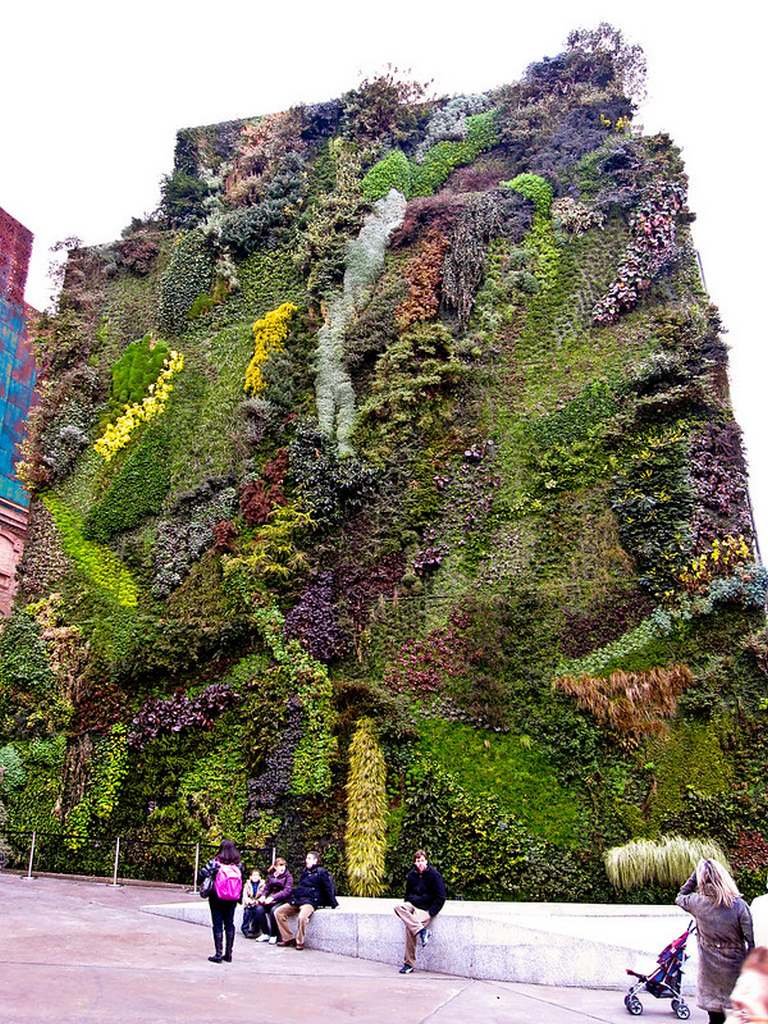
A living wall is covered by small plants of various colors, shades, sizes, and species, making it look as if the wall itself is made from living plants. Living walls can arguably look more impressive than any other type of vertical garden as an exterior décor element.
This effect is achieved by adding panels of modular substrate structures on the wall, usually preinstalled with herbs, small shrubs, and a drip irrigation system. More advanced gardeners with a greater understanding of hydroponic gardening may install a nutrient-rich substrate layer on the wall itself.
Previously, a decent knowledge of hydroponics horticulture was considered necessary to make a living wall truly come alive with blooming life in bright colors. It’s not as difficult or limited in its accessibility these days.
You can order everything you need from a gardening supply company like Vertical Garden Supply and they will send you the best ready-to-install setups, as per your needs and expertise.
Tower Gardens
As mentioned earlier, tower gardens are multistoried, square/rectangular structures capable of housing an astonishing number of plants inside.
These vertical structures can nurture so much variety in them that they are each a true garden of small flora all on their own. As a tip, it is recommended to keep the number of plants limited to roughly 60% of their full capacity.
This leaves more nutrition for fewer plants, allowing them to grow better and more beautiful. If you are growing succulents only, then that’s a different story.
There are different types of tower gardens, but they mostly differ in shape, capacity, and size, rather than in any real functional capacity. Common examples of tower garden structures would be pyramid towers, pagoda towers, multilayer planters, living towers, stair gardens, etc.
Living towers are more complicated in their design than those just mentioned. They closely replicate a multistoried apartment building with balconies. Each plant will grow out of its own little balcony, allowing for greater variety in each living tower.
Choose a vertical gardening tower based on your own gardening requirements, while also keeping the exterior décor in mind.
Tray and Trough Gardens
Tray/trough gardens can be arranged and installed in so many ways, but it varies depending on where you plan to install them and how much space you have.
The so-called installation can be something as simple as a single shelf full of succulents on your window, or as vast as several rows of planter troughs on an exterior wall. Those are usually attached to the gutter system for irrigation, which is why they may also be called gutter gardens.
Small to medium-sized trey gardens make for perfect window décor, provided that you have a bit of bay space. Even if you do not have a counter in front of your window, it does not take much to install one.
To conclude, it would be fair to state that vertical gardens are low cost, low maintenance, and low space alternatives to full-sized gardens. However, that is not always true.
For house owners with sufficient space, they are not alternatives but a complementary garden system to their main garden and landscaping design.